Households sharing biscuits
A twin pack gives several people a shared supply, while a smaller pack may make more sense if fewer biscuits will be eaten. Check how the opened pack should be stored.


Choose a shared pack if several people will eat the biscuits and you can store an opened pack; choose individually wrapped bars if carrying one defined portion matters more. Neither format establishes whether a biscuit is suitable before exercise, so compare the declared portion and ingredients on the exact product rather than treating it as an exercise-specific snack.
A twin pack gives several people a shared supply, while a smaller pack may make more sense if fewer biscuits will be eaten. Check how the opened pack should be stored.
An individually wrapped bar gives you a defined portion to take along. A biscuit from a shared pack is another option, but you would need to portion and carry it yourself.
Read the ingredients and allergy advice for the precise biscuit or bar, especially when buying for someone with an allergy. Similar product names do not establish identical recipes.
Decide first whether the biscuits are mainly for sharing at home or taking one at a time. Then compare the declared portion, total pack quantity and exact-product label.
| Priority | What to check | Your needs |
|---|---|---|
| Portion before activity | Read carbohydrate and fat per biscuit or bar, keeping each product’s stated serving basis. Tesco lists 10.4g carbohydrate and 3.9g fat per biscuit for the McVitie’s milk-chocolate digestive twin pack, and 15.7g carbohydrate and 6.7g fat per bar for the checked Penguin seven-pack. | If I decide to have a biscuit before exercise, I want to know what one biscuit or bar contains rather than assume the whole pack or its format makes it an exercise snack. |
| Sharing or carrying | Compare total weight, the number of declared portions and whether portions are individually wrapped. Tesco lists the McVitie’s milk-chocolate digestive twin pack as 2 x 266g, with approximately 32 biscuits; its checked Penguin pack has seven individually wrapped bars weighing 172.2g in total. | Several people will share the pack at home, or I need one portion that can travel without taking an opened shared pack. |
| Ingredients and allergens | Check the exact variant’s ingredients and allergy advice, then read the delivered pack. Sainsbury’s listing for its 300g milk-chocolate digestives includes a specific oat-allergy caution; that caution must not be assumed to describe other biscuits. | Someone sharing these biscuits has a dietary restriction, so I need the information for the product we will actually eat. |
| Pack size and storage | Choose an amount the household expects to use and follow the pack’s storage instructions after opening. Tesco instructs shoppers to keep its 300g milk-chocolate digestives in an airtight container once opened. | I would rather choose a pack we can use and store as directed than judge it by size alone. |
The checked biscuits and bars declare both carbohydrate and fat, but those figures do not establish a workout benefit. University College London Hospitals NHS Foundation Trust’s exercise-snack guidance concerns people managing diabetes; its timing advice is not a general biscuit recommendation.
Consider whether you want a snack at all, then read the portion information. If you manage diabetes during exercise, use advice appropriate to your own glucose management rather than a general product suggestion.
Tesco lists 532g across the checked McVitie’s digestive twin pack and 172.2g across the checked seven-bar Penguin pack. The first offers more total biscuit weight; the second divides its contents into wrapped bars.
Compare total weight and declared portions alongside where the biscuits will be eaten. For sharing, consider whether the household will use the opened pack.
Ingredients and cautions belong to the exact product. Sainsbury’s checked milk-chocolate digestives, for example, carry an oat-allergy caution that should not be transferred to another variant.
Read the delivered pack’s ingredients and allergy advice before offering biscuits to someone with a dietary restriction.
These examples show how pack formats differ; a brand name alone does not determine portion size, ingredients or suitability before exercise.
Tesco lists McVitie’s milk- and dark-chocolate digestive twin packs at 2 x 266g each.
Penguin is a McVitie’s chocolate biscuit-bar line. Tesco’s checked Original pack contains seven individually wrapped 24.6g bars.
Club is a McVitie’s coated biscuit-bar line. Tesco lists the checked Club Orange variant as seven bars in a 154g pack.
Tesco lists Fox’s Double Chocolate Rounds as a 117g pack of chocolate-coated shortcake biscuits.
Tesco lists its own-label milk-chocolate digestives in a 300g shared pack.
Sainsbury’s lists its own-label milk-chocolate digestives in a 300g pack with approximately 18 servings.
These options include chocolate biscuit packs for sharing and a caramel wafer multipack to consider when you want a portion to carry. Check the exact pack for portion and ingredient information before choosing a snack for before exercise.
 No image available
For sharing at home, two separate packs let you open one while leaving the other sealed.
Contains 2 x 262g packs, 524g in total. Check the exact pack for nutrition, ingredients and storage instructions.
 No image available
This 400g shared pack is an option when the household prefers dark-chocolate digestives to milk-chocolate ones.
Check its own per-biscuit label and storage instructions; figures for a different McVitie’s pack do not establish this pack’s portion values.
 No image available
This 400g shared pack suits a household choosing milk-chocolate digestives without a two-pack format.
Use this variant’s label for portion nutrition and allergy advice rather than applying figures from the 2 x 266g twin pack.
 No image available
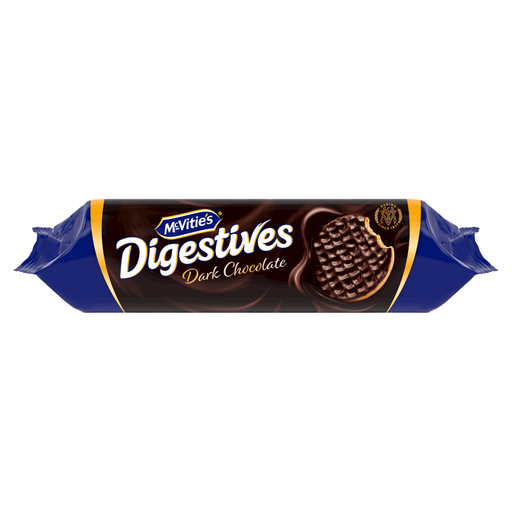
For a household sharing dark-chocolate digestives, the two-pack format lets one pack remain sealed until it is needed.
Contains 2 x 266g packs, 532g in total. Read the exact pack’s ingredients and per-biscuit nutrition before choosing a portion.
 No image available
If you want one wafer to take along, compare this eight-pack’s portion format with taking biscuits from a shared pack.
These are milk-chocolate caramel wafers rather than chocolate digestives. Check the exact pack for wrapping, per-wafer nutrition and allergy advice.
No biscuit’s carbohydrate figure establishes that everyone needs a snack before exercise. Decide whether you want one, then check the declared portion and ingredients; University College London Hospitals NHS Foundation Trust’s exercise-snack timing advice is for people managing diabetes and should not be applied to everyone.
Follow the instructions on the exact pack. Tesco’s checked 300g milk-chocolate digestives call for a cool, dry place and an airtight container once opened; do not assume every product gives identical directions.
Read the label on the delivered product before it is eaten. The checked Tesco and Sainsbury’s own-label listings advise shoppers to check the product label because ingredients can change; Sainsbury’s checked digestives also carry a specific oat-allergy caution.
The Department for Education’s school-food standards address food provided in covered school settings in England, not an ordinary household purchase. The standards exclude chocolate and chocolate-coated products during the school day; their lunchtime allowance for biscuits does not allow confectionery in them. Department for Education guidance says proposed updated standards for September 2027 remain subject to Parliamentary approval, and these England sources do not establish rules elsewhere in the UK.