Family tea hosts
If biscuits will be served from an open pack, compare its weight and stated servings with the number of guests and the leftovers you expect.


Choose a sharing pack if you plan to put chocolate biscuits out with tea; compare its weight and stated servings with your guest count, and check the exact pack’s ingredients for anyone with a dietary restriction. Choose individually wrapped bars if separate portions or taking biscuits away matters more, but count the bars rather than judging by the size of the outer pack.
If biscuits will be served from an open pack, compare its weight and stated servings with the number of guests and the leftovers you expect.
Individually wrapped bars make it straightforward to offer one to each guest or let someone take one away. Count the bars before choosing a multipack.
Check the current ingredients and precautionary allergen information on the exact pack. A familiar brand name does not establish whether a particular biscuit suits a guest’s restriction.
Decide how the biscuits will be served, then check the quantity and the exact product label. A pack’s weight and its stated servings answer different questions.
| Priority | What to check | Your needs |
|---|---|---|
| Enough portions | For wrapped bars, compare the bar count with the guest count. For an open pack, check its weight and stated servings; servings are not necessarily a biscuit count. | I want enough to put out without assuming that a heavier pack contains a particular number of biscuits. |
| Serving format | Choose between biscuits served from a sharing pack and individually wrapped bars. Check whether a chocolate coating, chocolate chips or another listed style matches what guests want. | Will people help themselves at the table, or would separate biscuits to hand out work better? |
| Taste comparisons | Good Housekeeping Institute’s June 2026 blind test compared milk-chocolate digestives. Its results do not rank wrapped bars, chocolate-chip digestives or dark-chocolate variants. | If I am choosing coated milk-chocolate digestives, that test covers the relevant style; for another style, I need to choose on its own terms. |
| Ingredients | Read the exact pack’s current ingredient list, highlighted allergens and any precautionary statements. Check the stated serving basis if using its per-portion information. | Someone at the table may need to avoid an ingredient, so I cannot judge suitability from the biscuit style alone. |
| Leftovers | Check the pack’s storage instructions and consider how much the group is likely to serve. Sainsbury’s advises an airtight container after opening its 400g chocolate-chip digestives. | I would rather choose an amount we can use and store as the particular pack directs. |
The Penguin and Fox’s Rocky formats described in the supplied listings each contain seven bars. The wrapper’s size does not change that count.
Count guests and bars if you plan to offer one per person. For biscuits from an open pack, use the stated servings as a planning guide rather than treating them as a guaranteed biscuit count.
Good Housekeeping Institute’s June 2026 blind test covered milk-chocolate digestives, not Penguin or Rocky bars, chocolate-chip digestives or dark-chocolate versions.
Use its results only when comparing the tested style, and make the sharing-pack-versus-wrapped-bar decision separately.
Sainsbury’s 400g chocolate-chip digestives list allergenic ingredients and carry a separate warning concerning barley allergy.
For a guest with an allergy, check the current ingredients and precautionary information on the exact pack against their restriction.
Its range includes chocolate digestives for sharing and Penguin individually wrapped biscuit bars.
Rocky Original is a wrapped chocolate-biscuit bar format; Tesco lists a seven-bar pack.
Its own-label range includes a 300g pack of milk-chocolate digestives.
Its listed options include 400g chocolate-chip digestives, distinct from its coated milk-chocolate digestives.
Its 300g milk-chocolate digestives are another coated-digestive reference.
These chocolate-biscuit packs are options for serving from a pack at the table, rather than individually wrapped bar multipacks. Check the stated weight against your plans for the gathering.
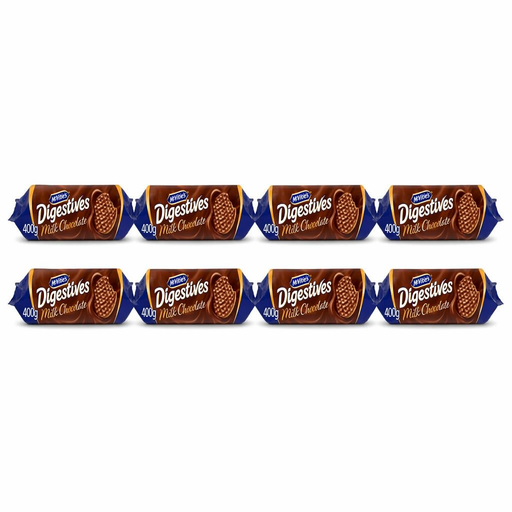 Image unavailable
A single 400g pack of milk-chocolate digestives for serving at the table. Check its stated servings and current ingredients against the number and needs of your guests.
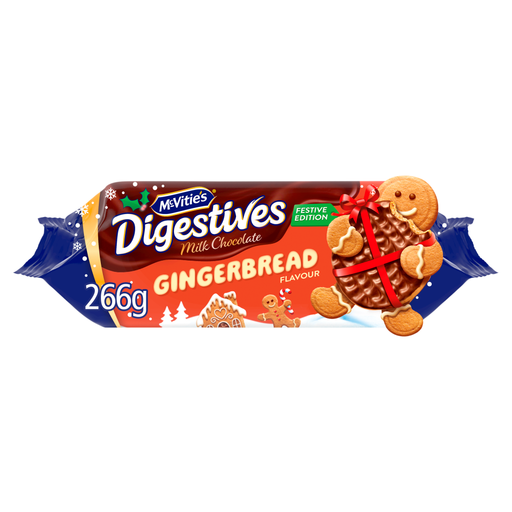 Image unavailable
The 266g sharing pack offers a gingerbread-flavoured variation if that flavour suits your guests. Use the pack’s stated portion information when planning how many to serve.
 Image unavailable
Two 262g packs give you separate packs to plan around for a gathering. Hobnobs are a different biscuit from the milk-chocolate digestives in Good Housekeeping Institute’s June 2026 taste test.
 Image unavailable
Two 266g packs offer a dark-chocolate digestive for serving to a group. The cited Good Housekeeping Institute taste test assessed milk-chocolate digestives, so its scores do not describe this variant.
 Image unavailable
A single 400g pack for hosts choosing dark-chocolate digestives rather than a twin pack. Check the pack’s stated servings and label when planning for guests.
Start with your guest count, then compare it with the bar count or stated servings on the packs you are considering. A seven-bar multipack contains seven separate bars; an open biscuit pack’s stated servings depend on its own serving definition and may not match what each guest takes.
Follow that pack’s storage instructions. Sainsbury’s advises storing its 400g chocolate-chip digestives in an airtight container once opened for best quality; check other products’ labels for their own directions.
Check the exact product’s current ingredients, highlighted allergens and any precautionary statement against the guest’s restriction. GOV.UK guidance says allergens used as ingredients must be listed and highlighted on the label; a brand name or biscuit style alone cannot establish suitability.
No: the Food Standards Agency distinguishes best-before dates, which concern quality, from use-by dates, which concern safety. Check the date type and storage instructions on the actual pack rather than treating the two labels as interchangeable.