Parents choosing a snack for home
Compare the biscuit’s stated portion and ingredients when choosing an occasional treat. For a regular after-school snack, the NHS suggests fruit and vegetables instead of biscuits.


For an occasional snack at home, compare the portion, ingredients and current pack label before choosing a chocolate-coated digestive; the listed milk-chocolate varieties differ in sugar per biscuit. For a regular after-school snack, the NHS suggests fruit and vegetables instead. If an English school or covered after-school club provides the food, Department for Education school-food standards restrict chocolate-coated products; a home snack is a different decision.
Compare the biscuit’s stated portion and ingredients when choosing an occasional treat. For a regular after-school snack, the NHS suggests fruit and vegetables instead of biscuits.
Check the exact pack for ingredients and allergy advice each time you buy. A product’s name alone cannot establish whether it suits a particular child.
Establish whether the setting provides the food and follow its food and allergy arrangements. Department for Education standards for covered provision in England restrict chocolate-coated products, including during after-school clubs.
Start with where the snack will be served, then compare the portion and the exact pack’s ingredients.
| Priority | What to check | Your needs |
|---|---|---|
| Serving setting | Check whether the snack is eaten at home or provided by an English school or covered after-school club. Ask the setting about its food and allergy arrangements. | If I am sending food to a club, I want to know its rules before packing a chocolate-coated biscuit. |
| Portion and frequency | Compare energy and sugar for the stated biscuit size, not just the adult reference-intake percentage. Decide how many biscuits make up the portion. | For an occasional biscuit at home, I want to know what one serving contains. For a regular snack, I would consider the fruit and vegetable swaps suggested by the NHS. |
| Ingredients and allergens | Read the current pack’s ingredient and allergen statements, including any recipe-specific precautions. Sainsbury’s 300g milk-chocolate digestive listing, for example, warns that it is unsuitable for customers with an oat allergy due to manufacturing methods. | I need to check suitability for my child rather than assuming every chocolate digestive has the same ingredients or allergy advice. |
| Chocolate and pack format | Check whether the coating is milk or dark chocolate and compare pack weights. For the listed 300g milk-chocolate recipes, Sainsbury’s states 27% milk chocolate, while Tesco and Asda each state 30%; the percentages do not establish a taste preference. | A smaller pack or a particular chocolate type may suit how often we have biscuits at home. |
The listed chocolate-coated biscuits contain sugar per biscuit, while the NHS suggests fruit and vegetables as regular after-school snack swaps.
Decide whether you are choosing an occasional biscuit or a routine snack, and check the stated serving size.
Allergy information differs between recipes. Sainsbury’s listed milk-chocolate digestives also carry a precaution for customers with an oat allergy.
Read the exact pack when buying and follow the child’s and setting’s allergy arrangements.
England’s rules on retail promotions address a different activity from Department for Education standards restricting chocolate-coated products in covered school provision, including after-school clubs.
Confirm who provides the snack and which rules and policies apply to that setting.
These examples describe specific listed products, not every recipe or pack sold under each brand.
Milk Chocolate Digestives are listed in several pack sizes.
Its listed 300g digestives are half-coated in milk chocolate.
Its listed milk-chocolate digestives come in a 300g pack.
Its listed 300g milk-chocolate digestives state 30% milk chocolate.
Its listed 300g wholemeal Milk Chocolate Digestives contain demerara sugar.
These McVitie’s milk- and dark-chocolate varieties are options to consider for an occasional snack at home. Their pack sizes and flavours differ; check the current label for portions and allergy suitability.
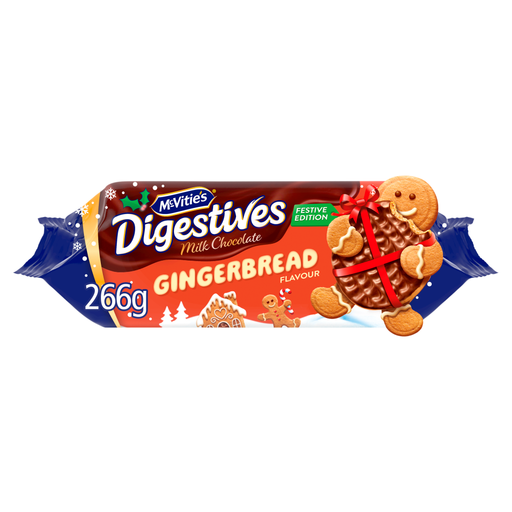 No image available
A gingerbread-flavoured chocolate digestive for an occasional snack at home. Check the current pack’s serving information and allergen statement before choosing it for a child.
 No image available
A 400g milk-chocolate variety for households choosing an occasional biscuit at home. Use this pack’s own serving and ingredient information rather than figures from another pack size.
 No image available
A dark-chocolate option in two 266g packs. If portion figures matter to your choice, check the nutrition panel and serving size on the pack you receive.
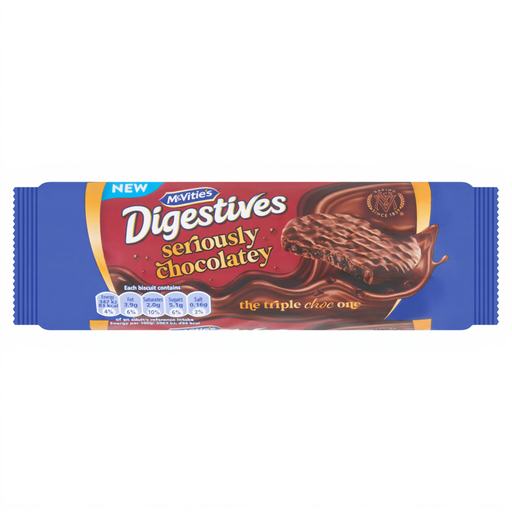 No image available
A 250g chocolate-digestive variant for an occasional snack at home. Check its current nutrition panel, ingredients and allergy advice rather than treating it as interchangeable with the standard milk-chocolate recipe.
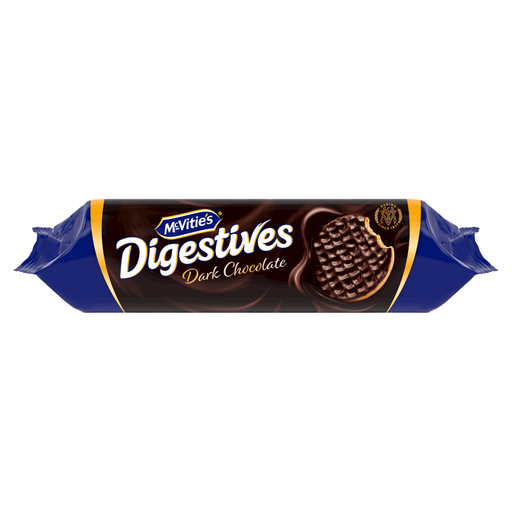 No image available
A single 400g dark-chocolate pack for those choosing that variety for home. Read its own serving figures and allergen statement before deciding on a portion or suitability.
Compare the stated serving size, energy and sugar per biscuit instead. An adult reference-intake percentage is not a child-specific allowance, and different products can use different biscuit sizes.
Ask whether the club provides the snack or accepts food sent from home, and follow its food and allergy policies. Department for Education school-food standards restrict chocolate-coated products in covered school provision in England, including after-school clubs; that is distinct from choosing a snack to eat at home.
No. Department of Health and Social Care guidance for England addresses promotions of qualifying products by location and volume price. The separate Department for Education school-food standards address food provided in covered school settings, so check the serving setting rather than using a retail-promotion rule to decide what a club may provide.