What should you check?
Decide whether a biscuit fits your plans for the run, then compare the exact product and serving you would eat.
| Priority | What to check | Your needs |
|---|
| Snack timing |
Consider the length of the run and when you last ate. University College London Hospitals NHS Foundation Trust says snacks for shorter activities may only be needed for hypoglycaemia prevention or treatment. |
After a usual meal, I may not want a biscuit for the run itself. If I want a pre-run snack, I would choose a familiar portion rather than try a new food on the day. |
| Carbohydrate and fat |
Compare per-biscuit figures on the same basis. Tesco Groceries lists 10.4 g carbohydrate and 3.9 g fat for a McVitie's milk chocolate digestive in the 266 g pack, versus 10.2 g carbohydrate and 4.1 g fat for the checked dark version. |
If I am choosing between coatings, I want the figures for the particular pack—not an assumption that dark chocolate means less fat. |
| Portion size |
Check the stated serving and how many biscuits you plan to eat. Sainsbury's lists 10.2 g carbohydrate and 3.6 g fat per biscuit for its 300 g milk chocolate digestives; Tesco Groceries lists 11.1 g available carbohydrate and 3.7 g fat per biscuit for its 300 g own-label pack. |
A small portion suits what I have in mind before the run; I do not want to mistake a whole pack's figures for one biscuit's. |
| Allergens and gluten |
Read the current ingredients and allergen statement. Tesco Groceries labels its Free From chocolate digestives gluten and wheat free but warns they may contain peanuts and nuts. Sainsbury's labels its Free From chocolate digestive suitable for coeliacs and warns it is not suitable for customers with a nut allergy due to manufacturing methods. |
If I need to avoid gluten, wheat or another ingredient, I need a claim and allergen statement that match my requirements; the words “digestive” and “Free From” are not enough on their own. |
Brand and own-label references
These label examples refer to the named products and pack sizes, not to every biscuit made by each brand.
McVitie's
Tesco Groceries lists milk and dark chocolate Digestives in 266 g packs with separate per-biscuit nutrition figures.
- The checked milk version provides 10.4 g carbohydrate and 3.9 g fat per biscuit.
- The checked dark version has less sugar per biscuit than the milk version, at 4.4 g versus 4.8 g, but more fat, at 4.1 g versus 3.9 g.
Tesco
Tesco Groceries lists a standard 300 g milk chocolate digestive and a separate Free From chocolate digestive.
- The standard product lists 11.1 g available carbohydrate and 3.7 g fat per biscuit.
- The Free From product is labelled gluten and wheat free, but its listing warns that it may contain peanuts and nuts.
Sainsbury's
Sainsbury's lists a standard 300 g milk chocolate digestive and a separate Free From chocolate digestive.
- The standard product lists 10.2 g carbohydrate, 3.6 g fat and 0.6 g fibre per biscuit.
- The Free From product is labelled suitable for coeliacs but carries a manufacturing warning for customers with a nut allergy. Sainsbury's chocolate-chip digestives contain chips rather than a chocolate coating.
Asda
ASDA Groceries lists a 300 g own-label milk chocolate digestive.
- Its listed per-biscuit figures are 11 g carbohydrate and 3.8 g fat.
- The listing also gives 4.8 g sugars per biscuit; compare the current pack if sugars affect your choice.
M&S
Marks & Spencer lists a milk chocolate digestive with UK nutrition information stated per 100 g.
- The listed figures are 63.3 g carbohydrate, 23.1 g fat and 31.7 g sugars per 100 g.
- Use the serving information on the pack before comparing one biscuit with products whose figures are stated per biscuit.
Chocolate digestives on Joybuy
These McVitie's chocolate digestives are options to consider if you want a familiar biscuit before a 5k; their presence here does not make a biscuit necessary during the run. Check the current pack for serving figures and allergens when choosing a variant.
 No image available
McVitie's Digestives Milk Chocolate 400g
A milk chocolate digestive to consider as a familiar snack before a short run, rather than as routine fuel during it.
Check the 400 g pack for its serving size, per-biscuit nutrition and allergen statement; figures for a different pack size should not be assumed to apply.
View on Joybuy
 No image available
McVitie's Digestives Dark Chocolate 400g
A dark chocolate digestive option if you prefer that coating for a familiar pre-run biscuit.
Check the 400 g pack's nutrition and allergen statement rather than assuming dark chocolate changes its suitability for your planned portion.
View on Joybuy
 No image available
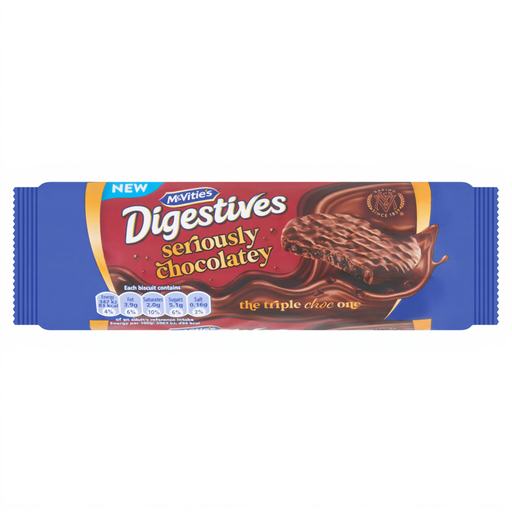
McVitie's Seriously Chocolate Digestives 250g
Another chocolate digestive variety to consider if you want a familiar biscuit before a 5k.
Use the serving size and nutrition on the 250 g pack to assess your intended portion, and check its current allergen statement.
View on Joybuy
Questions about 5k snacks
Do I need a chocolate digestive during a 5k?
Not as routine fuel for a short recreational run. University College London Hospitals NHS Foundation Trust says snacks for shorter activities may only be needed for hypoglycaemia prevention or treatment; if you use carbohydrate for an individual medical reason, follow your care plan.
How should I try a biscuit before a run?
If you want a pre-run snack, try a small, familiar portion during training rather than introducing a new biscuit on an event day. Check its per-biscuit nutrition and consider when you last ate.
Does dark chocolate mean less fat?
Not for the checked McVitie's 266 g varieties: Tesco Groceries lists 4.1 g fat per dark chocolate biscuit and 3.9 g per milk chocolate biscuit. The dark version lists less sugar, at 4.4 g versus 4.8 g, so compare the measures that matter to your choice on the exact pack.
Can a gluten-free chocolate digestive suit someone with coeliac disease?
Choose one explicitly labelled gluten free and suitable for coeliacs, then check its other allergen warnings. Sainsbury's labels its Free From chocolate digestive suitable for coeliacs but says it is not suitable for customers with a nut allergy due to manufacturing methods.
Is a digestive enough after a demanding run?
Do not treat a single biscuit as the whole post-exercise snack after intense or prolonged activity. The UK Sports Institute's general recovery guidance describes a carbohydrate-and-protein-rich snack with fluids for that situation; its advice is specifically about intense or prolonged exercise, not a requirement for every recreational 5k.


