Afternoon tea snackers
If you have a chocolate digestive with tea or coffee, compare milk and dark coatings alongside differences in the biscuit recipe. McVitie’s and M&S describe these variations, but their descriptions are not taste-test results.


For a snack at home, choose the coating and biscuit recipe you prefer, then compare the exact packs for portion information, ingredients and quantity. A dark coating does not establish dairy-free suitability or lower energy: McVitie’s lists milk in its dark recipe and 83 kcal per biscuit for both its cited milk and dark versions. Food provided by a school in England is a different setting: Department for Education guidance excludes chocolate-coated products across the school day.
If you have a chocolate digestive with tea or coffee, compare milk and dark coatings alongside differences in the biscuit recipe. McVitie’s and M&S describe these variations, but their descriptions are not taste-test results.
Check the nutrition per biscuit for the number you expect to eat, and per 100g when comparing biscuits of different sizes. A dark coating or a different pack size does not, by itself, settle that comparison.
Read the exact pack’s ingredients and allergen statement when milk, wheat, soya or oat cross-contact matters. McVitie’s dark recipe lists a milk ingredient, while Sainsbury’s gives a specific oat-allergy warning for its cited milk-chocolate variety.
Decide which coating and biscuit recipe appeals first; then compare portions and the label on the pack you intend to buy.
| Priority | What to check | Your needs |
|---|---|---|
| Coating and texture | Check whether the coating is milk or dark chocolate and whether the biscuit contains cocoa or chocolate chips. For the cited products, Tesco and Asda list 30% milk chocolate, Sainsbury’s 27%, and M&S 32% chocolate in each of its listed milk and dark recipes; these figures describe different recipes, not a taste ranking. | I’d choose the coating I enjoy, then look at the biscuit itself if I want a different crunch or chocolate throughout it. |
| Portion information | Compare nutrition per biscuit for your intended portion and per 100g across different-sized biscuits. McVitie’s lists 83 kcal for each cited milk and dark biscuit, with 4.8g and 4.4g sugars respectively. | If I’m planning to have more than one biscuit, I want figures for the number I’ll actually eat, not a conclusion based on “dark” in the name. |
| Ingredients and allergens | Read the exact pack, including its allergen and cross-contact statements. McVitie’s lists butter oil (milk) in its dark recipe; Sainsbury’s says its cited milk variety is unsuitable for customers with an oat allergy due to manufacturing methods. | Where an ingredient or allergen matters to me, the coating name alone is not enough to decide whether a biscuit is suitable. |
| Pack size and storage | Check the pack weight, serving information and instructions after opening. The cited ranges include 300g and 400g packs; Tesco advises cool, dry storage and an airtight container once opened. | Am I buying a pack for occasional biscuits or for sharing? I’d choose a quantity I can use and store as directed. |
| School provision | Distinguish a snack at home from food provided by a school in England. Department for Education school-food guidance excludes chocolate-coated products across the school day; the Requirements for School Food Regulations 2014 also prohibit biscuits provided otherwise than as part of a school lunch. | For food an English school provides, I need to follow the school-food rules rather than apply a home-snack choice. |
McVitie’s lists butter oil (milk) in its cited dark digestive. It also lists 83 kcal per biscuit for both its milk and dark versions.
Choose dark for your coating preference, and check the exact pack’s ingredients and portion figures for other requirements.
Department for Education guidance for England excludes chocolate-coated products across the school day. The Requirements for School Food Regulations 2014 separately prohibit biscuits provided otherwise than as part of a school lunch.
Keep decisions about food provided by an English school separate from buying a snack for home. Check the applicable guidance for schools elsewhere in the UK.
The cited chocolate digestives come in different pack weights, so pack size alone does not describe your likely portion or how long an opened pack will be kept.
Check the weight and serving information, then follow the pack’s storage instructions after opening.
These brand examples describe particular listed recipes, not every digestive each brand makes.
Its cited range includes milk and dark chocolate digestives, plus a Seriously Chocolatey recipe with a cocoa biscuit and dark-chocolate chips.
Its cited 300g digestive is half coated in milk chocolate.
Its cited 300g milk-chocolate digestives list 27% milk chocolate.
Its cited 300g milk-chocolate digestives list 30% milk chocolate.
Its cited 300g milk and dark chocolate digestives are described as containing demerara sugar for added crunch.
The cited Crawford’s Digestives 400g listing describes a plain biscuit, rather than a chocolate-coated choice.
This composite list follows the supplied order of snack scenarios—conventional milk coating, dark coating, own-label recipes and a texture variation. Its numbered positions are not a quality, sales or market ranking.
| Rank | Product | Main specifications | Reason for inclusion | Platform |
|---|---|---|---|---|
| 1 | McVitie’s Milk Chocolate Digestives 400g | 400g pack; McVitie’s lists 30% milk chocolate, 83 kcal and 4.8g sugars per biscuit for its milk recipe. | A conventional milk-chocolate reference. The recipe figures are from McVitie’s; the 400g listing is identified by Joybuy UK. | Joybuy |
| 2 | McVitie’s Dark Chocolate Digestives 400g | Dark-chocolate variety; McVitie’s lists 83 kcal and 4.4g sugars per biscuit, and butter oil (milk) among its ingredients. | Shows how a dark-coating preference differs from the cited milk recipe without implying dairy-free suitability. Figures and ingredients are from McVitie’s. | McVitie’s |
| 3 | Tesco Milk Chocolate Digestive Biscuits 300g | 300g pack; half coated in milk chocolate, listed as 30% of the recipe. | An own-label milk-chocolate recipe with a stated coating proportion, according to Tesco. | Tesco |
| 4 | Sainsbury’s Milk Chocolate Digestives 300g | 300g pack; 27% milk chocolate. Sainsbury’s warns that this variety is unsuitable for customers with an oat allergy due to manufacturing methods. | Includes a different stated coating proportion and a product-specific allergen warning from Sainsbury’s. | Sainsbury’s |
| 5 | M&S Milk Chocolate Digestives 300g | 300g pack; M&S lists 32% milk chocolate and describes demerara sugar in the biscuit. | A recipe variation for shoppers interested in the crunch described by M&S, not an independently tested texture result. | M&S |
These McVitie’s listings cover milk- and dark-chocolate digestives, different pack formats and a Seriously Chocolate variant for an afternoon snack at home. Check the exact listing and pack when choosing between them.
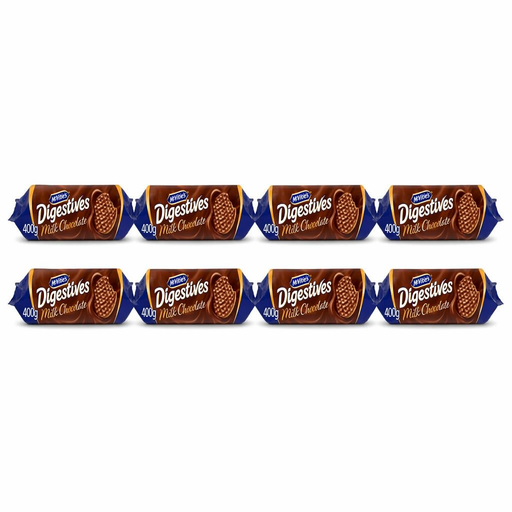 Image unavailable
A milk-chocolate digestive listing for buying in a case format; confirm the number of packs in the case before ordering. The named pack size is 400g. Check the pack’s ingredients and allergen information.
 Image unavailable
A dark-chocolate option in a twin pack of 2 x 266g. McVitie’s dark digestive recipe lists butter oil (milk), so do not use the coating name as a dairy-free indication; check the packs’ full allergen statements.
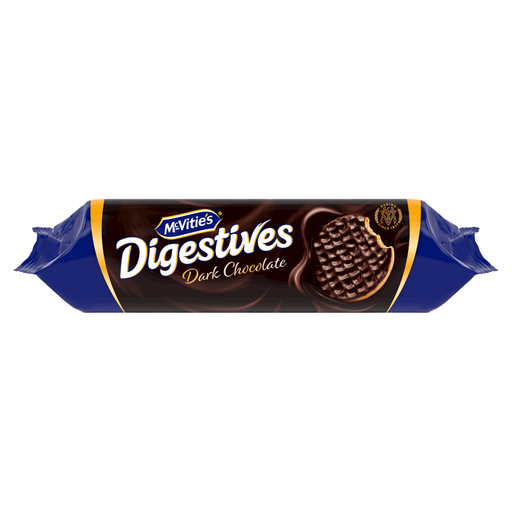 Image unavailable
A 400g dark-chocolate digestive pack if you prefer that coating without the twin-pack format. McVitie’s dark recipe lists butter oil (milk); check the exact pack’s ingredients and portion information.
 Image unavailable
A single 400g milk-chocolate digestive pack. McVitie’s lists 83 kcal and 4.8g sugars per biscuit for its cited milk recipe; use the information on the pack you receive to assess your intended portion and allergens.
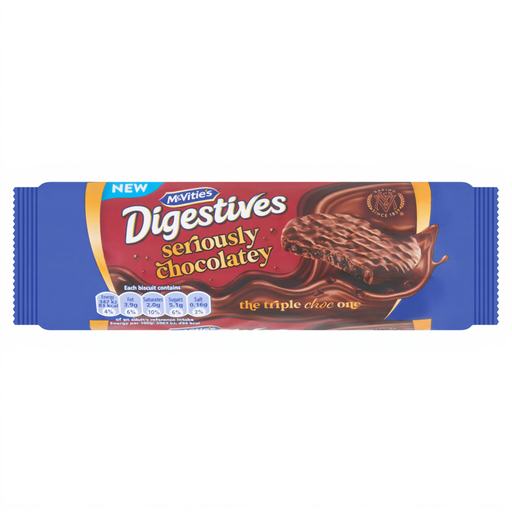 Image unavailable
A 250g chocolate-digestive option for comparing with the milk and dark packs above. Check this variant’s pack for its recipe, allergens and per-biscuit figures before making a portion comparison.
Not as food provided by the school during the school day. Department for Education school-food guidance excludes chocolate-coated products across the school day, and the Requirements for School Food Regulations 2014 prohibit biscuits provided otherwise than as part of a school lunch. This conclusion does not determine the rules for privately bought snacks or for schools elsewhere in the UK.
No. As at 30 September 2026, the Department for Education described changes planned for September 2027 as subject to Parliamentary approval. Decisions about food an English school provides should follow the current standards, not treat the proposed changes as already in force.
Not necessarily. McVitie’s lists butter oil (milk) in its cited dark-chocolate digestive, so check the complete ingredients and allergen statement on the particular pack.
Follow the instructions on your pack. Tesco’s cited milk-chocolate digestives advise a cool, dry place and an airtight container once opened.
Check the exact variety, pack format and weight before ordering, particularly when choosing between a single pack, twin pack and case SKU. Read the ingredients and allergen information on the delivered pack before eating, as product recipes can change.