Parents planning holiday snacks
If biscuits will be kept at home for an occasional treat, choose a pack and serving routine that leave room for everyday fruit and vegetable snacks. NHS Healthier Families recommends putting those snacks first.


Keep chocolate-coated digestives as an occasional school-holiday treat rather than the default snack: NHS Healthier Families puts fruit and vegetables first for children’s snacks. If choosing biscuits, compare sugars and saturates per biscuit, decide how many to serve, and check the exact pack’s allergen statement. Tesco Dark Chocolate Digestives list 4.2g sugars per 17g biscuit, less than the milk-chocolate products compared here, but they contain wheat and soya and may contain milk.
If biscuits will be kept at home for an occasional treat, choose a pack and serving routine that leave room for everyday fruit and vegetable snacks. NHS Healthier Families recommends putting those snacks first.
Chocolate digestives can list wheat, milk and soya, while precautionary warnings vary by product. Read the exact pack rather than assuming that a dark-chocolate variety is milk-free.
For food provided in a state-funded school in England, the Department for Education’s school-food standards prohibit chocolate-coated products across the school day. That provision is different from a family choosing snacks to eat at home during the holidays.
Start with when the biscuits will be served, then compare the portion and allergen information on the exact variety you intend to buy.
| Priority | What to check | Your needs |
|---|---|---|
| Snack routine | Decide when biscuits will be a treat and how many to serve. NHS Healthier Families puts fruit and vegetables first for children’s snacks and suggests aiming for no more than two packaged snacks a day. | I want biscuits available occasionally without making an open packet the usual snack choice. |
| Per-biscuit values | Compare the stated serving size, sugars, saturates and energy. Tesco Groceries lists 4.2g sugars and 85kcal per 17g Tesco Dark Chocolate Digestive, against 5.4g sugars and 83kcal per 17g Tesco Milk Chocolate Digestive; the lower-sugar option is not lower in energy. | When I put a biscuit on a plate, I want the label values for that biscuit, not just figures per 100g. |
| Allergens | Read both the ingredients and any “may contain” statement on the exact pack. Tesco Groceries lists wheat and soya in its Dark Chocolate Digestives and warns that they may contain milk. | Someone in my household needs to avoid a particular ingredient or precautionary allergen warning, so chocolate colour alone cannot settle the choice. |
| Pack format | Check the pack weight and whether it contains one or two packets. Match the amount kept open to how often you plan to serve biscuits. | A smaller pack may suit an occasional treat; if I choose a twin pack, I can keep the second packet sealed until needed. |
Chocolate-coated varieties still contain declared sugars and saturates per biscuit. NHS Healthier Families puts fruit and vegetables first for children’s snacks, so the biscuit name does not make them a substitute for those everyday options.
Set aside a defined serving when biscuits are the treat, rather than leaving an open packet out for repeated snacking.
Tesco Dark Chocolate Digestives contain wheat and soya and carry a “may contain milk” warning, according to Tesco Groceries. Dark chocolate does not, by itself, establish suitability for someone avoiding milk.
Check the current ingredients and precautionary allergen statement on the exact pack against the household member’s requirements.
The Department for Education’s school-food standards prohibit chocolate-coated products provided across the school day in state-funded schools in England. This is not a general prohibition on biscuits eaten at home during school holidays.
If the food will be provided by a school in England, choose an alternative that meets its food standards and check the school’s arrangements.
A larger pack keeps more biscuits available after opening, which may not fit a plan to serve them only occasionally.
Choose the pack format around the number of planned servings and keep unopened packets sealed until needed.
These product-label examples help compare varieties; they do not imply that every product from a brand has the same ingredients or nutrition values.
McVitie’s Milk Chocolate Digestives provide a reference point for a milk-chocolate variety.
Tesco’s 300g milk- and dark-chocolate digestives have per-biscuit values that can be compared on the same 17g serving basis.
Galaxy Milk Chocolate Digestive Biscuits provide another 300g milk-chocolate option with values stated per 17g biscuit.
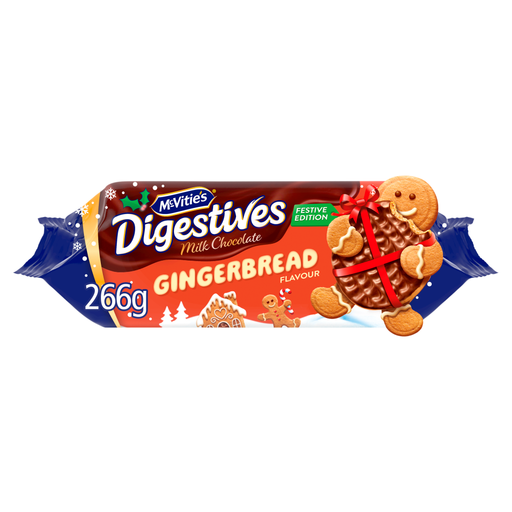
These McVitie’s milk-, dark- and gingerbread-chocolate digestives offer different flavours and pack formats for an occasional holiday treat. A dark-chocolate name alone does not establish a lower sugar value: compare the nutrition panel on the particular pack.
 No image available
A 400g milk-chocolate pack for planned biscuit servings. McVitie’s lists 83kcal and 4.8g sugars per biscuit for its Milk Chocolate Digestives; check the pack’s serving information and its wheat, milk and soya allergen statement before serving.
 No image available
The 266g gingerbread variety offers a different flavour from the standard milk-chocolate biscuit. Check its own per-biscuit nutrition values and allergen statement when planning servings.
 No image available
Two 266g packets allow one to remain sealed while the other is in use. For this McVitie’s dark-chocolate variety, check the pack’s own sugars per biscuit and allergen statement rather than applying Tesco’s dark-chocolate values to it.
 No image available
This is a single 400g dark-chocolate pack rather than the twin-pack format. Compare its own sugars and saturates per biscuit with any milk-chocolate alternative, and read its allergen statement on the pack.
 No image available
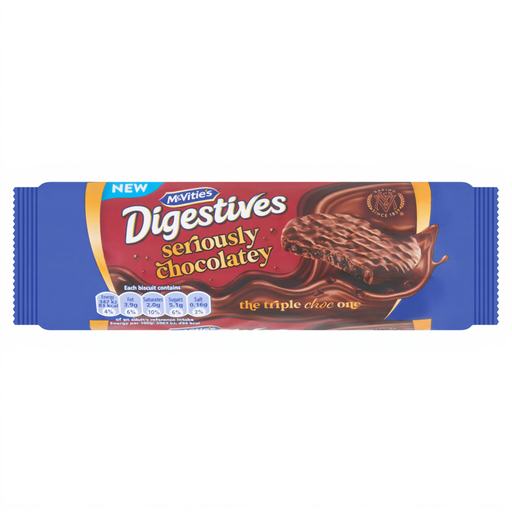
This 250g chocolate variety is a different product from the standard Milk Chocolate Digestives, so use its own label when comparing servings. Check the exact pack for wheat, milk and soya information and any precautionary nut or egg warning.
No, not as food provided across the school day. The Department for Education’s school-food standards prohibit chocolate-coated products, and England’s school-food regulations include products wholly or partly coated with chocolate in the confectionery definition. This does not automatically apply to biscuits a family serves at home during the holidays.
No. England’s school-food standards concern food provided in state-funded schools, not a general ban on household purchases or snacks eaten at home. Separate government HFSS rules address certain retail promotions and placement; a chocolate-coated name alone does not establish an individual product’s HFSS classification.
Tesco Groceries lists 4.2g sugars per 17g Tesco Dark Chocolate Digestive, compared with 5.4g for its 17g milk-chocolate biscuit. Its Galaxy Milk Chocolate Digestive lists 4.8g per 17g biscuit, while McVitie’s lists 4.8g per biscuit for its Milk Chocolate Digestives. These are values for the named products, not every dark- or milk-chocolate digestive; check the current pack before comparing.
Do not assume it is. Tesco Groceries lists a “may contain milk” warning for Tesco Dark Chocolate Digestives, alongside wheat and soya in the product information. Check the exact variety’s current ingredients and precautionary allergen statement against the person’s requirements.
Follow the instructions on the pack you buy. Tesco Groceries advises keeping its McVitie’s Milk Chocolate Digestives 266g pack in a cool, dry place and transferring the biscuits to an airtight container after opening; storage does not change its allergen ingredients.