Parents packing an occasional treat
Start with the school’s arrangements and your child’s dietary needs. Then read the current pack’s allergen declaration and per-biscuit nutrition rather than assuming all chocolate digestives are alike.


For an occasional school-lunch treat, choose a chocolate digestive only after checking the school’s current allergy arrangements and the exact pack: the standard products reviewed list wheat, milk and soya. If the biscuit is suitable, compare nutrition per biscuit and choose a pack you can portion at home. NHS lunchbox guidance recommends swapping biscuits and chocolate for alternatives such as fruit in everyday lunchboxes.
Start with the school’s arrangements and your child’s dietary needs. Then read the current pack’s allergen declaration and per-biscuit nutrition rather than assuming all chocolate digestives are alike.
Among the three 300g own-label listings compared here, Sainsbury’s lists 4.1g sugars and 1.8g saturates per biscuit, ASDA 4.8g and 2.0g, and Tesco 5.4g and 2.0g. These are figures for each retailer’s stated biscuit serving, not a reason to make biscuits an everyday lunchbox snack.
Check every relevant ingredient and precautionary allergen statement. The standard products reviewed list wheat, milk and soya; the Prewett’s gluten-free alternative listed by Waitrose contains milk and soya and may contain nuts.
Check school arrangements and allergens first; once a biscuit is suitable, use the serving information and pack format to make the remaining choice.
| Priority | What to check | Your needs |
|---|---|---|
| Allergens and school arrangements | Read the school’s current policy and the physical pack’s ingredient and precautionary allergen statements. Department for Education guidance for England says schools must publish an allergy safety policy; individual arrangements can differ. | I need a biscuit that fits my child’s dietary requirements and the school’s arrangements. The standard milk-chocolate products reviewed list wheat, milk and soya; Sainsbury’s also flags its product as unsuitable for customers with an oat allergy because of manufacturing methods. |
| Nutrition per biscuit | Compare the stated biscuit serving, sugars and saturates. Sainsbury’s lists 4.1g sugars and 1.8g saturates; ASDA 4.8g and 2.0g; Tesco 5.4g and 2.0g per biscuit, according to their respective listings. | For an occasional treat, I want to know what one biscuit contributes. These figures compare the listed servings of three 300g own-label milk-chocolate products, not equal weights of biscuit. |
| Chocolate variety | Check whether the pack is milk or dark chocolate and read its allergens rather than judging by the chocolate type. The McVitie’s dark variant listed by Waitrose includes wheat, milk and soya. | A dark-chocolate biscuit may suit my taste, but I still need to check whether its current ingredients are suitable for the child who will eat it. |
| Pack and portion format | Check the pack weight and biscuit count. The reviewed own-label packs are 300g; Marks & Spencer lists both a 300g pack and a 190g format containing six coated biscuits. | I can portion a cupboard pack at home, or choose a stated six-biscuit format when planning how many occasions the pack is for. |
The standard chocolate digestives reviewed list wheat, milk and soya. Department for Education guidance for England describes school allergy arrangements, and a school may discourage particular allergens on site.
Check the school’s current policy, the child’s dietary requirements and the physical pack before putting a biscuit in a lunchbox.
The Prewett’s gluten-free chocolate digestive listed by Waitrose contains milk and soya and carries a may-contain-nuts warning.
If gluten avoidance is needed, check the alternative’s full declaration against every other relevant allergy and the school’s arrangements.
Sainsbury’s lists fewer grams of sugars per biscuit than the ASDA and Tesco 300g own-label products compared here. NHS lunchbox guidance nevertheless recommends swapping biscuits and chocolate for alternatives such as fruit in everyday lunchboxes.
Use per-biscuit figures to compare occasional treats, not to replace checks on allergens or the rest of the lunchbox.
A product’s ingredients and allergen information can change, so a listing you read earlier may not describe the pack you are about to use.
Read the label on that pack before serving or packing it, especially when an allergen matters.
These examples describe specific chocolate digestive listings, not every biscuit made by each brand.
Milk- and dark-chocolate digestive variants appear in the reviewed retailer listings.
Its reviewed own-label milk-chocolate digestives come in a 300g pack.
Its reviewed 300g milk-chocolate pack lists 4.1g sugars and 1.8g saturates per biscuit.
Its reviewed own-label milk-chocolate digestive pack weighs 300g.
Marks & Spencer lists a 300g milk-chocolate digestive with a stated 32% milk-chocolate coating and a separate 190g pack containing six coated biscuits.
These McVitie’s chocolate digestive packs offer milk- and dark-chocolate choices, including a twin pack and a case-format listing. Check the exact pack and your school’s arrangements before choosing one for a lunchbox.
 No image available
The two-pack format allows one 266g pack to stay sealed while the other is in use. Before packing a biscuit for school, check the current pack’s wheat, milk and soya declaration and the school’s allergy arrangements.
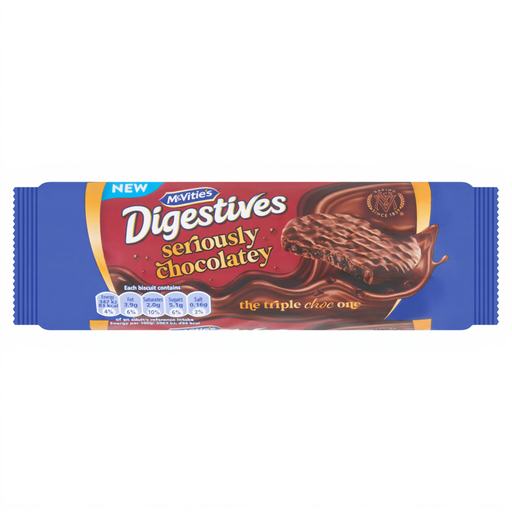 No image available
This 250g chocolate digestive pack is a choice for someone seeking the Seriously Chocolate variant. Check its wheat, milk and soya declaration and precautionary nuts and eggs statement on the physical pack before considering it for school.
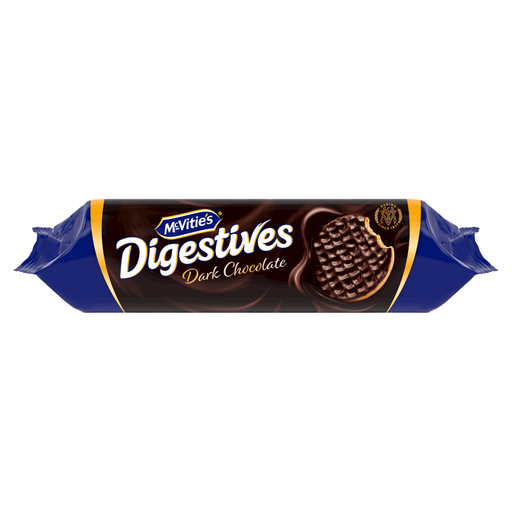 No image available
The 400g pack is a dark-chocolate option to portion at home for occasional use. Check the current wheat, milk and soya declaration and any school restrictions before putting it in a lunchbox.
 No image available
This 400g milk-chocolate pack can be portioned at home. Joybuy’s listing states 30% milk chocolate and lists wheat, milk and soya; confirm the declaration on the pack before school use.
 No image available
This case-format listing differs from a single 400g pack; check the listed case quantity against how many occasional portions your household intends to use. Check the physical packs for wheat, milk and soya before serving or packing them.
Check that the child can eat the exact product and that it fits the school’s current arrangements before packing it. Department for Education guidance for England says schools must publish an allergy safety policy and may discourage certain allergens on site. The standard chocolate digestives reviewed list wheat, milk and soya.
NHS lunchbox guidance recommends swapping biscuits and chocolate for alternatives such as fruit in everyday lunchboxes. If you include a chocolate digestive occasionally, check its serving information and portion it alongside the rest of the lunch.
For the three reviewed 300g milk-chocolate packs, Sainsbury’s lists 4.1g sugars per biscuit, ASDA 4.8g and Tesco 5.4g, according to their retailer listings. The comparison uses each product’s stated biscuit serving; it does not establish suitability for a child with an allergy.
Not necessarily. The Prewett’s gluten-free milk-chocolate digestive listed by Waitrose contains milk and soya and may contain nuts. Check the current pack against every relevant allergy, as well as the school’s arrangements.
Follow the instructions on the pack you buy. The reviewed Tesco and Marks & Spencer products call for cool, dry storage and airtight storage after opening; the Marks & Spencer six-biscuit listing also says to keep it away from sunlight. Storage does not change allergen suitability.