What should you check?
Start with the planned portion and time before exercise, then compare the exact packs for nutrition, ingredients and the setting in which they will be supplied.
| Priority |
What to check |
Your needs |
| Carbohydrate and portion |
Compare carbohydrate per biscuit on the same serving basis. ASDA Groceries lists 11 g for its Milk Chocolate Digestives 300 g; its listing for McVitie’s Dark Chocolate Digestives 400 g lists 10.2 g. Use the pack’s biscuit weight or serving information if you plan a different portion. |
I want to know what my planned portion contains, rather than treating one biscuit as a standard amount for every workout. |
| Timing and composition |
Consider when you last ate, the session ahead and how close to exercise you will have the snack. A 2014 review in Nutrients discusses pre-exercise carbohydrate, timing and meal composition in relation to endurance exercise, without recommending chocolate digestives specifically. |
If I am eating shortly before training, I want a portion and timing that suit me; a more demanding session may call for a separately planned snack. |
| Fat and sugars |
Read the values for the exact variant. ASDA Groceries lists 3.8 g fat and 4.8 g sugars per biscuit for its milk version, versus 4.1 g fat and 4.4 g sugars for the McVitie’s dark 400 g pack. These two products do not establish a rule about all milk and dark biscuits. |
Rich foods may not suit me close to exercise, so I would compare the portion I intend to eat instead of choosing by chocolate colour alone. |
| Allergens and ingredients |
Read the current physical pack, including precautionary allergen wording. ASDA Groceries lists milk, soya and wheat for its milk digestives and the McVitie’s dark 400 g pack; its own dark digestives also say they may contain rye, barley and oats. |
When an ingredient matters to me, I need the label for this flavour and pack—not an assumption based on another biscuit in the range. |
| School-food use |
Check the purpose of the purchase. The Department for Education’s guidance for state-funded schools in England excludes chocolate and chocolate-coated products across the whole school day; this is distinct from whether a product is sold in a shop. |
If I am purchasing food to supply to pupils during the school day in England, I need a non-chocolate option that meets the applicable school-food rules. |
Brand and product references
These examples help distinguish product formats and labels; a brand name alone does not tell you the nutrition or ingredients of every variant.
McVitie’s
McVitie’s has dark-chocolate digestive listings in different pack sizes, including the 400 g product listed by ASDA Groceries and a 266 g product listed by Tesco.
- ASDA Groceries lists 10.2 g carbohydrate, 4.1 g fat and 4.4 g sugars per biscuit for the dark 400 g product.
- That product lists milk, wheat and soya; its per-biscuit figures should not be applied to other pack variants without checking their labels.
ASDA
ASDA Groceries lists own-label milk- and dark-chocolate digestives in 300 g packs.
- The milk-chocolate listing gives per-biscuit carbohydrate, fat and sugar figures that can be compared with the intended portion.
- Both cited variants list milk, soya and wheat; the dark version also says it may contain rye, barley and oats.
Tesco
Tesco describes its own-label Milk Chocolate Digestive Biscuits 300 g as half-coated in milk chocolate.
- The listing identifies the coating format if that matters to your choice.
- Tesco advises reading the product label because ingredients, nutrition and allergen information can change.
Sainsbury’s
Sainsbury’s lists chocolate digestives alongside a chocolate-chip digestive, which is a different format from a chocolate-coated biscuit.
- Its chocolate-chip listing gives per-biscuit nutrition for shoppers considering that separate format.
- Do not use the chocolate-chip figures as the values for a coated digestive; Sainsbury’s advises checking the current product label.
M&S
Marks & Spencer describes milk- and dark-chocolate digestives with a wholemeal biscuit base, chocolate coating and demerara sugar.
- The product descriptions make the biscuit and coating format clear.
- Check the specific pack’s nutrition and allergen label before comparing a planned portion with another product.
Chocolate digestives on Joybuy
These milk- and dark-chocolate digestive options include a gingerbread-flavoured variant, a twin pack and a case SKU. Use the exact pack label when comparing portions; the products listed here do not represent every possible pre-exercise snack.
 No image available
McVitie’s Milk Chocolate Digestives 400 g (case SKU)
A milk-chocolate digestive option if you want a familiar biscuit before exercise. Check the case quantity and the current pack’s per-biscuit nutrition and allergens before deciding on a portion.
View on Joybuy
 No image available
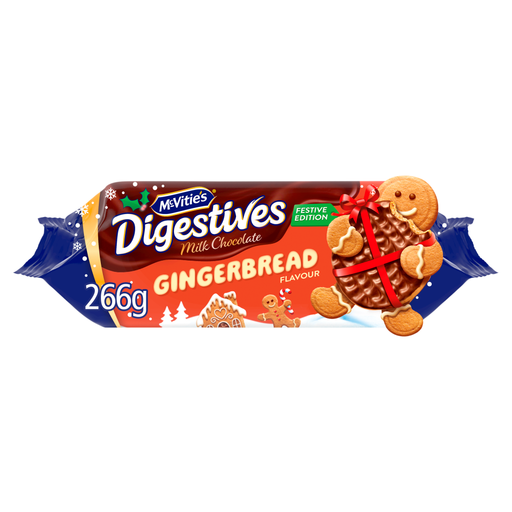
McVitie’s Gingerbread Chocolate Digestives 266 g
The gingerbread flavour makes this a different choice from a plain chocolate digestive. Check this variant’s coating, per-biscuit values and allergens on its own pack rather than using figures from another McVitie’s product.
View on Joybuy
 No image available
McVitie’s Digestives Dark Chocolate Twin Pack 2 x 266 g
This dark-chocolate option comes as two 266 g packs. Choose it for the flavour and pack format, not an assumed performance difference from milk chocolate; check the nutrition and allergens for this twin pack.
View on Joybuy
 No image available
McVitie’s Digestives Dark Chocolate 400 g
For this 400 g dark-chocolate product, ASDA Groceries lists 10.2 g carbohydrate, 4.1 g fat and 4.4 g sugars per biscuit, with milk, wheat and soya allergens. Use the current pack label to check the values and decide what portion, if any, suits your timing before exercise.
View on Joybuy
 No image available
McVitie’s Digestives Milk Chocolate 400 g
This 400 g milk-chocolate pack is an option if you prefer that flavour before a workout. Check its own per-biscuit nutrition and allergens rather than transferring values from the ASDA own-label milk biscuit or the McVitie’s dark version.
View on Joybuy
Questions about pre-workout digestives
Are chocolate-coated digestives a proven pre-workout food?
No specific exercise benefit has been established for chocolate-coated digestives. A 2014 review in Nutrients discusses pre-exercise carbohydrate, timing and meal composition in relation to endurance exercise, but it does not identify these biscuits as a universal choice. Check the portion and how eating it before your session suits you.
Is a dark-chocolate digestive different from a milk-chocolate one before exercise?
Compare the exact products rather than assuming dark chocolate has an exercise advantage. ASDA Groceries lists 11 g carbohydrate, 3.8 g fat and 4.8 g sugars per biscuit for its Milk Chocolate Digestives 300 g, and 10.2 g carbohydrate, 4.1 g fat and 4.4 g sugars for McVitie’s Dark Chocolate Digestives 400 g. Those figures describe two products, not every milk or dark version.
Should I check the allergens on each pack?
Yes, if an allergy or intolerance is relevant to you. ASDA Groceries lists milk, soya and wheat for the cited milk and McVitie’s dark examples; its own dark digestives also say they may contain rye, barley and oats. Read the current physical pack for the variant you intend to eat.
Can chocolate-coated digestives be supplied during the school day in England?
Not under the Department for Education’s school-food practical guide for state-funded schools in England: it excludes chocolate and chocolate-coated products across the whole school day. This England school-food conclusion should not be assumed to apply unchanged in Scotland, Wales or Northern Ireland.
Does a chocolate coating automatically make a digestive an HFSS product?
No classification follows from the coating alone. The Department of Health and Social Care’s nutrient-profiling guidance describes scoring based on nutrient content per 100 g; the applicable product and business scope also matters for England’s retail promotion rules. That is a separate question from England’s school-food restriction on chocolate-coated products.


