Classic digestive sharers
If the group wants a milk-chocolate digestive, compare the exact varieties and pack weights before choosing how much to put out.


For movie-night sharing, choose milk-chocolate digestives if guests want the familiar topping, or dark-chocolate digestives if they prefer that flavour. Penguin bars and Fox’s coated shortcake are different biscuits rather than interchangeable digestives. Compare pack weights for the number of people sharing, and check the exact pack’s allergen information before serving.
If the group wants a milk-chocolate digestive, compare the exact varieties and pack weights before choosing how much to put out.
A dark topping offers a different flavour choice on a digestive base. Check the pack if anyone must avoid milk; the word “dark” does not settle allergen suitability.
Check whether guests want digestive rounds, biscuit bars or shortcake, and read each pack’s ingredients and allergen statements before sharing.
Decide on the biscuit type and chocolate topping, then check quantity and the exact pack information for your guests.
| Priority | What to check | Your needs |
|---|---|---|
| Topping and texture | Choose a milk- or dark-chocolate topping. If texture matters, check whether the base is a digestive rather than another biscuit. | I want a topping the group likes without assuming that one taste-test result predicts everyone’s preference. |
| Pack quantity | Read the net weight on each pack. Where a biscuit count is given, use it to help plan how many to serve. | There should be enough to pass around without mistaking a smaller pack for the same quantity. |
| Ingredients and allergens | Read the delivered pack’s ingredients and allergen information, including any precautionary statement. Tesco’s listed dark-chocolate digestives say they may contain milk. | If a guest has an allergy, I need to assess the exact biscuit being served, not choose by chocolate colour alone. |
| Biscuit format | Check the base, filling and shape: Penguin Original is a cream-filled biscuit bar, while Fox’s Chocolatey Milk Chocolate Rounds are coated shortcake. | I might prefer individually portioned bars, but I do not want to mistake them for classic digestives. |
Penguin Original has a cream-filled biscuit-bar format; Fox’s Chocolatey Milk Chocolate Rounds have a shortcake base. Neither gives guests the same biscuit format as a classic digestive.
Choose the biscuit type first, then decide which chocolate flavour to serve.
Tesco’s listed dark-chocolate digestives carry a “May contain milk” statement, so the topping name alone cannot establish suitability for a guest with a milk allergy.
Check the ingredients and precautionary allergen statement on the exact pack before serving it.
McVitie’s makes milk-chocolate digestives, including a listed 266g pack.
Tesco lists 300g digestive packs half coated in either milk or dark chocolate.
Sainsbury’s 300g milk-chocolate digestives are another named milk-chocolate option.
Penguin Original is a cream-filled biscuit bar with a chocolate-flavour coating, rather than a digestive round.
McVitie’s Mint Club Digestives appear in Tesco’s chocolate-digestive range as a mint variation.
Fox’s describes its Chocolatey Milk Chocolate Rounds as milk-chocolate-coated shortcake.
These options are milk- and dark-chocolate digestives for a shared movie-night selection. Choose the topping and pack size that suit your group, then check the pack before serving.
 No image available
A 400g milk-chocolate digestive pack to consider when several people want the classic topping. Check its allergen information before sharing.
 No image available
Two 266g packs offer a dark-chocolate digestive option for sharing. Do not assume a dark topping means the biscuits are milk-free; check the exact pack’s allergen information.
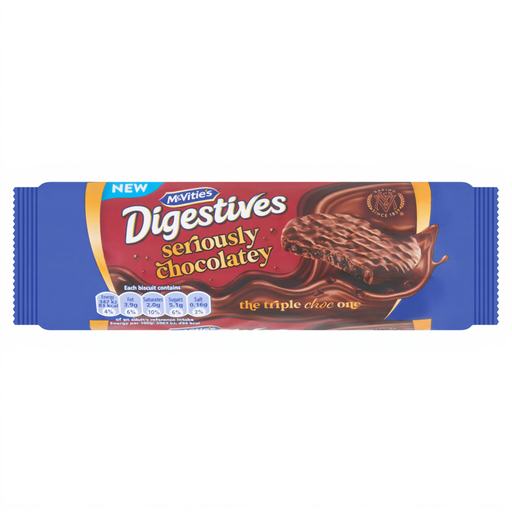 No image available
This 250g digestive variety offers another chocolate option when choosing for the group. Check the exact ingredients and allergen statement before serving.
No image available
A 400g dark-chocolate digestive pack for guests who prefer that topping. Check the physical pack’s allergen statement rather than relying on the word “dark”.
No. Tesco’s listed dark-chocolate digestives say they may contain milk. For a guest with a milk allergy, assess the ingredients and precautionary information on the exact pack.
The listed digestives are ready-to-eat biscuits. After opening a pack, follow its storage instructions.
Read the delivered pack before serving, especially when a guest has an allergy. Use its ingredient and allergen statements to assess that particular product.
Check the ingredients, including allergens, and the net quantity and date marking. UK food-labelling guidance from the Department for Environment, Food & Rural Affairs and the Food Standards Agency identifies these as prepacked-food information; a label still needs to be assessed against each guest’s requirements.