Tea-time digestive buyers
If you put biscuits out with tea, decide whether you want the familiar round digestive format and which chocolate variety you prefer.


Choose a standard chocolate digestive if you want a round biscuit to serve with tea; check the pack size, ingredients and nutrition panel when comparing varieties. If gluten avoidance is required, look for a digestive specifically labelled gluten free and check its other allergens too. Penguin and Club bars suit individually wrapped snacks, while Fox's cookies offer a different texture rather than a like-for-like digestive.
If you put biscuits out with tea, decide whether you want the familiar round digestive format and which chocolate variety you prefer.
If you keep biscuits for shared breaks, compare pack weights and per-biscuit nutrition as well as the type of biscuit inside.
If gluten avoidance matters, look for an explicit gluten-free label on the exact product. Check the full ingredients and precautionary statements for other allergens.
Start with the biscuit format for your tea break, then check the exact pack for dietary suitability, size and per-piece information.
| Priority | What to check | Your needs |
|---|---|---|
| Biscuit format | Check whether it is a chocolate-coated digestive, a cookie or an individually wrapped biscuit bar. For digestives, check the chocolate variety on the pack. | I want round chocolate digestives to put out with tea; for a lunchbox, an individually wrapped bar may fit the occasion instead. |
| Dietary suitability | Read the current ingredients, allergen declaration and any precautionary statement. If gluten avoidance is required, check for an explicit gluten-free claim; that claim does not cover other allergens. | I need to know whether this exact biscuit meets my dietary requirements before I serve or eat it. |
| Pack size | Compare the stated weight and, where given, the number of biscuits or servings. A twin pack and a single pack need not contain the same total amount. | For biscuits kept in the cupboard for shared breaks, I want a pack size that fits how I use them. |
| Per-piece nutrition | Compare sugars and saturates per biscuit or bar, noting the serving size; use per-100g figures when piece sizes differ. Tesco Groceries lists 5.4g sugars per 17g Tesco digestive, while Sainsbury's lists 4.1g per own-label digestive. | When I put biscuits out with tea, I want to understand what the label counts as one biscuit or bar. |
The standard chocolate digestives described by McVitie's, Tesco and Sainsbury's contain wheat or gluten. Sainsbury's Free From Chocolate Digestives are labelled gluten free but contain milk and soya and carry a nut-allergy warning.
Check the ingredients, allergen declaration and precautionary statements on the exact current pack, even when its front label says gluten free.
Penguin and Club are biscuit bars, while Fox's Milk Chocolate Cookies are cookie-style biscuits. They make a different choice from round chocolate digestives on a shared tea plate.
Choose by the occasion: look for digestives if that is the biscuit you want to serve, or check bar and cookie formats when portability or cookie texture matters more.
A per-bar figure and a per-biscuit figure describe different pieces. The checked Tesco digestive listing specifies a 17g biscuit, so its per-piece values should be read with that serving size.
Use the pack's per-piece panel to understand a serving, and compare per-100g figures where piece sizes differ.
Milk Chocolate Digestives are a wheatmeal biscuit covered in milk chocolate, directly matching the round digestive format for tea.
McVitie's Penguin Original is a chocolatey sandwich biscuit bar with chocolate-flavour cream, rather than a round digestive.
McVitie's Club Orange is a biscuit bar with orange-flavoured cream and a milk-chocolate-flavour coating.
Fox's Milk Chocolate Cookies are a cookie-style option with chocolate chunks, not a standard chocolate digestive.
Tesco Milk Chocolate Digestive Biscuits are an own-label version of the conventional tea-time format, half coated in milk chocolate.
Sainsbury's lists both standard Milk Chocolate Digestives and a separate Free From chocolate-digestive variety.
These McVitie's chocolate digestives cover dark-chocolate, milk-chocolate and Seriously Chocolate varieties in different pack sizes. Check the named variety if you are choosing biscuits for a particular tea plate.
 Image unavailable
A dark-chocolate digestive option for a shared tea break, supplied as two 266g packs. Choose this variant if you want dark rather than milk chocolate, and check the current pack for allergens.
 Image unavailable
A single 400g pack of dark-chocolate digestives for serving with tea. Check the variety before ordering if you intended to buy milk-chocolate digestives, and read the current allergen label.
 Image unavailable
A 400g milk-chocolate digestive pack for a conventional tea-and-biscuits plate. Check the current ingredients and allergen declaration when serving guests with dietary requirements.
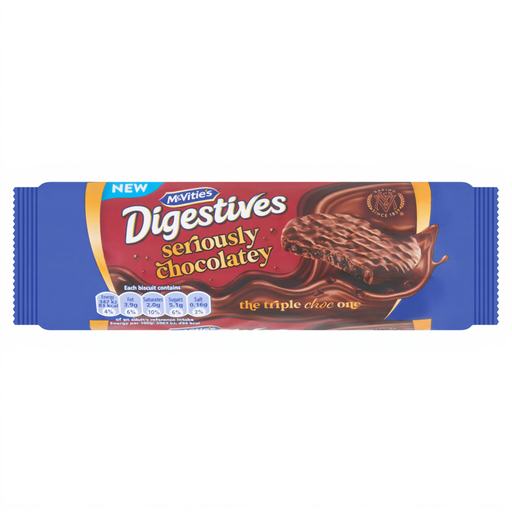 Image unavailable
A 250g Seriously Chocolate digestive variety for tea breaks. Check its current ingredients and coating description if you are comparing it with a standard milk- or dark-chocolate pack.
The checked McVitie's, Tesco and standard Sainsbury's chocolate digestives contain wheat or identify cereals containing gluten. If gluten avoidance is required, look for an explicitly gluten-free product and confirm the claim on its current pack.
No. Sainsbury's Free From Chocolate Digestives are labelled gluten free but contain milk and soya; the listing also says they are unsuitable for customers with a nut allergy because of manufacturing methods. Read the full current allergen information rather than relying on the gluten-free claim alone.
Follow the storage directions on the pack. The checked McVitie's, Tesco and Sainsbury's product information directs shoppers to keep the biscuits in a cool, dry place and use an airtight container once opened.
It flags possible unintended allergen presence, rather than an ingredient deliberately added to the recipe. The Food Standards Agency gives statements such as “may contain” as examples, so check both the ingredients list and any precautionary wording on the current biscuit pack.