What should you check before choosing?
Start with the carbohydrate contribution you need from a portion, then compare the chocolate’s other declared ingredients and practical format.
| Priority | What to check | Your needs |
|---|
| Ride intake |
For rides over 90 minutes, British Cycling advises 0.5–1 g carbohydrate per kg of body mass per hour, depending on intensity. Check the carbohydrate in the portion you plan to eat and how you will divide your food into small feeds. |
I need to know what each portion contributes to my ride plan, rather than treating one bar as an hour’s food. |
| Carbohydrate and sugars |
Compare labels per 100 g before comparing portions. The Cadbury White product listed by ASDA declares 64 g carbohydrate and 64 g sugars per 100 g; the Waitrose, Lindt and Green & Black’s 70–72% dark products examined declare 29.5–36 g carbohydrate and 24.4–29 g sugars per 100 g. |
If I want chocolate to contribute more carbohydrate, the white example has more per 100 g than these dark examples. If I prefer their cocoa profile, I still need to count their smaller carbohydrate contribution. |
| Fat |
Check fat alongside carbohydrate for the same weight or serving. The examined 70–72% dark bars declare 38.4–42 g fat per 100 g; the Cadbury White bar listed by ASDA declares 30 g per 100 g. |
I want to see what else comes with the carbohydrate in the amount of chocolate I intend to carry. |
| Allergens |
Read the exact pack’s ingredient list and precautionary wording. Lindt says its EXCELLENCE 70% is made to a vegan recipe but is not suitable for people with a milk allergy because it is made in a facility that uses milk. |
For an allergy, I cannot use “dark”, a cocoa percentage or “vegan recipe” as a shortcut for checking the pack. |
| Portion and storage |
Check the stated serving size, whether you can divide the bar before riding, and its storage instructions. The product information examined calls for chocolate to be kept cool and dry or protected from heat. |
Smaller, planned portions would be easier for me to count than eating an uncertain amount from a large bar. |
Which brand examples are relevant?
These product-line examples illustrate label differences; a brand name alone does not establish the composition or allergens of another bar.
Waitrose
The Waitrose Belgian Dark Chocolate bar examined is a 180 g, 72% cocoa example.
- Waitrose declares at least 72% cocoa solids and 29.5 g carbohydrate per 100 g for this bar.
- Its product information says it may contain milk and other nuts; check the current pack if those allergens matter to you.
Lindt
Lindt EXCELLENCE 70% is a high-cocoa dark-bar example with a vegan-recipe description.
- Lindt declares at least 70% cocoa solids and 34 g carbohydrate per 100 g for this bar.
- Lindt says it is made in a facility using milk and is not suitable for people with a milk allergy.
Green & Black’s
The organic 70% dark product examined is listed by Waitrose as a cooking chocolate bar.
- The Waitrose listing declares at least 70% cocoa solids and 36 g carbohydrate per 100 g.
- Check its pack format before choosing it for a ride, as well as its precautionary milk and tree-nut wording.
Cadbury
Cadbury provides a white-chocolate example and a separate Bournville dark bar; they should not be treated as interchangeable products.
- The Cadbury White bar listed by ASDA declares 64 g carbohydrate per 100 g.
- Cadbury describes Bournville Classic as dark chocolate, but that description alone does not establish that it matches the 70–72% cocoa examples.
Joybuy chocolate options
These options include white chocolate, high-cocoa dark bars and a white-chocolate-coated wafer snack. Compare the current pack’s portion nutrition and allergens with your ride plan; the wafer snack is not a plain chocolate bar.
 No image available
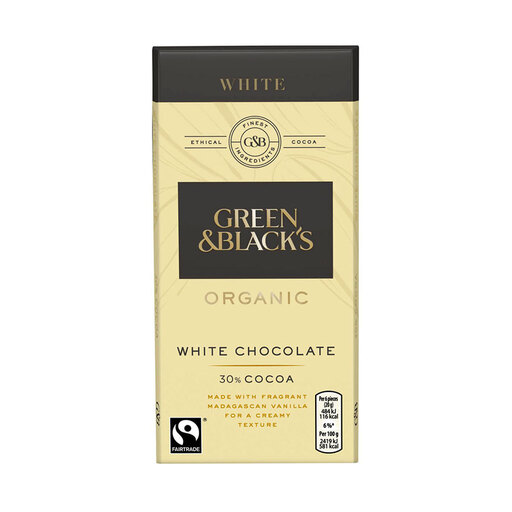
Green & Black’s White Chocolate 90g
A plain white-chocolate option if you want chocolate to contribute to a planned ride intake. Check the current pack’s carbohydrate per serving, milk and soya information, and instructions for carrying it in warm conditions.
View on Joybuy
 No image available
Green & Black’s Dark Chocolate 70% 90g
A 70% dark-bar option when cocoa content is part of your choice. Count the carbohydrate in the portion you would eat rather than using 70% as a measure of ride fuel, and check the current milk and nut warnings.
View on Joybuy
 No image available
Morrisons The Best 72% Cocoa Dominican Republic Dark Chocolate 100g
A 72% cocoa dark bar for comparing a stated cocoa level with its portion nutrition. Check carbohydrate and fat together, plus the current soya and precautionary allergen wording, before adding a portion to your ride food.
View on Joybuy
 No image available
Morrisons The Best 85% Cocoa Ecuador Dark Chocolate 100g
This 85% cocoa bar is a distinct dark-chocolate option, not one of the 70–72% examples compared above. Check its carbohydrate per portion against your ride plan rather than assuming a higher cocoa percentage provides more fuel; read the current allergen wording too.
View on Joybuy
 No image available
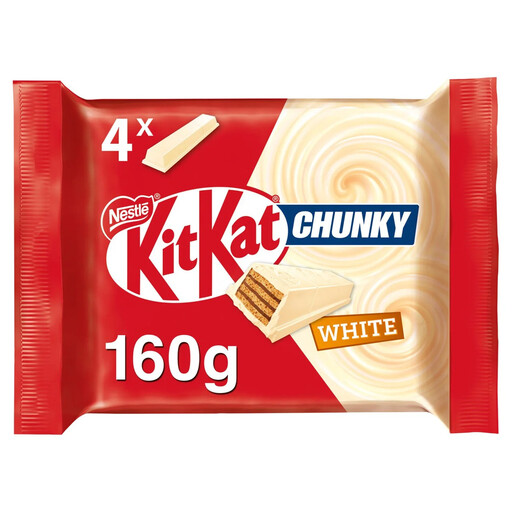
KitKat Chunky White Chocolate 4 Bars 160g
A four-bar wafer snack with a white-chocolate coating, rather than plain white chocolate. Check the current pack’s nutrition for the amount you intend to eat and its milk and wheat ingredients before using it in a ride plan.
View on Joybuy
Questions about chocolate on a ride
Can a chocolate bar be my main food for a long ride?
Do not assume one bar covers your carbohydrate plan. For rides over 90 minutes, British Cycling advises 0.5–1 g carbohydrate per kg of body mass per hour, depending on intensity, taken in small feeds. Check the carbohydrate in the amount of chocolate you would actually eat and plan the rest of your food accordingly.
Does higher cocoa content make dark chocolate a better cycling snack?
Cocoa percentage does not measure a bar’s contribution to a cycling carbohydrate plan. The Waitrose, Lindt and Green & Black’s 70–72% dark products examined declare 29.5–36 g carbohydrate per 100 g, compared with 64 g per 100 g for the Cadbury White product listed by ASDA. Compare portions as well as the per-100 g figures.
Is vegan-recipe dark chocolate suitable for a milk allergy?
Not necessarily. Lindt says its EXCELLENCE 70% bar is made to a vegan recipe but is not suitable for people with a milk allergy because it is made in a facility using milk. Read the current allergen statement on the exact pack you intend to buy.
What should I read on a chocolate pack before a ride?
Check carbohydrate for the portion you intend to eat, along with fat, the ingredient list, allergens and any precautionary wording. The stated serving size helps you compare that portion with your ride plan; storage instructions matter if you will carry the chocolate in warm conditions.
How should I carry chocolate while cycling?
Divide the amount you plan to eat before riding and protect it from heat. The product information examined calls for cool, dry storage or protection from heat, while pre-portioning makes it easier to count how much of a larger bar you have eaten.


