
24/7 全天候客户支持

免费退货

当日/次日达

品质保障

开启新人专享福利: 全场免邮 | 低至 2 折 | 免费试用 30 天 JoyPlus 会员
下载 Joybuy
Whether you are preparing a Sunday roast, baking for a school fête or serving food at a large event, disposable aluminium foil trays can reduce washing-up and simplify transport. However, buying by appearance or pack size alone can lead to unstable trays, unsuitable lids and unnecessary waste.
This guide explains the practical details to check before choosing ovenable foil trays, recyclable foil trays or larger catering formats for UK kitchens and events.
A tray may look spacious but have shallow sides that are unsuitable for sauces, layered bakes or roasting juices. Check the length, width and depth, rather than relying only on descriptions such as “large” or “family-sized”.
For example, a 45mm-deep aluminium roasting tray is more suitable for filled dishes and roasting than a shallow foil serving platter. For pies and quiches, the diameter and depth both affect how much filling the dish can hold.
“Disposable” does not automatically mean oven-safe, grill-safe or suitable for direct heat. Look for clear packaging instructions confirming whether the product is ovenable or an oven-safe aluminium tray.
Aluminium foil trays should not be placed directly on an open flame or exposed heating element. They can also be unsuitable for microwave ovens, particularly where the product instructions specifically prohibit microwave use. When moving a filled tray, place it on a solid baking sheet to improve stability.
Many foil trays are recyclable, but acceptance depends on your local council or recycling provider. Foil usually needs to be reasonably free from food residue, and mixed-material products such as trays with plastic lids may require separate disposal.
Reusable claims should also be viewed practically. A tray can often be washed and used again if it remains structurally sound, but thin foil may bend, crease or develop sharp edges after repeated handling. Choose a pack size that matches your actual usage rather than buying a large quantity that may remain unused.
For cooking or reheating, select trays specifically described as ovenable, oven-safe or suitable for freezer use where required. Check the product label for temperature limits and handling instructions.
Aluminium conducts heat efficiently and is commonly used for foil baking trays, pie dishes and catering trays. It is not, however, a replacement for cookware on a hob. Keep foil away from direct flames and heating elements, and use oven gloves when removing hot food.
Use the measurements to match the tray to the recipe and serving format:
Also consider whether the tray will fit inside your oven, fridge, freezer, storage cupboard or delivery box.
Foil trays with lids are useful when food needs to be transported, refrigerated or stacked. Allow hot food to cool sufficiently before fitting a lid, unless the packaging gives different instructions.
For occasional home use, a two- or three-pack may be more economical and easier to store. For food stalls, restaurants, community groups and event organisers, bulk foil trays or packs of 30 to 50 pieces can reduce the need for frequent reordering. Compare the cost per tray, not just the headline pack price.
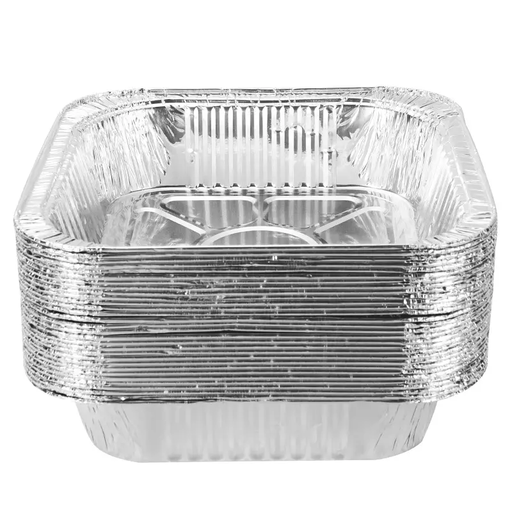
Why This Fits Their Persona: The 30-piece pack suits home bakers, party hosts and anyone who needs several disposable baking trays for brownies, lasagne, casseroles or sharing homemade food.
The stated 7-inch square format gives a clearer basis for planning than vague size descriptions. Confirm oven suitability and handling guidance on the packaging before use.
30 pans per pack; square shape supports baking, serving and giving away portions without needing to collect dishes.
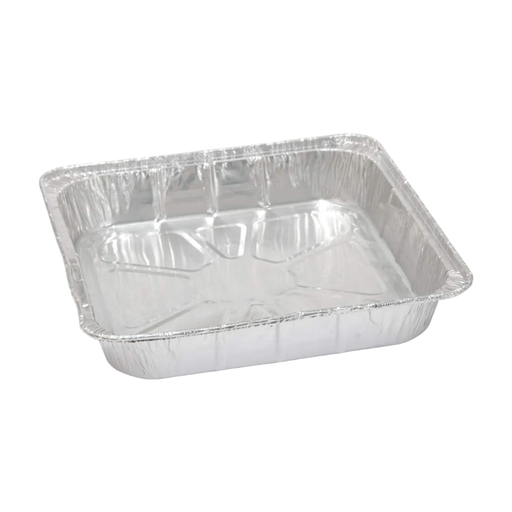
Why This Fits Their Persona: Its square 227 x 227mm format and 38mm depth provide a tidy presentation for family gatherings, buffet dishes and prepared meals.
The listed dimensions and 60oz capacity make portion planning more straightforward than relying on promotional wording alone. Use a baking sheet for support.
Ovenable and recyclable foil; two trays supplied for cooking, reheating and serving.
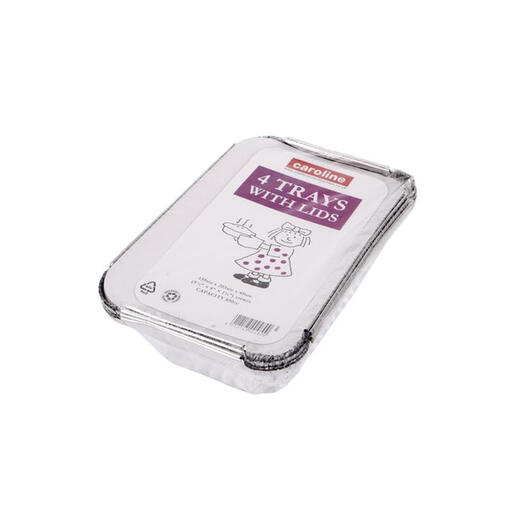
Why This Fits Their Persona: Caterers, food stalls, restaurants and meal-prep households can cook, cover, chill and transport individual portions in a consistent format.
The fitted lids address the common problem of uncovered food during delivery or storage. Cool contents before sealing and check local recycling arrangements for mixed components.
Four trays with lids; 30oz capacity and 45mm depth for meals, pasta bakes, curries and desserts.
We have compiled a complete, real-time list of products that fully satisfy these strict selection criteria and UK safety regulations.
Before using disposable food trays:
Many are designed for oven use, but not all disposable trays have the same heat rating. Choose products labelled ovenable or oven-safe, follow the packaging instructions and place the tray on a baking sheet for stability. Do not use it on an open flame or direct heating element.
Aluminium foil trays may be recyclable through local schemes when they are empty and sufficiently clean. Collection rules differ between councils. Check your local guidance, particularly when the tray is supplied with a plastic lid or contains heavy food residue.
A sturdy tray may be washed and reused if it remains clean, stable and free from sharp edges or deep creases. Thin disposable trays are generally more suitable for limited use, while catering platters and thicker formats may tolerate careful reuse. Always inspect the tray before cooking or serving.