Detail-focused ballet viewers
If facial expressions, costumes and the set matter across a large image, you may prioritise resolution and colour features while making time to control the room lighting.


Choose the projector around the viewing room before choosing a headline specification. Consider 4K capability if fine costume and stage detail matter, but match brightness to the light you cannot control and check that the model can produce your intended image width from its available position. A short-throw or ultra-short-throw model may help where seating or room depth prevents conventional placement, but it still needs a model-specific fit check.
If facial expressions, costumes and the set matter across a large image, you may prioritise resolution and colour features while making time to control the room lighting.
If windows or household lights will remain on while friends or family watch, you need to assess the projector's stated brightness against that viewing environment.
If seating, walkways or room depth limit where a projector can stand, the distance needed to produce your intended image width may determine which models you can use.
Decide how much you can darken the room, then measure the available projector-to-screen distance and intended image width. Those decisions give the picture and sound specifications a practical context for a group ballet screening.
| Concern | What to check | Who this matters to |
|---|---|---|
| Stage detail and colour | Check displayed resolution and whether the recording and playback equipment can use any advertised 4K or HDR capability. Consider how much you can darken the room. | If I want to follow facial expressions and costume detail on a large image, those details come before setup convenience; around 33% of consumers put image detail and colour first. |
| Ambient light | Compare stated light output using its measurement label, alongside the planned image size and whether lights or curtains can be adjusted. | When the group watches in a partly lit living room, I need to judge the picture under those conditions rather than assume the room will be dark. Roughly 42% of consumers prioritise viewing with ambient light. |
| Room fit and group setup | Check the model's throw distance at your intended image width, plus connections for the recording source and a suitable audio arrangement. | If seating leaves little space for a projector, I need the image to fit without obstructing the group, and everyone needs to hear the recording. Around 25% of consumers put room fit and practical setup first. |
ProjectorCentral explains that image size and throw distance are linked by the lens optics. A model cannot produce every screen width from every position, even if its other specifications suit your viewing plans.
Measure the usable lens-to-screen distance, choose a provisional image width and check the exact model's projection calculator or manual before ordering.
A mismatch may require a different mounting position or screen position.
Epson United Kingdom distinguishes projector brightness guidance by viewing environment. A quoted output figure alone does not account for your room light or planned image size.
Decide whether the ballet screening will take place in a dark, partly lit or bright room, then compare model ratings stated on a comparable basis.
Which? reports differences in projector sound quality, while a speaker specification by itself cannot tell you how audio will carry through your particular room.
Check how the recording source connects and whether the projector can feed the audio setup you plan to use for the group.
External speakers, a soundbar, cables or adapters may be needed for that setup.
These brands have relevant projector ranges; compare individual models against your room and recording source rather than treating a brand name as a room-fit guarantee.
Its UK home-entertainment range includes models with different resolutions, brightness ratings and placement approaches.
Its UK range includes standard-throw and short-throw options relevant to different room layouts.
Its UK home-entertainment selection includes standard-, short- and ultra-short-throw categories.
These projectors and the projector-and-case bundle offer starting points for a group ballet setup. Assess each against your room light, intended image width, recording source and audio arrangement.
 No image available
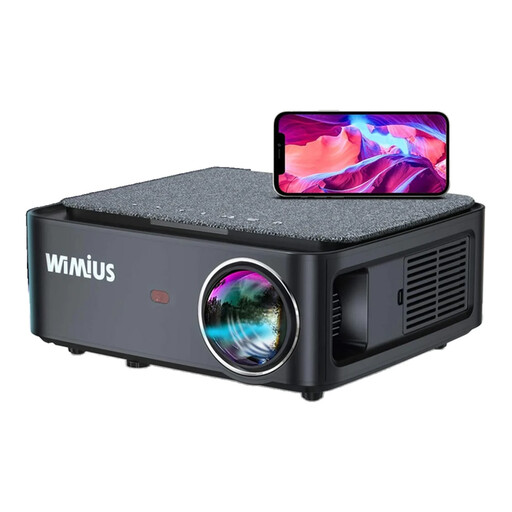
Consider it if you plan to play a ballet recording from an external device and can check its placement against your screen. The listing names HDMI and USB connections, Full HD 1080P, 4K input support, a 1,200 ANSI-lumen rating and dual stereo audio; 4K support does not make this a native 4K projector. Check whether the stated output and onboard sound suit your room and audience.
 No image available
Consider this model if a flexible position matters, then check the required distance for your chosen image width. Its title states native 1080P, 8K input support, 900 ANSI lumens, Android 14 and a rotating design. Input support does not mean the projected image has 8K resolution; confirm that your recording source works with the connections or apps you intend to use.
 No image available
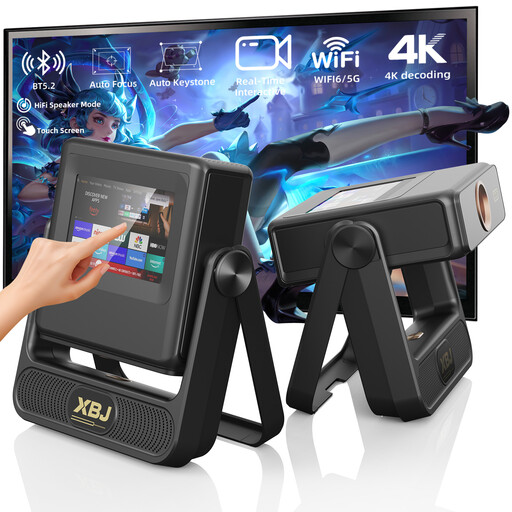
Consider it for a setup where automatic focus and keystone adjustment would be useful, provided its placement fits the room. The listing names native 1080P, 4K input support and a 900 ANSI-lumen rating. Check the required throw distance and your group-audio arrangement separately; 4K input support is not native 4K projection.
 No image available
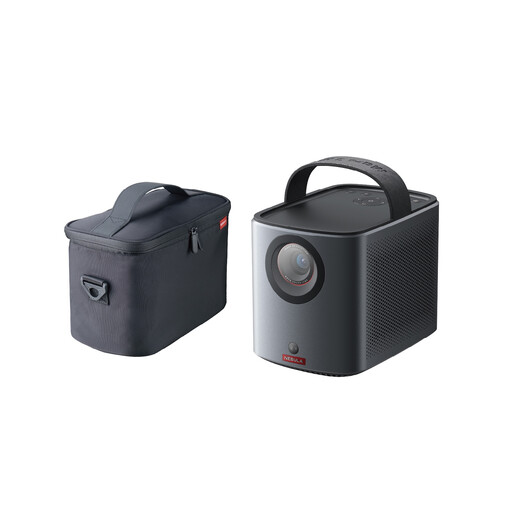
The carry-case bundle may suit a host who needs to transport the projector between viewing locations. Before planning a group screening around it, check the image size at each location, the recording-source connection, the audio arrangement and how the projector will be powered for the full session.
 No image available
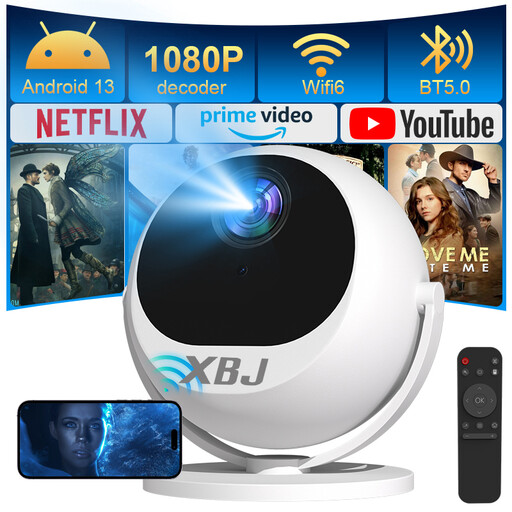
Consider its rotating design if the available projection position is awkward, but confirm that it can produce your intended image width there. The title states Full HD 1080P, 360° rotation, a 500-lumen rating and HDMI connectivity. Check brightness for the actual room light and whether the audio setup will reach every seat.
Measure the available lens-to-screen distance and decide on an image width, then check the exact model's projection calculator or manual. ProjectorCentral explains that distance and image width depend on the lens optics, so a screen-size claim alone cannot establish room fit.
Not necessarily: lower room light gives you more freedom to consider image attributes other than brightness. Epson United Kingdom places 1,500–2,500 lumens in its dedicated dark-home-theatre guidance, 2,500–3,500 lumens for living rooms with some ambient light and 3,500 lumens or more for bright rooms; also consider your intended image size and the model's stated measurement label.
It may be, but check the specific projector and where people will sit rather than relying on its speaker rating alone. Epson United Kingdom lists a 16W mono speaker for the EB-FH18, while Which? reports differences in sound quality between projectors; plan how to connect external audio if the recording needs to be heard clearly throughout your room.
Ask the seller for clear product and manufacturer or importer information applicable to supply in Great Britain. GOV.UK's Office for Product Safety and Standards identifies the Electrical Equipment (Safety) Regulations 2016 as relevant to electrical equipment in Great Britain and, in guidance dated 25 March 2025, says recognition of certain goods meeting EU requirements, including CE marking, has been extended indefinitely. Check which requirements apply to the particular product rather than assuming that one marking settles every compliance question; Northern Ireland has separate guidance.