Gluten-free snack shoppers
If you need a portable bar for a gluten-free diet, look for a specific gluten-free claim. An oat or rice base alone does not establish gluten-free status; other declared allergens still need checking.


Choose a mid-morning bar by the exact allergen or dietary requirement you need to avoid, rather than treating “free-from”, gluten-free and vegan as interchangeable. Check the current pack’s ingredients, allergen declaration and any “may contain” statement before comparing portion size and nutrition per bar. A gluten-free protein bar containing peanuts, for example, is not a peanut-free choice.
If you need a portable bar for a gluten-free diet, look for a specific gluten-free claim. An oat or rice base alone does not establish gluten-free status; other declared allergens still need checking.
If you avoid peanuts, tree nuts, milk, soya or wheat, match any free-from claim to that particular allergen. Read the ingredients and precautionary wording on the current pack as well.
If you want a plant-based or protein-focused mid-morning bar, check that its ingredients suit you first. Then compare protein, fibre, sugars and energy using the portion you would actually eat.
Start with the restriction that determines whether you can choose the bar at all; compare nutrition and portion sizes only among suitable options.
| Priority | What to check | Your needs |
|---|---|---|
| Named allergens | Match a free-from claim to the allergen you avoid. Read the current ingredients and allergen declaration; the Food Standards Agency says a free-from claim concerns the specified allergen, not every allergen. | I need a bar that excludes my particular allergen, not one that merely looks suitable because it is vegan or gluten-free. |
| Gluten-free status | Look for an explicit gluten-free claim rather than judging by oats or rice in the product name. The Food Standards Agency defines gluten-free as no more than 20 mg/kg of gluten in the food as sold. | For a gluten-free mid-morning snack, I need to know the bar’s stated gluten-free status and whether its other ingredients suit me. |
| “May contain” wording | Check precautionary statements separately from ingredients. GOV.UK explains that accidental allergen cross-contamination can introduce traces into a product. | An allergen might be absent from the ingredient list but still appear in a warning I need to consider. |
| Portion and nutrition | Compare the serving size and the stated energy, sugars, protein and fibre per bar. Check whether a multipack contains one bar or more than one portion per wrapper. | I want to compare what I would eat mid-morning, rather than assume a protein or natural-sounding label tells me the bar’s sugar or energy content. |
A claim about gluten or animal-derived ingredients does not establish whether a bar contains peanuts, soya or another allergen you avoid.
Identify the named allergen first, then read the current pack’s ingredients, highlighted allergens and precautionary statement.
Kellogg’s lists barley malt extract and wheat gluten in its Rice Krispies Cereal & Milk Bar. Nature Valley says its Crunchy Oats & Honey bars contain oat gluten.
Choose by an explicit gluten-free claim, not by the cereal named on the front of the pack.
Eat Natural lists peanuts and almonds in its Peanuts, Almonds & Cocoa Protein Bar. Nature Valley’s Protein Peanut & Chocolate bar contains peanuts; its allergen statement also warrants checking for other nuts.
If you avoid a particular nut, look for a claim addressing that nut and check the full declaration before choosing a bar.
“Protein” and other front-of-pack descriptions do not tell you the sugars or energy in the portion you plan to eat. Action on Salt & Sugar’s November 2025 UK snack-bar review found that 37% of the bars it assessed were high in sugars under UK front-of-pack labelling thresholds; that figure describes the reviewed products, not any individual bar.
Compare sugars, energy, protein and fibre per actual bar, alongside its portion size and allergen information.
These examples show why the exact product matters: a claim or ingredient list for one bar does not apply to everything made by its brand.
TREK describes its Original Oat flapjack as gluten-free and vegan, with 10g plant protein per 50g bar.
Its Protein Peanut & Chocolate and Crunchy Oats & Honey bars illustrate why claims must be checked by product line.
Its Peanuts, Almonds & Cocoa Protein Bar is a gluten-free example with prominently declared nut ingredients.
Alpen Light Chocolate & Fudge is an example of a smaller cereal-bar portion, at 19g per bar.
The Rice Krispies Cereal & Milk Bar shows why a rice-based name is not enough to judge allergen suitability.
Graze positions its Oat Boost flapjacks around wholegrain oats and fibre.
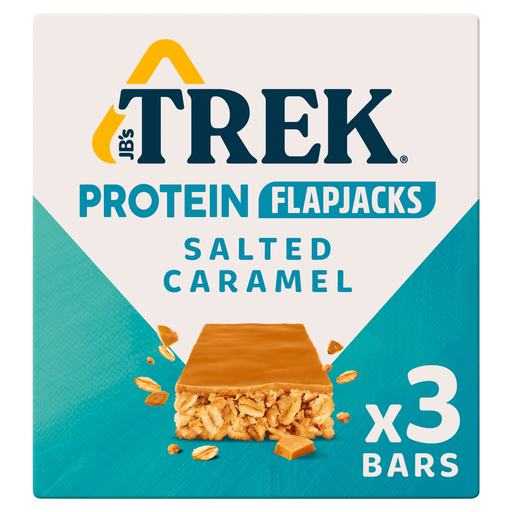
These options cover a peanut-and-chocolate protein bar and a salted-caramel flapjack for a mid-morning snack. Check each pack against your own free-from requirement; information about TREK Original Oat does not establish the ingredients of the Salted Caramel variant.
 No image available
A protein-bar option to consider if the current pack’s gluten-free claim and allergen declaration meet your needs. Nature Valley lists around 10g protein per 40g Protein Peanut & Chocolate bar; this product contains peanuts, soya and milk, and its tree-nut precautionary wording needs checking.
 No image available
A flapjack option if you prefer this format for a mid-morning snack. Check the Salted Caramel pack for its own gluten-free and vegan claims, ingredients and “may contain” wording, particularly if you avoid soya, milk, peanuts or nuts.
No. The Food Standards Agency says a free-from claim applies to the specified allergen. Match that claim to the allergen you avoid, then read the current pack for other ingredients and precautionary statements.
The Food Standards Agency defines gluten-free as no more than 20 mg/kg of gluten in the food as sold. That claim does not establish that the bar is free from peanuts, milk, soya or other allergens.
No. The warning concerns possible accidental cross-contamination rather than an intentionally added ingredient, as explained in GOV.UK’s precautionary allergen labelling guidance. Consider the named allergen when deciding whether the bar meets your requirements.
No. Look for a specific gluten-free claim on the product you are buying. Nature Valley says its Crunchy Oats & Honey bars contain oat gluten, while its Protein Peanut & Chocolate bars are presented as gluten-free; their other allergens still differ from the gluten question.
Check allergen suitability first, then compare the portion you would eat and its stated energy, sugars, protein and fibre. Use per-bar figures where available so that different bar sizes do not obscure what is in your snack.