
24/7 Customer Support

Free returns

Same-day & Next-day Delivery

Quality Guaranteed

Unlock Your Welcome Offers: FREE Delivery | Up to 80% OFF | Free 30-day JoyPlus trial
Download the APP
Buying a freezer can look straightforward until capacity, installation type, ventilation and running costs start competing for attention. A compact appliance may fit beneath a worktop but lack useful storage, while a large chest freezer can offer generous capacity yet become difficult to organise.
The most suitable choice depends on where the freezer will sit, how much food you store and whether you prioritise easy access, low maintenance or flexible capacity. This guide explains the main buying pitfalls and highlights practical options for UK households.
A freezer’s width and height do not tell the whole story. Thick insulation, compressor space and internal shelves can reduce usable storage. Always compare the net capacity in litres, rather than relying on a product description that only says “large” or “family-sized”.
For reference, 85–99-litre models can suit smaller households or provide secondary storage. A freezer around 197–212 litres is more appropriate for families, meal preppers and regular bulk buyers. Larger chest freezers, such as 249–299 litres, require considerable floor space but can accommodate bulky items more easily.
Frost-free, No Frost and Total No Frost generally refer to systems that circulate cold, dry air to reduce or prevent ice accumulation. However, buyers should still check the stated defrost system in the technical specification.
A manual-defrost freezer may cost less initially, but ice build-up can reduce available space and requires periodic emptying and cleaning. For people who want lower maintenance, frost-free freezers are usually more convenient. Do not assume that every integrated or under-counter model includes No Frost: some compact units, including selected 85–86-litre models, use manual defrost.
An integrated freezer is not simply a freestanding appliance placed behind a cupboard door. It needs a suitable housing unit, compatible door fixing system and adequate ventilation. Fixed-hinge and sliding-hinge designs attach to furniture doors differently, so check the kitchen manufacturer’s specifications before ordering.
For under-counter freezers, measure the niche height, width and depth, not just the appliance dimensions. Freestanding chest and upright freezers also need clearance around ventilation areas. A freezer placed in a garage or outbuilding must be specifically described as garage-safe or suitable for the expected ambient temperature.
Capacity should match your shopping habits. Upright freezers provide shelves, drawers or compartments that make individual items easier to find. Chest freezers offer a large open cavity, which is useful for bulky meat, batch-cooked meals and seasonal produce, but smaller items can become buried.
Consider the internal layout as carefully as the litre figure:
If you are specifically comparing 199-litre freezers or 200-litre freezers, check whether the capacity is offered in an upright or chest format. The same approximate volume can have a very different footprint and storage experience.
UK freezer energy labels use the A to G scale, with A representing the highest efficiency class. Many current models in this selection carry an E rating, but the rating alone does not determine the exact annual cost.
To estimate running cost, multiply the appliance’s annual electricity consumption in kWh by your electricity tariff. A larger freezer may use more electricity overall even if it has an efficient compressor. Look for the energy label and technical sheet rather than relying on phrases such as “energy-saving” or “low cost to run”.
Noise levels are stated in decibels, such as 35 dB, 37 dB or 39 dB. A lower number generally indicates quieter operation, which may matter in an open-plan kitchen, flat or utility room beside living areas.
Check how far the door or lid opens and whether it will hit a wall, cabinet or worktop. Reversible doors can help with awkward layouts, but hinge reversal may need to be completed during installation.
For garages, cold weather suitability is essential. The Midea chest freezer options listed below specify operation in ambient temperatures down to -18°C, while the Hisense model specifies Winter Guard operation down to -15°C. These figures should be checked against the actual conditions in your outbuilding.

Why This Fits Their Persona: Its 85-litre capacity and 55 cm width suit smaller kitchens, flats and utility rooms where floor space is limited.
The specification clearly states manual defrost, so buyers can plan for maintenance rather than assuming it is a No Frost freezer.
4-star freezing rating, reversible door, adjustable shelves and a stated 39 dB noise level.
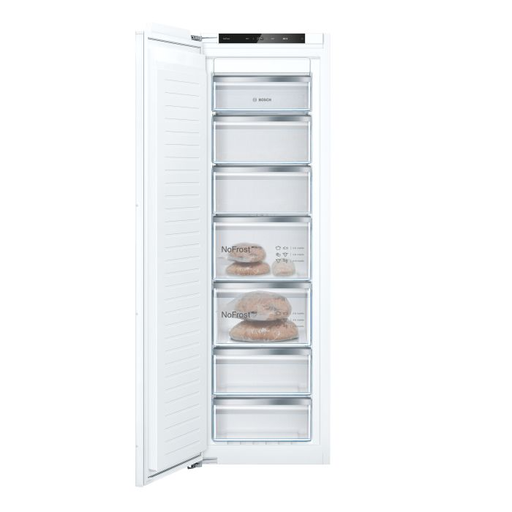
Why This Fits Their Persona: This 212-litre integrated freezer is designed for homeowners planning a fitted kitchen with concealed, tall storage.
The required niche dimensions and fixed-hinge design are specified, helping buyers check cabinetry compatibility before purchase.
NoFrost technology, two BigBox drawers, VarioZone storage and a stated 35 dBA noise level.
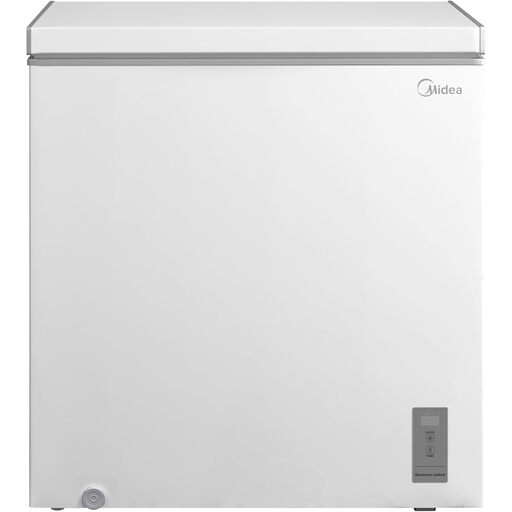
Why This Fits Their Persona: Its 198-litre chest format suits bulk buyers, families and households needing flexible storage in a garage or utility room.
It specifies garage-safe operation down to -18°C, rather than leaving cold-outbuilding suitability unclear.
Convertible fridge/freezer operation, fast freeze, counter-balanced lid and 37 dB noise level.
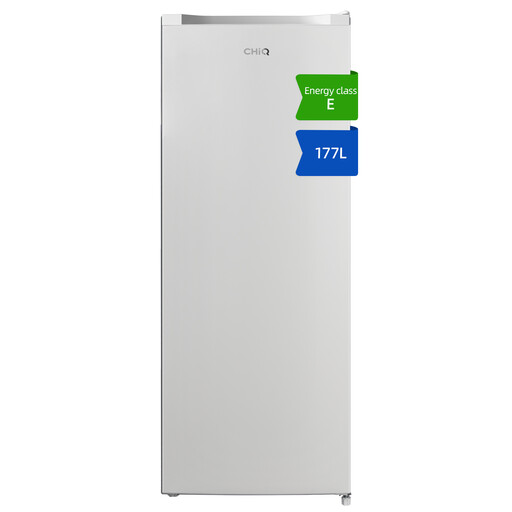
Why This Fits Their Persona: Six transparent drawers provide a straightforward way to separate batch-cooked meals, vegetables, meat and everyday frozen food.
Its 54.5 cm width and 55 cm depth are stated clearly, helping buyers assess narrow kitchen and utility-room spaces.
144 cm height, six transparent drawers, reversible door and E energy rating.
We have compiled a complete, real-time list of products that fully satisfy these strict selection criteria and UK safety regulations.
A freezer may provide many years of service when it is correctly installed, ventilated and maintained. Lifespan varies by model, usage and environment. Keep the door seal clean, avoid blocking ventilation areas and defrost manual models when ice becomes substantial. Always follow the manufacturer’s instructions for transport, settling time and installation.
Only if the product specification confirms that it is suitable for the expected ambient temperature. Standard freezers may not operate correctly in an unheated garage during cold UK winters. Garage-safe models with a stated low-temperature operating range are more appropriate, but they still need a level surface, ventilation and protection from moisture.
They can be useful for households that want to avoid manual defrosting and maintain accessible storage. However, they may cost more than manual-defrost models and can have different capacity, noise and energy specifications. Compare the full product details, including net litres, energy label, decibel rating and installation dimensions, before deciding.