
24/7 Customer Support

Free returns

Same-day & Next-day Delivery

Quality Guaranteed

Unlock Your Welcome Offers: FREE Delivery | Up to 80% OFF | Free 30-day JoyPlus trial
Download the APP
A fridge freezer is a major household purchase, but the most attractive specification can be misleading if it does not suit your kitchen or shopping habits. A narrow appliance may save floor space yet provide too little usable storage, while a large 50/50 fridge freezer may leave limited room for fresh food.
The right choice depends on available dimensions, usable capacity, defrost technology, noise, energy rating and installation type. This guide explains the key details to check before buying and highlights suitable options for different UK households.
A listed width of 50cm, 54cm or 55cm does not mean the appliance can be placed tightly against every wall or cabinet. You also need to check:
A 50cm fridge freezer can suit a galley kitchen or utility room, but its internal capacity is usually lower than a standard 60cm model. Always compare the dimensions with the manufacturer’s installation guidance.
A Total No Frost fridge freezer is designed to circulate cold air and reduce or prevent frost formation in the fridge and freezer compartments. A low frost fridge freezer, by contrast, reduces ice build-up but may still require occasional manual defrosting.
Terms such as “frost-free”, “NoFrost”, “NanoFrost” and “Low Frost” can describe different systems. Check the full specification rather than assuming that every model eliminates maintenance.
UK appliances use the current A-to-G energy label, where A is the higher efficiency class and G is the lower class. Many models in this guide are rated E, but actual running costs depend on usage, room temperature, installation, door opening frequency and the appliance’s annual energy consumption in kWh.
For a meaningful comparison, check the energy label and compare annual kWh consumption, not just the letter rating. An energy-efficient fridge freezer that is too small may also encourage more frequent shopping or overfilling, which can affect convenience and performance.
A freestanding fridge freezer is finished externally and can be positioned wherever there is a suitable power supply and adequate ventilation. It is generally simpler to replace or move between properties.
An integrated fridge freezer sits inside a tall kitchen housing behind a furniture door. It creates a consistent fitted-kitchen appearance, but compatibility is essential. Check:
Integrated models commonly measure around 177cm high and 54cm wide, but cabinet dimensions can vary.
Net capacity is more useful than external dimensions alone. For example, a 255-litre model may offer approximately 171 litres of fridge space and 84 litres of freezer space.
A 50/50 fridge freezer divides storage broadly equally between fresh and frozen food. It suits households that batch-cook, buy frozen items in larger quantities or prefer a substantial freezer. If your household mainly buys fresh food, a 60/40-style layout may provide more practical fridge capacity.
As a general guide:
Noise is particularly important in an open-plan kitchen or studio flat. Look for the listed decibel figure and compare models on the same basis. The Bosch KGN27NLEAG, for example, is specified at 41dB, while the integrated Bosch KIN85NSE0G is listed at 39dB.
Adjustable glass shelves, transparent freezer drawers, LED lighting and a dedicated crisper can make everyday use easier. Reversible doors are also useful in narrow kitchens, particularly where the hinge side is restricted by a wall.
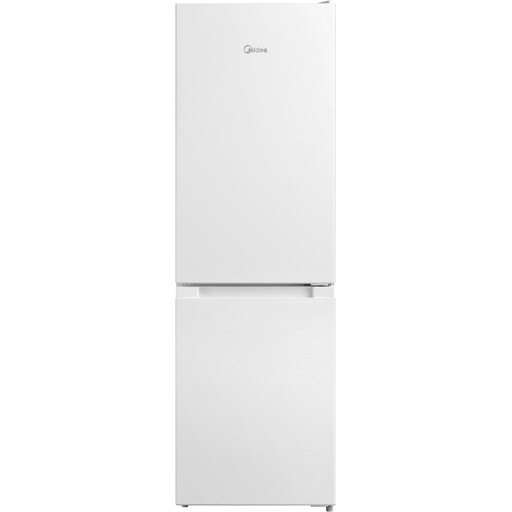
Why This Fits Their Persona: Its 50cm width suits renters, first homes, compact flats and utility rooms where a standard appliance will not fit.
The specification clearly states 173 litres, including a 121-litre fridge and 52-litre freezer, helping buyers judge its real storage limits.
50cm width, reversible door, LED lighting, transparent freezer drawers and E energy class.
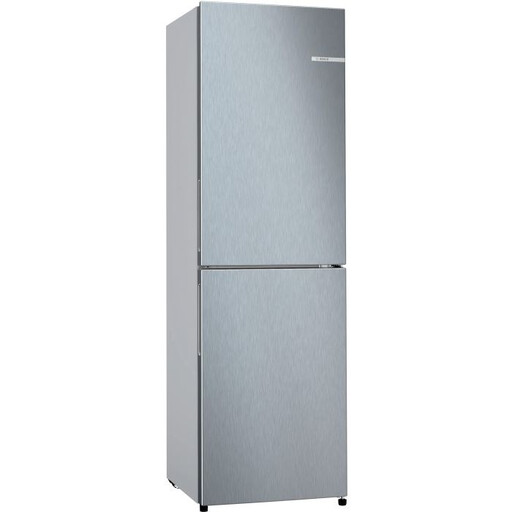
Why This Fits Their Persona: It offers a slimline footprint with 255 litres of stated capacity, making it suitable for households wanting more storage without moving to a 60cm appliance.
Its Total No Frost specification is distinct from low frost systems, while the 41dB rating gives a clearer basis for judging kitchen noise.
55cm width, 171-litre fridge, 84-litre freezer, MultiBox drawer, LED lighting and reversible door.
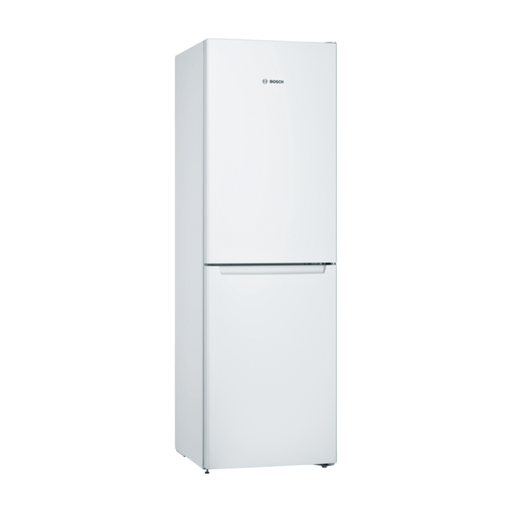
Why This Fits Their Persona: Its 300-litre capacity and 50/50 arrangement suit families who regularly batch-cook, freeze ingredients or buy larger weekly shops.
The 60cm width and 300-litre total capacity are stated clearly, reducing the risk of choosing a compact model that cannot handle heavy use.
50/50 split, Total NoFrost, SuperFreezing function, MultiBox drawer and three transparent freezer drawers.

Why This Fits Their Persona: This built-in 50/50 model is designed for a seamless fitted kitchen and offers 249 litres of stated net capacity.
The fixed-hinge system and 177.2cm × 54.1cm dimensions are specified, so cabinet compatibility can be checked before ordering.
NoFrost cooling, 39dB noise level, 150-litre fridge, 99-litre freezer and four transparent freezer drawers.
We have compiled a complete, real-time list of products that fully satisfy these strict selection criteria and UK safety regulations.
Lifespan varies with build quality, installation, usage and maintenance. Keeping condenser areas and ventilation clear, avoiding overfilling and checking door seals can support reliable operation. The warranty provides a clearer indication of the manufacturer’s support period, but it is not a guaranteed lifespan.
A frost-free or Total No Frost fridge freezer can reduce the need for manual defrosting and help freezer drawers remain easier to open. It may be worthwhile for busy households, although a low frost model can be a suitable alternative if occasional defrosting is acceptable and the purchase price is a priority.
Running cost depends on the appliance’s annual kWh figure and your electricity tariff. Multiply the stated annual consumption by your tariff per kWh for an estimate. Installation conditions, room temperature and how often the doors are opened can also influence real-world consumption.