For several friends, a centrifugal juicer is a sensible speed-first choice if its feed chute, pulp container and cleaning arrangements suit the ingredients you plan to use. Consider a slow juicer if leafy greens or a quieter early-morning routine matter more, but check the noise and feeding requirements of the exact model. A self-feeding model may suit frequent hosts who have room to store it.
Who each approach suits
Fast multi-glass breakfast hosts
If you want to serve several friends without repeatedly stopping to chop produce or empty pulp, look closely at chute width, pulp capacity and clean-up. Those features are specified for the cited nutribullet centrifugal models, but preparation instructions still apply.
Quiet green-juice hosts
If leafy greens or a less disruptive early morning matter more than serving speed, consider a slow-press model. Check the noise claim on the exact machine: Ninja describes its JC151UK motor as quiet, which does not establish the noise level of other slow juicers.
Occasional compact-kitchen hosts
If you make juice for guests only occasionally, check where the assembled machine will sit and where its parts will dry and be stored. A large self-feeding hopper is useful only if that feeding routine earns its space in your kitchen.
What matters when choosing
Centrifugal juicer
Choose when: Serving several drinks promptly is your main concern.
Trade-off: A speed-focused routine may be less appealing if leafy greens or lower-noise use is your priority.
Hand-fed slow juicer
Choose when: You regularly juice leafy greens or want to assess a quieter model for early mornings.
Trade-off: Pressing and feeding produce can take longer; chute size and noise vary by model.
Self-feeding slow juicer
Choose when: You host often enough to value loading prepared produce into a hopper rather than feeding it continuously.
Trade-off: Check whether the assembled appliance fits your worktop and storage space.
| Concern | What to check | Who this matters to |
|---|
| Serving without interruptions |
Feed-chute width and pulp-container capacity; follow the model’s produce-preparation instructions. |
If several friends are waiting, I want to make their drinks without repeatedly stopping to chop produce or empty pulp. Around 36% of consumers put serving flow first. |
| Cleaning after breakfast |
Which removable parts are dishwasher-safe and how the sieve or filter is cleaned. |
Once breakfast is over, I want the juicer dismantled and cleaned without a lengthy chore. Clean-up is the primary concern for around 29% of consumers. |
| Greens and early-morning use |
Suitability for your usual ingredients and any noise claim for the exact model. |
If I regularly use leafy greens or make juice while others are still asleep, I can accept a slower routine for a model that meets those needs. Around 21% of consumers prioritise this combination. |
| Space for occasional use |
Assembled dimensions, weight and where the parts will be stored. |
When friends visit only occasionally, I need a juicer I can realistically keep and put away. Space and occasional-use fit come first for around 14% of consumers. |
Buying pitfalls
-
Choosing slow press for the label alone
A slow-press mechanism may suit your preferred ingredients, but it can also mean more feeding time or chopping. The extraction method does not establish how easy a particular machine is to clean.
Decide whether your ingredients and morning routine justify that trade-off; otherwise compare chute, pulp-container and cleaning details on the models you are considering.
-
Treating container capacity as a portion size
Juice-jug and pulp-container capacities describe different parts of the serving workflow, not how much each guest should drink. NHS guidance advises limiting fruit juice and smoothies to one small 150ml glass a day, taken with a meal.
Plan individual servings separately from the machine’s capacity, and offer other breakfast drinks too.
-
Assuming a wide chute eliminates preparation
A wider opening may reduce cutting, but the ingredients still have to fit and follow the machine’s instructions for items such as stones, peels and seeds.
Check the exact model’s preparation instructions rather than forcing produce into its feed chute.
-
Confusing two versions of a juicer
Joybuy’s nutribullet Juicer 800W listing describes a 1.5L pulp basin, while its separate Juicer Pro 1000W listing names a 2L basin. Details for one version should not be carried over to the other.
Check the complete model name, supplied accessories and current availability on the product page before choosing.
Brands to consider
Philips
Philips lists the centrifugal HR1855/01 with an 800W motor, an XL tube and capacity for up to 2L of juice in one go.
- The stated batch capacity is relevant when preparing several drinks.
- Its centrifugal format is not, by itself, a reason to choose it for leafy greens or lower-noise use.
Ninja
Ninja positions its JC151UK cold-press model for quieter use and says specified removable parts, including the juice jug and pulp container, can go in the dishwasher.
- Those model-specific features may matter for an early breakfast and subsequent cleaning.
- Check its feeding and container capacities before relying on it for consecutive guest servings.
nutribullet
nutribullet’s centrifugal Juicer Pro 1000W lists a 3-inch feed chute, 2L pulp basin and three speeds.
- The stated chute and pulp basin address two potential interruptions during multi-glass preparation.
- Check the exact version: the separate Juicer 800W listing specifies a smaller 1.5L pulp basin.
Kuvings
Kuvings describes the AUTO10S as a self-feeding slow juicer with a 3,000ml hopper for pre-loading ingredients.
- Pre-loading may suit hosts who prefer not to feed produce continuously.
- Its listed 7.5kg weight and 459mm height make storage and worktop clearance important checks.
Juicers to consider on Joybuy
These choices cover a centrifugal model for serving several drinks and a hand-fed slow-press alternative for breakfasts featuring leafy greens. Compare the container and preparation details against your own serving routine.
 No image available
nutribullet Juicer 800W, 1.5L pulp basin
Consider this centrifugal model if you want to prepare several drinks without frequent pulp-emptying stops.
Its listing names a 3-inch feed chute and dishwasher-safe parts. Follow its produce-preparation instructions, and confirm the supplied voltage, plug and applicable electrical documentation for where you will use it.
View on Joybuy
 No image available
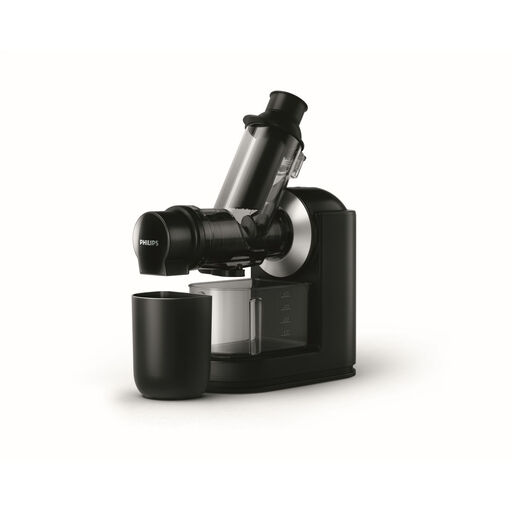
Philips Viva Collection Masticating Juicer HR1889/71
Consider this slow-press model if the ingredients you want to juice make that approach more important than a speed-first serving routine.
Allow for the feeding pace of a masticating juicer. Confirm the supplied plug and applicable electrical documentation before buying.
View on Joybuy
Frequently asked questions
How much juice should I plan for each guest?
Use the juicer’s capacity to plan the preparation workflow, not an individual portion. NHS guidance advises limiting fruit juice and smoothies to one small 150ml glass a day and having it with a meal because they are high in sugar; offer water or other drinks alongside breakfast.
Should I wash produce and clean the juicer after serving?
Yes: wash fruit and vegetables and clean the equipment used to prepare them. Food Standards Agency guidance for food businesses also covers handwashing and cleaning work surfaces and equipment; check the juicer’s instructions for cleaning its removable parts.
What electrical details should I check before buying a juicer?
Check the voltage and plug of the version supplied, along with its applicable product documentation and markings. GOV.UK’s Office for Product Safety and Standards provides Great Britain electrical-equipment guidance separately from Northern Ireland guidance, so check the requirements relevant to where you will use the juicer.


