
24/7 Customer Support

Free returns

Same-day & Next-day Delivery

Quality Guaranteed

Unlock Your Welcome Offers: FREE Delivery | Up to 80% OFF | Free 30-day JoyPlus trial
Download the APP
A Ciarra 60cm cooker hood can be a practical fit for a standard UK hob, compact kitchen or low-cabinet installation. However, choosing by appearance or headline airflow figures alone can lead to installation problems, extra filter costs and disappointing everyday performance.
Before buying, check how the hood will be installed, how grease is captured and whether its controls and dimensions suit your cooking routine. The following guide compares the important details and highlights suitable options for different household needs.
A nominal width of 60cm does not tell you the full installation story. A hood may be 596mm or 600mm wide but have very different depths and heights. Cabinet clearance, wall brackets, duct connections and the position of the hob all need checking before ordering.
A slimline cooker hood for cabinet mounting may suit a low cupboard, while a wall-mounted cooker hood requires sufficient clear wall space above the cooking zone. Always compare the product dimensions with your available opening rather than relying on the category name.
Maximum airflow is normally measured at the highest speed, which may also produce more sound. For example, the Ciarra slimline models list airflow from 138m³/h to 184m³/h, with maximum noise listed at 61dB. The wall-mounted 60cm versions list up to 367m³/h and 63dB.
These figures are useful for comparison, but your choice should also reflect kitchen size, cooking habits and whether the hood is ducted. A more powerful wall-mounted extractor may be unnecessary for light cooking, while a frequent stir-fryer may prefer the higher listed airflow.
A ducted and recirculating cooker hood offers installation flexibility, but the two modes work differently. Ducting sends filtered air outside through a suitable route. Recirculation returns air to the room after passing it through grease and carbon filters.
Washable grease filters can be cleaned rather than routinely replaced, but carbon filters used in recirculation generally require replacement according to the manufacturer’s guidance. Check whether the required carbon filter is included, sold separately or identified by a specific model code.
A 60cm kitchen extractor fan is commonly selected for a standard 60cm cooking area, but the hood should cover the hob appropriately and be installed at the clearance specified in its instructions. The Ciarra slimline models measure 596mm wide, 440mm deep and 85mm high, making them suitable for some low-cabinet layouts.
The wall-mounted models measure 600mm wide, 432mm deep and 572–950mm high, with an adjustable chimney section. For a concealed installation, the 52cm built-in cooker hood measures 520mm wide, 280mm deep and 130mm high.
If an external route is available, ducting can be a straightforward choice, subject to suitable pipework and installation conditions. If ducting is impractical in a flat, rental property or internal kitchen, recirculation may be more convenient.
Look for a removable metal grease filter. The listed Ciarra 60cm models use two washable aluminium filters, while the 52cm built-in model uses one. Clean the filter regularly; the supplied guidance suggests every two to four weeks, depending on usage.
A push-button cooker hood keeps fan-speed and light controls simple. This can be useful for tenants, landlords or households that prefer direct mechanical controls instead of touch panels.
Integrated lighting illuminates the cooking surface, particularly useful in kitchens with limited overhead light. For sound, compare the noise figures at each speed rather than looking only at the maximum. The slimline model lists 51dB at speed one, 58dB at speed two and 61dB at speed three.
For UK installation, follow the manual and relevant electrical safety requirements. A suitably qualified installer should handle any fixed electrical connection, structural mounting or ductwork that requires specialist work. Disconnect the power before cleaning or maintenance.
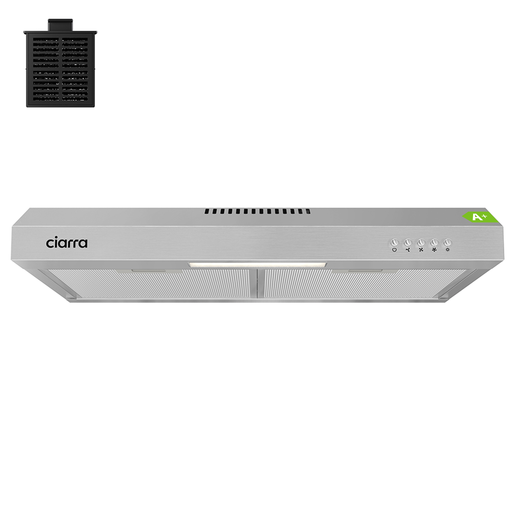
Why This Fits Their Persona: Its compact under-cabinet format suits smaller kitchens, rented homes and straightforward replacement projects where space and price are important.
The dimensions, ventilation options and speed-specific noise figures are clearly listed, helping buyers check suitability before installation.
Two washable aluminium filters, push-button controls, integrated light and ducted or recirculating operation.
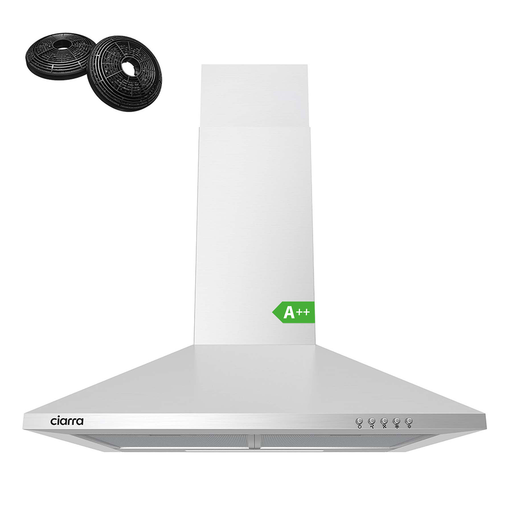
Why This Fits Their Persona: This stainless steel cooker hood suits homeowners renovating a visible kitchen wall and wanting an adjustable chimney design for a more substantial installation.
Its adjustable 572–950mm height and stated ducting or recirculation compatibility make planning clearer than choosing from width alone.
Listed airflow reaches 367m³/h; it includes two washable aluminium filters, push-button control and task lighting.
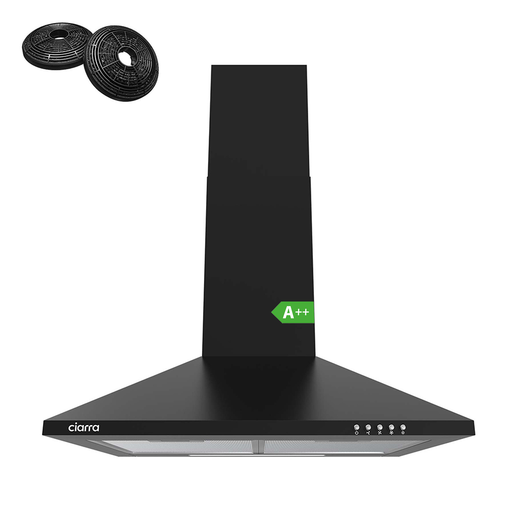
Why This Fits Their Persona: The black cooker hood is designed for households that cook frequently and prefer a visible wall-mounted unit with higher listed airflow.
The three-speed airflow and noise data show the trade-off between extraction rate and sound, rather than presenting one maximum figure without context.
Up to 367m³/h listed airflow, two washable metal filters, integrated lighting and dual ventilation mode.
We have compiled a complete, real-time list of products that fully satisfy these strict selection criteria and UK safety regulations.
The 596mm and 600mm models are designed around a 60cm cooking area, but suitability depends on the actual hob, cabinet and clearance measurements. Check the installation manual and confirm the required distance above the hob before fitting.
Both options use the hood’s motor and lighting, so electricity use depends on the selected speed and frequency of operation. Recirculation can avoid duct installation work, but carbon filters need periodic replacement. Ducting may involve additional installation materials but does not use charcoal filters. Compare the total installation and maintenance costs for your kitchen.
The supplied guidance recommends cleaning the washable grease filter every two to four weeks, depending on how often and how intensely you cook. Homes that fry or sauté regularly may need more frequent cleaning. Use a suitable cleaning method from the manual and make sure the filter is fully dry before refitting.