
24/7 全天候客户支持

免费退货

当日/次日达

品质保障

开启新人专享福利: 全场免邮 | 低至 2 折 | 免费试用 30 天 JoyPlus 会员
下载 Joybuy
Buying clamps and pliers can seem straightforward until a tool slips on a fitting, damages a hose or fails to hold timber securely. Product listings often focus on jaw capacity or material names while leaving out details that affect everyday use.
Before choosing a tool, look beyond the headline specification. The most useful option depends on the workpiece, the pressure required, the available working space and how often you expect to use it.
A large opening does not automatically mean a tool is suitable for every job. Water pump pliers with a 50 mm maximum opening may be useful for larger pipes and fittings, but they can be unnecessarily bulky for small nuts or confined spaces. Similarly, a woodworking clamp with a stated load limit should not be treated as a substitute for a heavier-duty engineering clamp.
Check both the jaw opening and the shape of the jaws. A toothed jaw may grip rounded fittings effectively, while soft clamp pads are more appropriate for finished timber and painted surfaces.
Hose clamp pliers are designed for specific flexible hose applications. Plastic line clamp pliers can help close off suitable fuel, brake, gas, coolant and radiator hoses without cutting into them. However, they are not intended for hard, reinforced or high-pressure lines.
Before purchase, confirm the tool’s opening range and jaw design. Straight and 90° angled jaws serve different access requirements, particularly inside an engine bay or around awkwardly positioned hoses.
One-handed clamps, quick-release clamps and ratchet bar clamps are convenient for assembly and positioning, but a quick-release mechanism does not by itself indicate high clamping force. For woodworking, compare the stated force, throat depth, jaw width and rail construction.
Also check whether protective pads are included. Bare metal jaws can mark timber, laminate or painted components, even when the clamp is otherwise correctly sized.
Measure the width or diameter of the object before selecting a tool. For pliers, compare the maximum jaw opening with the fitting size and consider whether the jaws can sit squarely on the workpiece.
For clamps, look at:
A G-clamp provides firm threaded adjustment and is useful for controlled pressure. A bar clamp or ratchet bar clamp is generally quicker to reposition across wider panels.
Chromium-vanadium steel is used in several adjustable pliers because it offers a combination of hardness, strength and resistance to corrosion when properly maintained. Heat-treated alloy steel is also common in general-purpose pliers sets.
For woodworking clamps, reinforced nylon bodies can reduce weight, while steel rails provide structural support. TPU, rubber or nylon jaw pads help reduce surface marking, but they should still be aligned correctly before tightening.
For hose work, reinforced nylon can offer a non-conductive alternative to metal jaws. Always check that the tool is suitable for the fluid line and application rather than relying on the material name alone.
Push-button adjustment can be quicker than repeatedly repositioning a slip joint. A clear tooth pattern helps water pump pliers grip round, flat, square and hexagonal shapes, but the jaws must be seated securely before force is applied.
For automotive work, cable hose clamp pliers with a flexible cable can reach spring clamps in restricted areas. A locking ratchet can hold the clamp open, leaving one hand available for removal or installation.
Handle design also matters. Non-slip resin, PVC or composite grips can make repeated use more comfortable, but gloves, posture and access remain important factors.
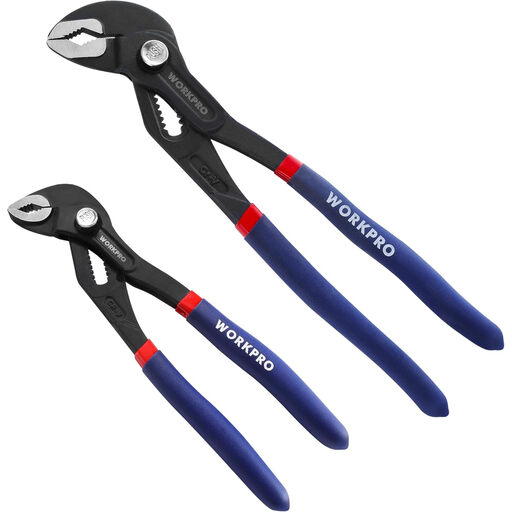
Why This Fits Their Persona: Two common sizes give new DIY users practical coverage for plumbing, maintenance and general repairs around a UK home or garage.
The set lists maximum openings of 33 mm and 43 mm, making the size range clearer than choosing a single oversized pair.
Chromium-vanadium steel construction, push-button adjustment and toothed jaws for varied shapes.
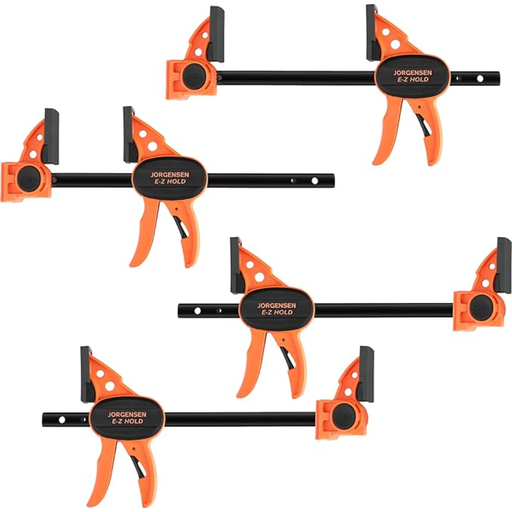
Why This Fits Their Persona: Suitable for furniture assembly, joinery and repeated workshop projects where surface protection and flexible positioning matter.
The product specifies soft rubber pads, a 68 kg clamping force and a 62 mm throat depth rather than relying only on general durability language.
Two-in-one clamping and spreading function; two 150 mm clamps can be joined to create a stated 400 mm clamp.
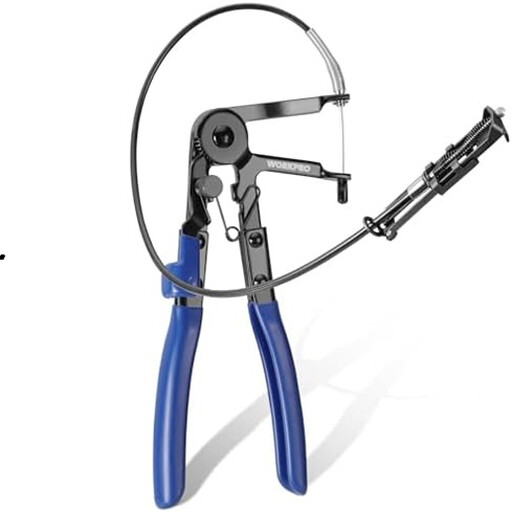
Why This Fits Their Persona: A practical choice for automotive maintenance where spring hose clamps are located behind components or inside confined engine-bay spaces.
Its 67 cm flexible hose and 10–50 mm opening are stated clearly, helping buyers judge access and compatibility before ordering.
Ratchet lock for holding a clamp compressed; PVC-coated handle and carbon-steel construction.
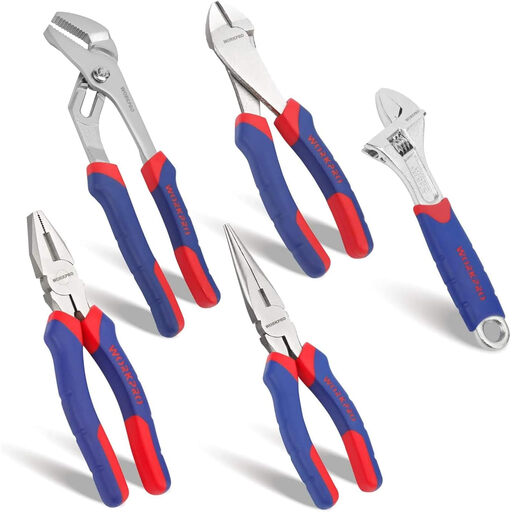
Why This Fits Their Persona: Useful for a mixed toolbox covering plumbing, electrical tasks, automotive repairs, cutting and general maintenance.
The five included tools are listed individually, so buyers can assess whether the set covers their actual tasks instead of paying for unused pieces.
Includes water pump pliers, combination pliers, side cutters, needle-nose pliers and an adjustable wrench.
Use the tool only within its stated application and capacity. Wear safety glasses when cutting wire or working near pressurised components, and keep fingers clear of adjustment points and closing jaws.
To extend service life:
For hose work, release pressure where appropriate and confirm the line is compatible before pinching it off. For woodworking, check that the clamp is aligned and that the workpiece is supported before applying force.
We have compiled a complete, real-time list of products that fully satisfy these strict selection criteria and UK safety regulations.
They can be suitable for gripping and turning compatible pipes, fittings and nuts when the jaw opening and shape match the job. Position the jaws securely and avoid excessive force, particularly on plated or soft fittings that may be marked.
Start by identifying the hose type, clamp style and available access. Compare the opening range and choose straight, angled or cable hose clamp pliers according to the working space. Do not use plastic line clamp pliers on hard, reinforced or high-pressure lines unless the manufacturer specifically permits it.
Many are suitable for holding, positioning and assembling light-to-medium woodworking projects. Compare the stated clamping force, span, throat depth and rail material. For large panels or high-pressure jointing, use enough clamps to distribute pressure evenly rather than relying on one clamp at its maximum limit.