Teachers printing repeated handout batches
Check how many A4 sheets a session needs at once. Paper capacity affects reloads, while automatic duplex printing avoids manually turning sheets when character sheets use both sides.


For repeated A4 character-sheet batches, start with the largest number of sheets needed in one session, then check paper capacity, automatic duplex printing and how staff will connect. A higher-capacity refillable model can mean fewer paper reloads, while a smaller tray may be sufficient for modest batches; if staff also copy multi-page originals, check for an automatic document feeder.
Check how many A4 sheets a session needs at once. Paper capacity affects reloads, while automatic duplex printing avoids manually turning sheets when character sheets use both sides.
Look beyond the all-in-one label. A flatbed handles individual originals, whereas an automatic document feeder is useful when multi-page source packs are routine.
A compact A4 all-in-one may suit modest batches if its tray fits the workload. Leave room to access the paper feed and follow the maker’s maintenance instructions if output becomes faint or incomplete.
For classroom character sheets, identify the need that matters most, then compare the printer’s paper handling, supplies and approved connection options against that need.
| Concern | What to check | Who this matters to |
|---|---|---|
| Batch capacity | Match the A4 paper tray to the largest session batch; check automatic duplex support for the intended paper. | If character sheets must be ready before a lesson, I want to finish the batch without stopping to reload paper. Around 36% of consumers would put uninterrupted batch printing first. |
| Ink replenishment | Check the exact model’s replacement bottles, their availability and the conditions behind any stated page yield. | When I print character sheets repeatedly, I need to plan refills rather than rely on an advertised page count as my actual output. Approximately 29% of consumers would make refill planning their primary concern. |
| Shared access and copying | Confirm approved device connections and software compatibility; decide whether multi-page originals call for an automatic document feeder. | If several staff members print or I copy source packs, I need a setup that fits our devices and scanning routine. For around 21% of consumers, that shared workflow would take priority. |
| Placement and occasional use | Check the space needed to load paper and access the printer, alongside tray capacity and the maker’s maintenance instructions. | In a small room where printing is occasional, I need the printer to fit without choosing a tray too small for my handouts. Roughly 14% of consumers would put placement and occasional use first. |
Manufacturer page yields depend on the model and stated test conditions; they are not a count of classroom-ready character sheets. Epson also warns that excessive print-head cleaning consumes ink.
Use yield to plan refills, but consider your page mix and check which replacement bottles the exact model takes.
Paper, replacement ink and ink used during maintenance remain part of day-to-day operation.
A compact printer can fit the room yet require a reload halfway through a lesson batch. Epson lists a 100-sheet tray for the ET-2950, compared with Canon’s 250-sheet cassette for the GX1050 and Brother’s 150-sheet tray for the DCP-T780DW.
Count the largest same-session batch before deciding how much tray capacity is useful.
Canon lists a flatbed scanner for the GX1050, while Brother lists a 20-sheet automatic document feeder for the DCP-T780DW. That distinction matters when originals have several pages.
Choose a feeder if multi-page copying or scanning is routine; a flatbed may suffice for individual sheets.
For Great Britain, the Health and Safety Executive says electrical equipment that could cause injury must be maintained safely; it does not prescribe a universal annual portable appliance testing interval.
Follow the school’s safety policy and risk-based maintenance arrangements when introducing a printer.
These model examples illustrate paper handling and copy-and-scan choices; check the specifications of the particular printer you intend to buy.
Canon positions its MAXIFY GX line as refillable-ink printers for higher-volume work. Its documented GX1050 is an A4 print, copy and scan model.
Brother’s tankbenefit range uses refillable ink tanks. The DCP-T780DW combines A4 printing, copying and scanning.
Epson’s EcoTank range uses refillable tanks. The ET-2950 is an A4 print, copy and scan model with wireless setup and automatic duplex printing.
These A4 printer choices are relevant to classroom character sheets and differing batch or copy-and-scan needs. Compare each model with the paper, connections and lesson workload your school requires.
 No image available
For repeated character-sheet batches, check the GX6150’s tray capacity and duplex options against the largest session you expect to print.
Confirm that the intended paper and the school’s approved device connections are supported.
 No image available
For A4 character sheets that staff also need to scan or copy, this Wi-Fi model combines those functions in one printer.
Check the required paper, batch size and school network setup before choosing it.
 No image available
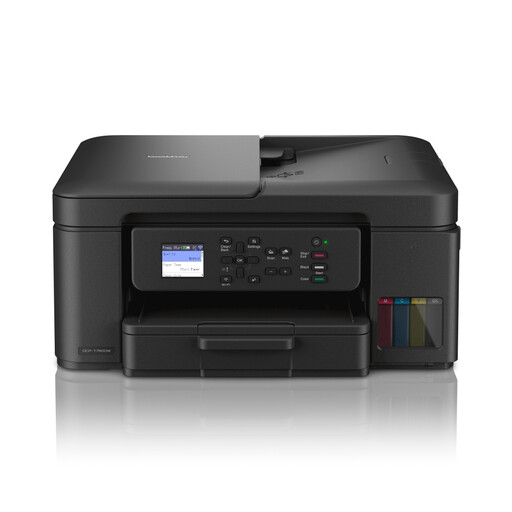
For staff who regularly copy or scan multi-page source packs, Brother lists a 20-sheet automatic document feeder for this A4 model.
Brother also lists a 150-sheet input tray, automatic duplex printing, USB and 2.4/5 GHz Wi-Fi. Check whether the tray suits your largest batch and whether the approved school connection suits this model.
Choose capacity against the largest batch printed in one session, not just the room’s size. Count sheets per lesson and likely daily batches; Department for Education school-buying guidance also advises assessing annual print volume, locations and the need for scanning or network access.
It is useful when character sheets routinely use both sides and staff want to avoid turning pages by hand. Canon lists automatic A4 duplex printing for the GX1050, Brother for the DCP-T780DW and Epson for the ET-2950; check the intended paper against the exact model’s media requirements.
For Epson inkjets covered by its support guidance, run a nozzle check and use head cleaning if needed. Check the result before repeating a cleaning cycle: Epson warns that excessive cleaning consumes ink.
No universal annual PAT-testing interval is prescribed by the Health and Safety Executive. In Great Britain, electrical equipment that could cause injury must be maintained safely; follow the school’s policy and risk-based inspection and testing arrangements.
Check the school’s approved electrical-waste process and ask the seller about its take-back route. UK guidance from the Office for Product Safety and Standards and the Department for Environment, Food & Rural Affairs explains that waste electrical and electronic equipment is regulated to reduce disposal to landfill; it does not provide one disposal procedure for every school.