Teacher-led lesson recorders
You mainly need explanations, pronunciation examples and instructions to come through clearly. Capturing every distant pupil contribution is not the priority.


For a lesson centred on the teacher’s explanations and pronunciation, choose a microphone worn by or positioned close to the teacher. If pupil dialogue must be intelligible, plan microphones around where pupils speak rather than relying on one distant microphone. An installed ceiling system is a separate room-planning decision, suited to repeated whole-room or hybrid use only when the acoustics and AV infrastructure can support it.
You mainly need explanations, pronunciation examples and instructions to come through clearly. Capturing every distant pupil contribution is not the priority.
You need to review pupil answers, oral drills or small-group exchanges. Microphone positions and the number of coverage points matter because speakers may be spread across the room.
You are equipping a room used repeatedly for remote participation or recording, with the opportunity to assess its acoustics and plan installed audio and AV connections.
Start with whose speech the recording must capture. Shure’s microphone-placement guidance explains why a distant microphone cannot separate direct speech from room reverberation; that makes teacher-close capture, pupil-group coverage and an installed room system different purchases.
Choose when: Explanations and pronunciation modelling matter more than distant pupil comments.
Trade-off: A microphone near the teacher does not also provide dependable coverage of pupils across the classroom.
Choose when: Desk-based dialogue or spoken practice needs to be intelligible on the recording.
Trade-off: Coverage follows seating positions and may require several microphones and recording inputs.
Choose when: A classroom is used regularly for whole-room capture or hybrid lessons and an installed AV system can be planned.
Trade-off: Shure cautions that overhead microphones work satisfactorily only in quiet, fairly non-reflective classrooms; installation also needs room and infrastructure assessment.
| Concern | What to check | Who this matters to |
|---|---|---|
| Teacher speech | Can the microphone stay near the moving teacher, and will it work with the intended recording device and app? | If my explanations and pronunciation examples are the point of the recording, I want my voice captured close up rather than from across the room. Roughly 42% of consumers put teacher speech first. |
| Pupil dialogue | Map microphone positions to desk groups and check the number of recording inputs. For its MX690 boundary microphone, Shure advises placement within 1.5 m of a talker and one microphone per two talkers. | When pupils practise speaking in groups, I need their replies to be intelligible for review, not merely audible in the background. Pupil dialogue is the main concern for around 33% of consumers. |
| Whole-room use | Assess room noise and reflections, ceiling installation, available network or power connections, and compatibility with the existing AV system. | For a classroom used repeatedly with remote participants, I need a recording arrangement planned for the room and its changing speakers. About 25% of consumers prioritise that installed or hybrid-room need. |
Shure explains that a microphone cannot remove unwanted reverberation from distant speech. A recording that captures the teacher clearly may still leave pupils hard to understand.
Decide whose speech must be intelligible, then position microphones near those speakers. Plan separate coverage points if several pupil groups matter.
Additional coverage can mean more microphones, recording inputs and cable-management work.
Overhead capture depends on room acoustics, while installed arrays need configuration and AV connections. Shure advises that overhead microphones give satisfactory results only in quiet, fairly non-reflective classrooms.
Assess the room and available installer support before choosing a ceiling system; mounting a tabletop boundary microphone overhead is not a substitute for that assessment.
Installation may also involve mounting, network or power connections and ongoing configuration.
A wireless feed or its receiving device can fail during a lesson. Onboard recording, where a system offers it, provides a separate recording path.
For lessons that cannot easily be recorded again, check whether the chosen system records onboard, has enough storage and lets you monitor the recording before teaching starts.
Information relating to an identifiable pupil or staff member is personal data. Department for Education guidance requires schools to establish a lawful basis for processing and not retain personal data longer than necessary.
Before recording, agree the purpose, access, storage and retention arrangements under the school’s policies, involving its data-protection lead where needed.
Portable wireless systems for recording speakers close to the microphone.
Close speech microphones, boundary microphones and classroom-audio guidance.
Installed ceiling-array options for planned classroom and hybrid AV systems.
Installed ceiling-array systems for lecture and hybrid spaces.
These lapel microphones are choices to consider when recording speech close to the teacher. For either one, confirm the connection and recording-device compatibility before buying; a lapel microphone alone is not a plan for capturing distant pupil groups.
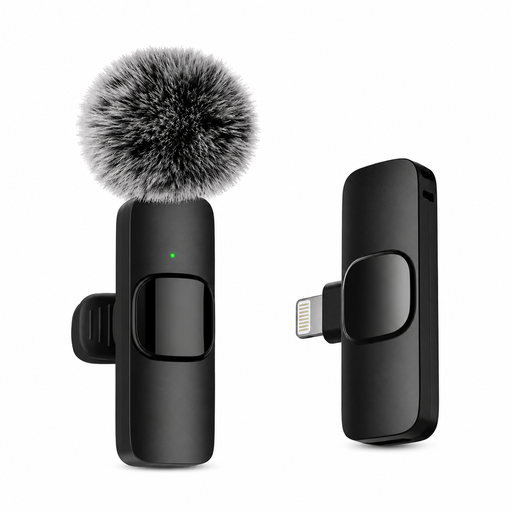 Image unavailable
Consider its close-worn format when the teacher’s explanations are the recording priority.
This is a single-microphone variant listed with an iOS interface. Confirm how it connects and whether it works with the intended device and recording app; it does not establish coverage of distant pupils.
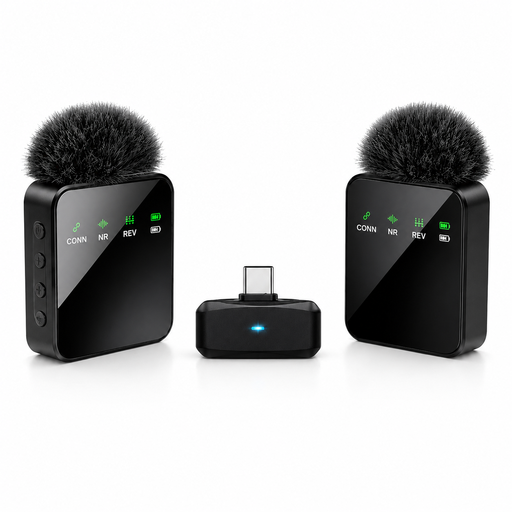 Image unavailable
Consider close placement for teacher-led recording rather than assuming the dual-mic description provides whole-class coverage.
The variant is listed with a Type-C interface. Confirm its connection method, compatibility with the intended device and whether the two microphones can be positioned as the lesson requires.
Do not rely on one distant microphone when individual pupil contributions must be intelligible. Shure’s placement guidance explains that a microphone cannot separate direct speech from room reverberation; plan nearby coverage around the relevant speakers instead.
No. Shure advises that overhead microphones give satisfactory results only in quiet, fairly non-reflective classrooms. Assess the room’s acoustics and AV infrastructure before considering an installed system.
Consent is not automatically the lawful basis for every lesson recording. Where the recording contains identifiable personal data, Department for Education guidance requires the school to establish an appropriate lawful basis for its purpose; follow school policy and consult its data-protection lead about the particular recording.
Keep recordings containing personal data no longer than necessary for their purpose. Department for Education guidance calls for documented retention arrangements and safe disposal when the information is no longer needed.
It can provide a separate recording if the wireless feed or receiving device fails. RØDE lists onboard recording for its Wireless PRO transmitters, but that feature does not extend the microphones’ coverage to distant pupil voices.