
24/7 Customer Support

Free returns

Same-day & Next-day Delivery

Quality Guaranteed

Unlock Your Welcome Offers: FREE Delivery | Up to 80% OFF | Free 30-day JoyPlus trial
Download the APP
As energy prices remain a concern and living spaces become more compact, the humble clothes airer has become an essential household item. Tumble dryers are costly to run, and the unpredictable British weather makes outdoor drying a gamble. However, not all indoor clothes airers are created equal. Choosing the wrong one can lead to cluttered rooms, damp clothes and wasted money.
As the Joybuy Product Recommendation Officer, my role is to help you navigate the market. Before you buy, be aware of these common pitfalls that catch out many UK shoppers.
To avoid these issues, focus on a few key parameters rather than marketing hype. A good quality laundry drying rack is an investment in convenience and efficiency.
The stability of a clothes horse depends entirely on its frame. Look for models constructed from powder-coated steel. This finish provides a crucial barrier against rust, which is vital in a damp environment. Pay close attention to the joints; reinforced plastic connectors are far more durable than thin, brittle alternatives. The thickness of the steel tubes also matters—a flimsy frame will not withstand the weight of a full winter wash load.
Consider the layout that best suits your home. A tall, tiered concertina clothes airer is excellent for maximising vertical space in rooms with a small footprint. In contrast, a wider, multi-panel folding clothes airer might be better if you have more floor area.
More importantly, assess the spacing between the drying rails. There should be enough room for air to circulate freely around each garment. Some designs also include corner hooks, which are perfect for hanging shirts or blouses on hangers, preventing creases and further optimising your drying space.
For anyone in a flat, student hall or starter home, storage is paramount. Always check the folded dimensions of the airer. A truly space-efficient model should fold down compactly enough to slide under a bed, behind a sofa or into a narrow cupboard. Lightweight construction is also a plus, making it easy to move the indoor clothes airer from room to room, perhaps to catch a sunny spot by the window. For those needing a dual-purpose solution, a portable wardrobe or fabric wardrobe can offer both clothes storage and a place to air garments.
Based on these practical criteria, we have matched several products to specific needs common among UK residents.
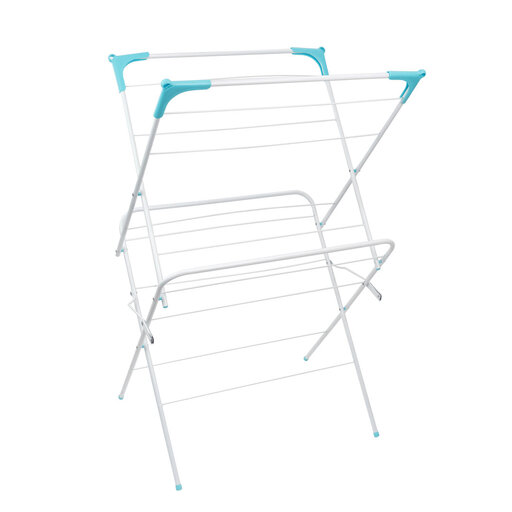
Why This Fits Their Persona: Ideal for individual use or small loads in tight spaces. Its vertical design takes up minimal floor space, and it's lightweight enough to be moved and stored easily, which is perfect for temporary or shared accommodation.
It folds down to a slim 5cm depth, genuinely solving the "space-saving" myth. This makes it easy to tuck away, avoiding permanent room clutter.
Provides 9 metres of drying space in a compact footprint. Features corner hooks for extra hanging capacity using your own coat hangers.
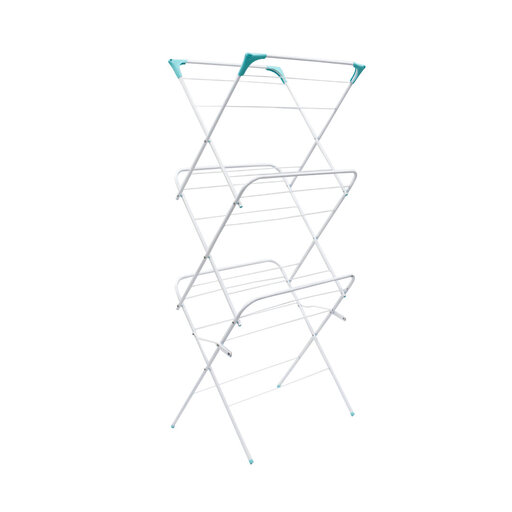
Why This Fits Their Persona: With 14 metres of drying space, this airer can handle larger family-sized laundry loads, including towels and bedding. The three-tier design is space-efficient, making it suitable for a living room or spare bedroom.
The powder-coated steel construction and easy locking system provide a sturdy frame that avoids the "flimsy frame failure," holding heavier items without buckling.
Offers significant capacity (14m) in a vertical format. Folds flat for storage and includes protective feet to prevent scratching floors.

Why This Fits Their Persona: This is more than an airer; it's a complete storage solution. For renters who can't install permanent wardrobes, this **fabric wardrobe** provides extensive space for hanging and shelving, while also serving as a place to air clothes.
It directly counters the "misleading capacity" trap by providing four distinct hanging rails and multiple shelves, offering structured, high-volume storage and airing space.
Combines drying and storage functions. The steel tube frame is robust, with each rod supporting up to 15 kg. Tool-free assembly is ideal for renters.
We have compiled a complete, real-time list of products that fully satisfy these strict selection criteria and UK safety regulations.
To speed up drying, ensure good air circulation. Place the airer in a well-ventilated room or use a dehumidifier nearby to draw moisture from the air. Space garments evenly on the rack, avoiding overcrowding. For thicker items, rotating them every few hours can also help them dry more uniformly.
A well-made clothes airer with a powder-coated steel frame and sturdy joints should last for many years with proper care. The key to longevity is to avoid overloading it beyond its stated weight capacity and to distribute the weight of wet laundry evenly. Wiping it down occasionally will also help maintain its finish.
Yes, substantially. A clothes airer has no running costs, relying only on ambient air to dry your laundry. In contrast, a tumble dryer is one of the most energy-intensive appliances in a home. Switching to an airer for most of your laundry can lead to noticeable savings on your electricity bills.