Choose a multifunction printer around the minutes you need to scan: recurring stacks of loose, two-sided A4 sheets make automatic double-sided scanning through an automatic document feeder (ADF) particularly useful, while originals that need individual handling call for a flatbed. If the club also prints meeting packs, consider the ink system and paper capacity, but check the scan workflow separately: automatic double-sided printing does not necessarily mean automatic double-sided scanning.
Who is this for?
Recurring minute-stack digitiser
You regularly receive loose, multi-page A4 minutes and want to preserve their page order without placing every sheet on the scanner individually. If the sheets are printed on both sides, the difference between automatic and manual double-sided ADF scanning matters; Epson and Canon specify different workflows for the models discussed below.
Mixed-originals club archivist
Your records include ordinary loose minutes and occasional originals that need individual handling. You need to think about the finished files as well as the scanner: The National Archives describes digitisation as a process extending from initial scanning through to delivery.
Low-intervention hobby-room printer user
The same machine will scan minutes and print club documents. You want to compare feeder handling, paper capacity and ink format against the space and attention you can give the printer between meetings.
What matters when choosing?
Start with the condition and sidedness of the original minutes, then consider the club’s printing routine. A feeder’s sheet capacity and its ability to scan both sides automatically answer different questions.
| Concern |
What to check |
Who this matters to |
| Batch and double-sided scanning |
Check whether the ADF scans both sides automatically, its capacity and which originals it accepts; do not rely on a double-sided printing specification. |
If I repeatedly scan loose minutes printed on both sides, I want to avoid turning each stack over and disturbing page order. Around 40% of consumers put batch handling first. |
| Original handling and retrieval |
Check for a flatbed where individual originals need it, and plan consistent file names and a backup routine. |
When some originals need careful individual handling, I want files the club can find again rather than a folder of unidentified scans. Roughly 30% of consumers prioritise original handling and retrieval. |
| Printing between meetings |
Compare the ink format, paper capacity and the space the printer needs in the hobby room. |
For regular agendas and meeting packs, I would rather not keep interrupting printing to refill paper or supplies. Approximately 30% of consumers make ongoing printing convenience their main concern. |
Mistakes to avoid
-
Assuming double-sided printing means double-sided scanning
These are separate functions. Canon says the MAXIFY GX4050 requires pages to be turned and reloaded for double-sided ADF copying and scanning, even though the machine offers other double-sided functions.
Look for the exact model’s double-sided scan or duplex scan specification, and check whether the process is automatic or manual.
Turning and reloading stacks adds handling time and another opportunity to disturb page order.
-
Choosing by stated ink yield alone
A manufacturer’s yield figure cannot tell you whether the scanner suits the club’s originals or whether completed files will be easy to retrieve.
Decide how the minutes will be scanned before weighing supplied ink and paper capacity against the club’s printing routine.
-
Treating a scan folder as the entire archive
Scanning creates files, but the club still needs to keep them identifiable and accessible. Where minutes contain personal data, the Information Commissioner's Office calls for security measures appropriate to the risk, including attention to restoring access after an incident.
Use meeting dates and record series consistently in file names, decide who should have access and test a backup route.
Relevant printer brands
These model lines illustrate different scanning and printing arrangements; a brand name alone does not establish how a particular printer handles two-sided originals.
Epson
Epson’s EcoTank ET-3956 and ET-4950 are relevant when recurring two-sided A4 minute stacks and refillable ink are both priorities.
- Epson specifies double-sided ADF scanning, copying and printing for these models.
- Epson’s stated supplied-ink yields of up to 15,100 black pages and 5,500 colour pages are manufacturer claims, not a prediction of how long a club’s ink will last.
Canon
Canon’s refillable-ink MAXIFY GX4050 is relevant when the club values paper capacity alongside feeder-based scanning.
- Canon specifies a 35-sheet ADF and 350-sheet plain-paper capacity for the GX4050.
- Canon specifies manual, not automatic, double-sided ADF copying and scanning: pages must be turned and reloaded.
Brother
Brother’s cartridge-based MFC-J4540DWXL is an A4 multifunction option for clubs considering feeder capacity, paper storage and an included warranty package.
- Brother specifies a 20-sheet ADF, 400-sheet paper capacity, automatic double-sided printing and an included three-year warranty for this model.
- If the minutes are two-sided, confirm the MFC-J4540DWXL’s ADF scanning procedure separately from its printing specification.
Joybuy products for club-minute archiving
These multifunction printers offer options for scanning loose club documents and printing meeting materials. Choose among them by the originals you handle and the printing you expect to do; for frequent two-sided minute stacks, confirm each exact model’s ADF scanning procedure before purchasing.
 No image available
Canon MAXIFY GX6150
Consider this model for recurring loose-sheet minutes alongside club printing. Compare its feeder capacity with your usual stack, and confirm whether scanning two-sided originals requires turning and reloading them. If some originals need individual placement, check for a flatbed on this exact model.
View on Joybuy
 No image available
Epson EcoTank ET-5150 +Ink A4 Multifunction Printer
This A4 model is worth considering when the club scans loose minutes and also prints documents regularly. Check its exact ADF procedure for two-sided sheets and whether it offers the individual-original handling your archive needs. The ET-5150 should not be assumed to have the scanning functions specified for Epson’s ET-3956 or ET-4950.
View on Joybuy
 No image available
Brother MFC-L3740CDWE Colour LED Multifunction Printer
Consider this colour LED model if the club needs a feeder for loose minutes and a flatbed path for occasional individually handled originals. Confirm its procedure for two-sided feeder scans rather than inferring it from printing features. Check that the intended hobby-room position and handling arrangements suit the stated 20 kg weight.
View on Joybuy
 No image available
Brother MFC-J6760DW Inkjet Multifunction Printer
This inkjet model is relevant to clubs handling multi-page minutes and considering searchable files. Confirm how its searchable-PDF workflow fits the club’s file-handling routine, whether two-sided ADF scanning is automatic and whether a flatbed is available for individual originals. Its stated 20.2 kg weight also matters when choosing a position for it.
View on Joybuy
 No image available
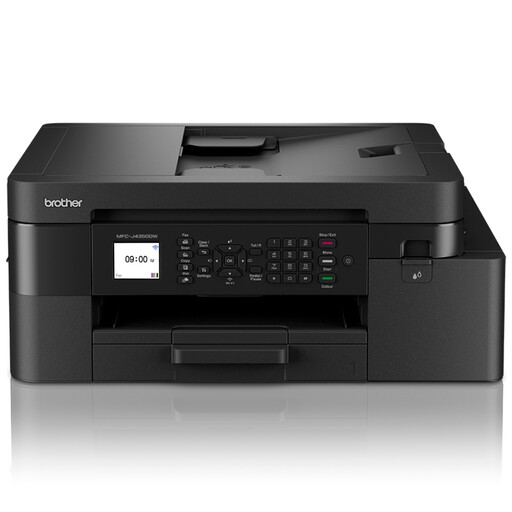
Brother MFC-J4350DW Inkjet Multifunction Printer
Consider this inkjet model for smaller loose-sheet batches where the club also needs everyday printing. Compare its feeder capacity with the number of pages in a typical set of minutes. For two-sided sheets or originals requiring individual placement, confirm the scan procedure and flatbed arrangement for this model.
View on Joybuy
Frequently asked questions
Do I need automatic double-sided scanning for club minutes?
It is particularly useful if you repeatedly scan loose minutes printed on both sides. Epson specifies double-sided ADF scanning for the ET-3956 and ET-4950; Canon says the MAXIFY GX4050 instead requires pages to be turned and reloaded for double-sided ADF scanning. Check the exact model you plan to buy.
Should every original go through the document feeder?
Use a feeder only for originals suitable for that model’s feeding requirements; an original that needs individual handling calls for a different scan path, such as a flatbed. Try a duplicate or other low-risk batch before feeding important records, and keep the resulting files consistently named. The National Archives treats digitisation as a process that extends beyond the initial scan.
What if the scanned minutes contain members’ personal data?
Plan access and security around the information the minutes contain and how the club shares it. The Information Commissioner's Office says the UK GDPR security principle requires technical and organisational measures appropriate to the risk, addressing confidentiality, integrity, availability and restoration of access after an incident. The club’s particular legal duties depend on its role and handling of the data.
Will a stated ink yield tell us how long supplies will last?
No manufacturer yield figure can predict the club’s actual replacement schedule on its own. Treat the figure as a stated product characteristic, then consider the club’s print volume and page coverage; Epson, Canon and Brother describe different supply arrangements for the models discussed here.


