Families planning several school-holiday lunches
If your plan calls for about six imperial pints, four 1-litre cartons provide enough volume. Check how long each carton can be kept after opening before deciding when to open the next one.


For roughly six imperial pints, four 1-litre cartons provide 4 litres, just over the approximately 3.41 litres needed. For school-holiday lunches, choose the individual drink by its sugar declaration, fortification, allergen statement and opened-carton instructions; do not assume a coconut drink is a like-for-like main milk replacement for a young child.
If your plan calls for about six imperial pints, four 1-litre cartons provide enough volume. Check how long each carton can be kept after opening before deciding when to open the next one.
Compare the exact products’ sugar declarations, allergen statements and added nutrients. A dairy-free description does not answer every allergy or nutrition question.
The NHS North West Knowledge Now guidance for children aged 1 and over with cow’s milk protein allergy advises checking that a plant-based milk alternative is unsweetened and fortified with calcium, iodine, vitamin D and vitamin B12. It also notes that some coconut-based products are very low in energy and protein.
Work out the volume first, then compare cartons for the people who will drink them and the way you will use them.
| Priority | What to check | Your needs |
|---|---|---|
| Amount | Six imperial pints is approximately 3.41 litres. Check the number and size of cartons: four 1-litre cartons provide 4 litres, while three provide 3 litres. | I need enough for several lunches without opening every carton at once. |
| Sugars | Read both the sweetened or unsweetened description and sugars per 100ml. Alpro UK lists 0.0g per 100ml for Coconut No Sugars; Tesco Groceries lists 2.4g per 100ml for its sweetened Long Life Coconut Original. | For a regularly used drink or recipe ingredient, I want to know what the particular carton declares rather than judging by coconut flavour alone. |
| Regular use by a child | Compare energy, protein and listed calcium, iodine, vitamin D and vitamin B12 on the exact product. NHS North West Knowledge Now warns that some coconut-based alternatives are very low in energy and protein; fortification varies by product. | A child may drink this routinely, not just have a little in a recipe, so I need to assess it as a possible main milk drink rather than an occasional ingredient. |
| Allergens | Read the current pack’s ingredients and warnings. Tesco Long Life Coconut Original says it may contain peanuts and nuts; Sainsbury’s Sweetened Long Life Coconut Drink says it is not suitable for customers with a soya allergy due to manufacturing methods. | Someone at lunch has an allergy, so a vegan or dairy-free description alone is not enough for my decision. |
| After opening | Check the refrigeration and use-within instructions for each carton. The listed Koko and M&S drinks specify five days after opening; the Plenish listing at Waitrose specifies four days. | Lunches are spread across the holidays, and I want to open cartons at a pace that fits their storage instructions. |
The UK Office for Health Improvement and Disparities says plant-based drinks vary in nutrient content and fortification. NHS North West Knowledge Now also notes that some coconut-based products are very low in energy and protein, which matters when a child relies on one as a main drink.
For regular replacement use, compare the exact carton’s energy, protein and added nutrients. If a child has a medical dairy exclusion, seek advice from an appropriate clinician or dietitian about their individual needs.
Marks & Spencer describes its Creamy Coconut Drink as vegan but says it is not suitable for those with a milk allergy. Other named cartons carry nut or soya warnings.
Check the current pack’s ingredient and allergen statements for the specific drink before serving someone with an allergy.
Three 1-litre cartons provide 3 litres, less than six imperial pints, or approximately 3.41 litres.
Choose at least four 1-litre cartons for that volume, and check each product’s instructions before opening them across several lunches.
Tesco Groceries lists added calcium, iodine and vitamins for its sweetened Long Life Coconut Original, alongside 2.4g sugars per 100ml. Sainsbury’s sweetened long-life drink also lists fortification and declares 1.7g sugars per 100ml.
Compare the sugars declaration and the nutrient list separately on the product you intend to buy.
These named cartons illustrate different label details to compare; a brand name alone does not establish the ingredients or suitability of another product in its range.
Alpro Coconut No Sugars is a 1-litre option for shoppers comparing declared sugars and added nutrients.
Koko Dairy Free Unsweetened Alternative Longlife Drink is a 1-litre coconut-based carton.
Tesco Long Life Coconut Original is a sweetened 1-litre own-label drink.
Sainsbury’s Sweetened Long Life Coconut Drink is a 1-litre carton with listed fortification.
M&S Creamy Coconut Drink is a 1-litre carton with listed added nutrients.
Waitrose is a retailer reference here: the named product is Plenish Organic Coconut Unsweetened, a coconut-and-rice drink, not a Waitrose own-label drink.
These are larger coconut-containing barista-drink multipacks for planning several lunches. The 6 × 1L and 8 × 1L packs both exceed a roughly six-imperial-pint requirement; compare their ingredients with the drink you actually need rather than treating them as the same products as the single cartons above.
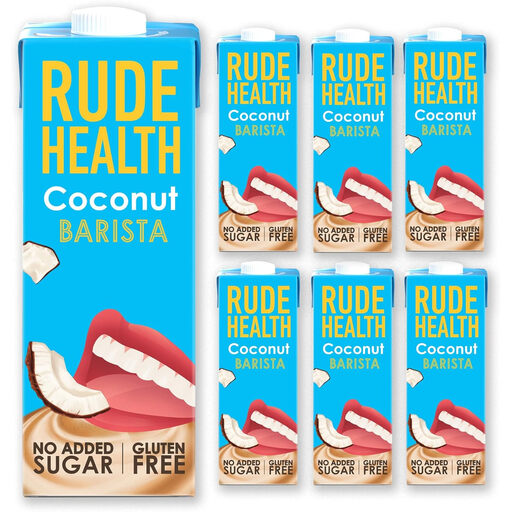 No image available
Six 1-litre cartons provide 6 litres for lunches planned across several days, more than the approximately 3.41-litre target.
This is a coconut-and-oat blend; check the current ingredients and allergen information if the distinction matters to your household. The supplied product instructions say to refrigerate after opening and use within five days.
 No image available
Eight 1-litre cartons provide 8 litres, so this pack makes sense only if your plans extend well beyond the roughly six-pint lunch requirement.
Its listed ingredients include soya; check the current pack before serving anyone who needs to avoid it. The supplied product instructions say to refrigerate after opening and use within five days. This Barista Coconut drink is a different product from Alpro Coconut No Sugars.
Buy four 1-litre cartons to meet a six-imperial-pint plan. Six imperial pints is approximately 3.41 litres; four cartons provide 4 litres, while three provide only 3 litres.
Do not assume that any coconut drink is suitable as a main milk replacement. NHS North West Knowledge Now guidance for children aged 1 and over with cow’s milk protein allergy advises choosing unsweetened alternatives fortified with calcium, iodine, vitamin D and vitamin B12, and notes that some coconut-based products are very low in energy and protein. The Koko carton also advises consulting a GP or qualified dietitian before using it as a main milk source for an infant under 2.
No. Marks & Spencer describes its Creamy Coconut Drink as vegan but explicitly says it is not suitable for those with a milk allergy. Check the current allergen statement for the exact carton before serving it to someone with an allergy.
Follow the instructions on the carton you buy. The named Koko and M&S drinks specify refrigeration and use within five days after opening; the Plenish drink listed by Waitrose specifies four days.