Adults in dairy-free households
If you use coconut drink in tea, cereal or cooking, compare the pack’s ingredients, nutrients and volume. The UK SACN and COT assessment notes that the nutrient content of plant-based drinks varies considerably.


For adult household use, choose a coconut drink by its ingredients and nutrient label rather than assuming it comes in a four-pint bottle. Tesco Groceries lists four pints of dairy milk as 2.272L, while the coconut drinks discussed here are listed in 1L cartons, so plan the quantity around what you will use. Do not substitute an adult coconut drink for a baby’s main milk without advice from a GP or qualified dietitian; Sainsbury's gives that warning for the Koko drink and infants under two.
If you use coconut drink in tea, cereal or cooking, compare the pack’s ingredients, nutrients and volume. The UK SACN and COT assessment notes that the nutrient content of plant-based drinks varies considerably.
If a clinician has advised a cow’s-milk-free diet, choose an adult drink that fits the specific avoidance plan. Frimley HealthierTogether’s NHS-linked guidance includes calcium-enriched coconut drink among possible alternatives and notes that some parents may also need to avoid major soya sources.
An adult dairy alternative is a separate decision from a child’s main milk. Sainsbury's Koko listing advises consulting a GP or qualified dietitian before using that drink as a main milk source for infants under two.
Start with who will drink it, then compare the exact carton’s label and the quantity your household will use.
| Priority | What to check | Your needs |
|---|---|---|
| Nutrients | Read the current label for calcium, vitamin D, vitamin B12, iodine and protein. Calcium fortification alone does not establish that the other nutrients are present. | I use this regularly instead of dairy milk and want to know what the drink contributes to my diet. The UK SACN and COT assessment says plant-based drinks vary considerably in nutrient content. |
| Ingredients | Check the ingredients and allergen information against the precise foods you need to avoid. Do not treat lactose-free dairy milk as a dairy-free drink. | If I am following a clinician-advised milk-free diet, my choice needs to fit that advice, including any instruction to avoid major soya sources. |
| Child’s use | Distinguish an adult drink used in the household from a child’s main milk. Check with a GP or qualified dietitian before using Koko as a main milk source for an infant under two, as its Sainsbury's listing advises. | I need a drink for adults or cooking, but I do not want to mistake that carton for my baby’s main milk. |
| Quantity and storage | Tesco Groceries lists four pints as 2.272L; compare that with the carton volume. Check the current pack’s refrigeration and use-after-opening instructions. | Two 1L cartons would give me 2L, short of four pints; three would give me 3L. I would choose a quantity I can use within the pack’s instructions. |
Tesco Groceries uses four pints for a 2.272L dairy-milk bottle. The Koko, Alpro, Plenish and Rude Health coconut drinks discussed here are listed in 1L cartons, so the same pack-size wording does not apply to them.
Plan in litres: choose two 1L cartons if 2L is enough, or consider three if you need more than 2.272L and can use them within their storage instructions.
The UK SACN and COT assessment says plant-based drinks vary considerably in nutrient content. Alpro UK’s Coconut Original label, for example, lists 0µg iodine per 100ml alongside calcium.
Compare the exact drink’s calcium, vitamins, iodine and protein information if it will regularly replace dairy milk in an adult’s diet.
Sainsbury's Koko listing specifically advises consulting a GP or qualified dietitian before using it as a main milk source for infants under two.
Keep adult household use separate from decisions about an infant’s main milk, and seek professional advice before making a substitution.
Cartons can have different refrigeration and use-after-opening instructions, which matter when planning several litres at once.
Check each current pack and open cartons as needed rather than assuming every coconut drink has the same storage period.
Koko Dairy Free Unsweetened is a 1L coconut-based drink listed by Tesco Groceries.
Alpro Coconut Original is a 1L coconut-and-rice drink.
Plenish Organic Coconut Unsweetened is a 1L coconut-and-rice option listed by Waitrose & Partners.
Waitrose & Partners lists chilled calcium-fortified and organic long-life coconut-and-rice drinks from Rude Health.
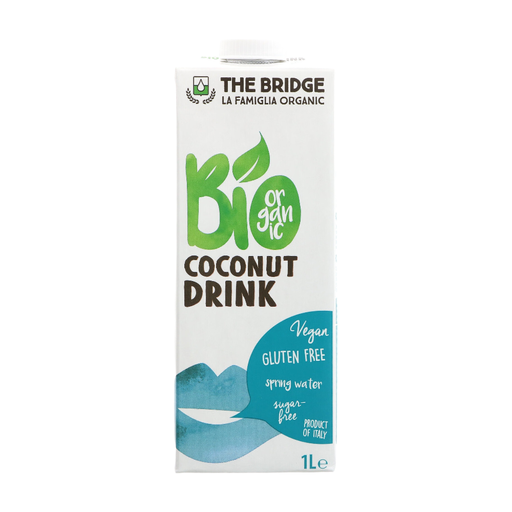
This 1L option is for planning adult household use of coconut drink, rather than buying a single four-pint bottle.
 No image available
The 1L carton can be counted towards an adult household’s planned quantity. The listing describes it as dairy- and soya-free; check the current pack for nutrient information and storage instructions if these affect your choice.
Two 1L cartons give you 2L, which is less than the 2.272L that Tesco Groceries lists for four pints of dairy milk. Three cartons give you 3L, so choose according to what your household will use and each carton’s storage instructions.
Do not make that substitution without professional advice. Sainsbury's Koko listing says to consult a GP or qualified dietitian before using the drink as a main milk source for infants under two.
Choose an adult drink that fits your clinician’s specific dietary advice. Frimley HealthierTogether’s NHS-linked milk-free guidance includes calcium-enriched coconut drink among possible alternatives and notes that avoiding major soya sources may also be necessary in some cases.
Do not assume it is. The UK SACN and COT assessment says plant-based drinks vary considerably in nutrient content, and Alpro UK lists 0µg iodine per 100ml for Coconut Original. Compare the exact label for the nutrients that matter to your adult household.
Follow each carton’s current storage and use-after-opening instructions. If you need several litres, plan when to open each carton so the quantity fits your household’s expected use.