Households making regular bedtime drinks
A pourable drink in a carton fits this use better than a canned cooking ingredient. Consider how quickly the household will finish each carton after opening.


For regularly poured bedtime hot drinks, start with a ready-to-drink coconut beverage rather than canned coconut milk intended for cooking. A 1-litre carton may suit a household that can use it within the opened-storage period on its label; compare sugar, fortification and allergens before choosing, particularly if the drink will replace dairy.
A pourable drink in a carton fits this use better than a canned cooking ingredient. Consider how quickly the household will finish each carton after opening.
If a coconut drink will replace dairy in everyday use, compare the nutrients listed on the particular carton. Fortification differs between plant-based drinks, as the UK Scientific Advisory Committee on Nutrition and Committee on Toxicity noted in their 2025 assessment.
Do not assume a coconut drink has the same nutrient profile as cow’s milk. If it would replace cow’s milk in a child’s diet, consider the whole diet and seek individual advice from a qualified health professional.
Choose the drink format first, then compare the labels of the cartons you would actually use.
| Priority | What to check | Your needs |
|---|---|---|
| Drink or cooking milk | Look for a ready-to-drink coconut beverage rather than canned coconut milk. Compare nutrition figures per 100 ml if considering both formats. | I want something pourable for mugs, not an ingredient chosen for richness in a recipe. |
| Sugar | Distinguish unsweetened or no-added-sugar wording from the total sugars figure per 100 ml. Check the ingredients of sweetened variants. | If this is a regular evening drink, I want to know what contributes to its sweetness. |
| Fortification | Check the particular carton for calcium, iodine, vitamin B12 and vitamin D; do not assume they are present across a brand’s range. Compare protein information if replacing dairy. | When dairy is absent from our usual drinks, I need to know which nutrients this carton lists. |
| Hot-drink use | Read the named product’s heating directions. Koko Dairy Free describes its Unsweetened No Sugar Milk as suitable for hot and cold drinks; that guidance does not establish instructions for other variants. | I plan to heat the drink, so the directions for the carton I buy matter. |
| Allergens | Read the current on-pack allergen statement, even when a product is labelled vegan. The cited M&S Creamy Coconut Drink is labelled unsuitable for people with a milk allergy. | For someone with a milk allergy, I cannot rely on a vegan label alone. |
| Young children | Compare the drink’s ingredients and nutrient panel, and consider what else the child eats and drinks. Do not treat a plant-based drink as an automatic equivalent to cow’s milk. | If a child will drink it regularly instead of cow’s milk, I need advice that takes their whole diet into account. |
| Opened storage | Check the storage instructions and use-after-opening period on each carton. Plan the number of cartons around how quickly they will be used. | A larger pack works for us only if we can finish each opened carton as directed. |
Canned coconut milk is generally presented as a cooking ingredient rather than a ready-to-drink beverage. Tesco Groceries lists 13 g saturates per 100 ml for its 400 ml canned coconut milk.
Start with cartons labelled as coconut drinks, and compare the per-100 ml nutrition panels if a can is also under consideration.
Fortification varies between plant-based drinks, according to the UK Scientific Advisory Committee on Nutrition and Committee on Toxicity’s 2025 assessment. A brand name alone does not tell you what a particular variant contains.
Check the exact carton for calcium, iodine, vitamin B12 and vitamin D when those nutrients matter to your choice.
The cited M&S Creamy Coconut Drink is described as vegan but labelled unsuitable for people with a milk allergy.
For an allergy, follow the current product’s allergen declaration and individual clinical advice rather than a category filter.
An opened carton has its own refrigerated-storage instructions. A multipack is only practical when the household can use cartons within those instructions.
Check each product’s label before stocking up, and open the next carton only when it is needed.
These examples illustrate differences between named drinks; a brand’s other variants may have different ingredients and labels.
Koko Dairy Free describes its Unsweetened No Sugar Milk as a drink for hot and cold use.
Alpro Coconut Original Chilled is a 1-litre coconut drink listed by Tesco Groceries.
Tesco’s named products show why a long-life coconut drink and canned coconut milk should be assessed separately.
M&S lists a Creamy Coconut Drink in its Plant Kitchen range.
Plenish Organic Unsweetened Long Life Coconut Drink is a 1-litre coconut drink.
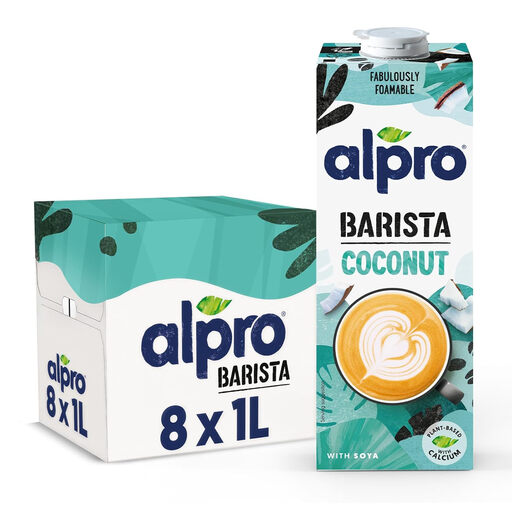
The option below is an 8 x 1L pack of a coconut-containing barista drink for households considering several cartons for hot drinks. Check its particular ingredients and heating directions against your needs.
 No image available
The 8 x 1L carton pack is an option if the household can use multiple cartons while following each opened carton’s storage directions. Check the current ingredients for sugar and soya, as well as the heating directions, before choosing it for bedtime mugs.
Start with a ready-to-drink coconut beverage if you want something pourable for regular mugs. Canned coconut milk is generally sold for cooking; Tesco Groceries lists 13 g saturates per 100 ml for its 400 ml canned product, so compare nutrition panels rather than treating the formats as interchangeable.
No. A no-added-sugar description does not mean the total sugars figure is zero. Read both the ingredients and sugars per 100 ml on the carton you intend to buy.
Compare the particular drink’s calcium, iodine, vitamin B12, vitamin D and protein information alongside the rest of the household’s diet. The UK Scientific Advisory Committee on Nutrition and Committee on Toxicity noted in 2025 that plant-based drinks vary considerably in nutrient content.
No: do not assume the two drinks provide the same nutrients. If cow’s milk is being excluded from a child’s diet, consider their other foods and drinks and seek advice from a qualified health professional about their individual needs.
Check the storage and use-after-opening instructions for each carton, then consider how quickly the household will finish one. Keeping unopened cartons for later does not extend the period stated for a carton once it has been opened.