Families avoiding both gluten and dairy
Check the finished drink’s current gluten-free wording, ingredients and allergen declaration. A coconut-based name alone does not establish whether a particular blend meets both requirements.


For a child who needs a gluten-free and dairy-free after-school snack, choose a ready-to-drink coconut product whose current pack confirms both requirements and matches the child’s allergen plan. If it regularly replaces dairy milk, also compare its fortification and nutrition information; a gluten-free claim does not mean the drink carries a certification mark or has the same nutritional profile as milk.
Check the finished drink’s current gluten-free wording, ingredients and allergen declaration. A coconut-based name alone does not establish whether a particular blend meets both requirements.
Coeliac UK says products carrying its Crossed Grain Trademark undergo checks that include gluten-analysis certificates and independent manufacturing audits. If that certification is required, look for the mark on the pack rather than assuming a gluten-free claim is the same thing.
Check the school’s allergy policy and any arrangements for the child before sending a drink in. Department for Education guidance for England includes food brought from home in schools’ allergy-safety planning and calls for clear labelling, preparation and storage expectations.
Start with the label requirements for the child, then decide whether the product is a snack drink, a regular dairy substitute or an ingredient for a recipe.
| Priority | What to check | Your needs |
|---|---|---|
| Gluten-free status | Read the current pack for an explicit gluten-free claim. The Food Standards Agency states that food labelled gluten-free must contain no more than 20 mg/kg gluten as sold to the consumer. If certification matters, check separately for the relevant mark. | I need a claim I can check on this drink, not an assumption based on coconut as an ingredient. |
| Other allergens | Compare the ingredient and allergen declaration with the child’s requirements. Coconut drinks can have different formulations: Waitrose lists Alpro Coconut Barista With Soya as dairy-free and gluten-free, but its name also identifies soya. | A dairy-free drink still needs to fit the other allergens my child avoids. |
| Regular dairy replacement | Compare calcium and iodine fortification, protein and energy per 100 ml. Kingston and Richmond NHS Foundation Trust advises checking fortification when a child cannot consume dairy and gives 120 mg calcium per 100 ml as an ideal label benchmark. | If this drink regularly replaces milk, I want to compare its nutrition label rather than treat all dairy substitutes as equivalent. |
| Drink or recipe ingredient | Distinguish a ready-to-drink carton from culinary coconut milk. Koko Dairy Free lists 15.7 g saturated fat per 100 ml for its Cuisine Coconut Milk; check that product’s own gluten and allergen information before using it in a snack recipe. | For a drink, I’m looking at products made to be poured and served. For cooking, I’ll check the ingredients I actually use. |
| School arrangements | Read the school’s allergy policy and any child-specific arrangements. Check how the drink should be labelled, packed and stored when food is brought from home. | A carton that works at home also has to fit the arrangements for bringing food or drink into school. |
A gluten-free claim and a certification mark mean different things. The Food Standards Agency defines the UK gluten-free labelling limit as no more than 20 mg/kg; Coeliac UK describes additional checks for products carrying its Crossed Grain Trademark.
If certification is essential, look for the required mark on the current pack rather than relying on a product name or shop category.
Culinary coconut milk is a different type of product from a fortified drinking alternative. For example, Koko Dairy Free lists 15.7 g saturated fat per 100 ml for Koko Cuisine Coconut Milk.
Choose a ready-to-drink product when you want a drink, and check the particular culinary product’s label if it is going into a snack recipe.
Kingston and Richmond NHS Foundation Trust notes that some dairy substitutes are low in protein or energy and advises checking calcium and iodine fortification when a child cannot consume dairy.
Compare nutrition information per 100 ml, particularly if the drink will regularly replace milk, and seek individual professional advice for a child with a restricted diet.
Department for Education guidance for England includes packed food in school allergy-safety planning. A drink’s suitability for a child does not, by itself, settle how it should be brought into school.
Check the school’s published policy and any arrangements for the child, then follow its labelling and storage instructions.
These examples show why the exact product and variant matter more than the brand name alone.
Koko has both a ready-to-drink coconut alternative and a separate Cuisine Coconut Milk for cooking.
Alpro coconut drinks appear in different formats, including no-sugar, chilled and barista products.
Tesco lists own-label original and sweetened coconut drinks alongside branded alternatives.
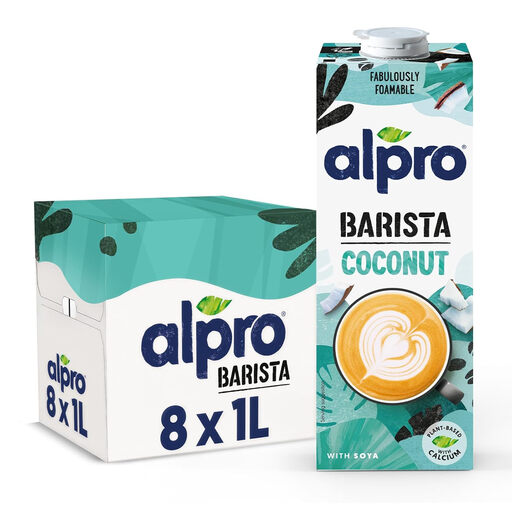
This barista-style coconut drink is an option to assess for an after-school snack, provided its soya content fits the child’s requirements. Check the current pack if a gluten-free certification mark is required.
 No image available
The listing describes this drink as gluten-free and dairy-free, with added calcium and vitamins, but it contains soya. Its barista formulation is described for coffee use; for a child’s snack, compare the current pack with their allergen requirements and check any school arrangements. The 8 x 1L format does not establish whether the drink carries a gluten-free certification mark.
No: check the finished product’s current pack rather than relying on coconut as an ingredient. The Food Standards Agency states that food labelled gluten-free in the UK must contain no more than 20 mg/kg gluten as sold to the consumer.
No. A gluten-free claim is subject to the UK labelling limit of 20 mg/kg, while Coeliac UK says products carrying its Crossed Grain Trademark undergo additional checks, including checks of gluten-analysis certificates and independent manufacturing audits. Look for the mark on the pack if that certification is required.
Check the particular drink’s ingredients and allergen declaration. Sainsbury’s lists Koko Unsweetened Coconut UHT as free from dairy, soya, nut and gluten; Waitrose lists Alpro Coconut Barista With Soya as dairy-free and gluten-free, but it contains soya. Neither listing establishes the contents of every coconut product.
Compare calcium and iodine fortification, protein and energy on the label. Kingston and Richmond NHS Foundation Trust notes that some dairy substitutes are low in protein or energy and gives 120 mg calcium per 100 ml as an ideal label benchmark when choosing a calcium-fortified substitute. Seek individual professional advice if a child has a restricted diet.
Check the individual school’s allergy policy and any arrangements for the child before packing it. Department for Education guidance for England includes food brought from home in allergy-safety planning and calls for clear expectations about labelling, preparation and storage.