Gluten-free lunch planners
If you use a coconut drink with lunch, look for an explicit gluten-free declaration on the current carton rather than judging suitability from a short ingredients list alone.


For a working-from-home lunch, Koko Dairy Free Unsweetened suits a general-use coconut drink if you also need dairy, soya and nut exclusions: Tesco Groceries lists it as free from all three and from gluten. Rude Health Coconut Drink is an explicitly gluten-free organic rice-and-coconut option, but its carbohydrate and sugars differ from Koko’s. For a foamed coffee, Sainsbury’s describes Alpro Coconut Barista as gluten free and suitable for frothing; it contains soya.
If you use a coconut drink with lunch, look for an explicit gluten-free declaration on the current carton rather than judging suitability from a short ingredients list alone.
Check each exclusion separately. Tesco Groceries lists Koko Dairy Free Unsweetened as free from dairy, soya and nuts, while Sainsbury’s lists soya in Alpro Coconut Barista.
If the drink is mainly for a foamed coffee, Alpro Coconut Barista is positioned for frothing. Its soya ingredient and nut precautionary statement still matter when choosing a carton.
These choices concern carton coconut drinks for pouring or coffee, rather than tinned coconut milk for cooking. Start with the gluten-free wording on the pack, then compare the nutrition panel, other allergens and intended use.
| Priority | What to check | Your needs |
|---|---|---|
| Gluten-free labelling | Look for an explicit gluten-free declaration on the current carton. The Food Standards Agency says a food labelled ‘gluten-free’ in the UK must contain no more than 20 mg/kg of gluten as sold; also read the ingredients and allergen information. | I want a clear declaration on the drink I will actually use, not an assumption based on its ingredients. |
| Nutrition per 100ml | Compare carbohydrate, sugars and protein on the same per-100ml basis. Tesco Groceries lists 0.2g sugars and 1.2g protein for Koko Unsweetened; Sainsbury’s lists 11g carbohydrate, 4.1g sugars and less than 0.5g protein for Rude Health Coconut Drink. | If I pour a substantial amount with lunch, I want the nutrition panel to reflect what matters to me; ‘no added sugar’ alone does not tell me the sugars value. |
| Other allergens | Read the exact variant’s ingredient, free-from and precautionary statements. Sainsbury’s lists soya and a may-contain-nuts statement for Alpro Coconut Barista; Tesco Groceries lists separate dairy-, soya- and nut-free statements for Koko Unsweetened. | Gluten is not my only exclusion, so I need to check the other allergens independently. |
| Use and storage | Decide whether the carton is for cereal, drinking or frothing in coffee. Check its size and its instructions for refrigeration and use after opening. | For an occasional lunch-time coffee, I would rather choose a carton I can use within its stated opened-life period. |
| Named certification | Check the current pack for the specific certification mark you require. Coeliac UK’s Crossed Grain Trademark is a separate scheme from a UK gluten-free labelling claim. | If a named certification matters to me, I want to see its mark on the carton rather than assume a gluten-free declaration includes it. |
An ingredients list is important, but it is not the same as an explicit gluten-free declaration. In the UK, the Food Standards Agency sets a limit of 20 mg/kg of gluten for food labelled ‘gluten-free’ as sold.
Look for the declaration on the current carton and read its ingredients and allergen statements before use.
A gluten-free coconut drink can still contain soya or carry a nut precautionary statement. Sainsbury’s lists both considerations for Alpro Coconut Barista.
Match every exclusion you need against the statement for the exact product and variant.
‘No added sugar’ does not give the carbohydrate, sugars or protein values. Sainsbury’s lists 11g carbohydrate and 4.1g sugars per 100ml for Rude Health Coconut Drink, which contains rice.
Compare the per-100ml values on the cartons, particularly if you use more than a splash.
A carton used only for occasional coffee may remain open longer than one shared across several lunches.
Check the pack’s refrigeration and opened-life instructions, then choose a size that fits how you will use it.
These details concern the named cartons, not every drink made by each brand. Check the current pack when a gluten-free or other allergen statement is essential.
Koko Dairy Free Unsweetened is a carton coconut drink for everyday pouring or drinking.
Rude Health Coconut Drink is an organic rice-and-coconut carton labelled gluten free and no added sugar by Sainsbury’s.
Alpro Coconut Barista is a gluten-free coconut-and-soya drink that Sainsbury’s describes as foamable for coffee.
M&S Creamy Coconut Drink is another carton to assess by its current pack information.
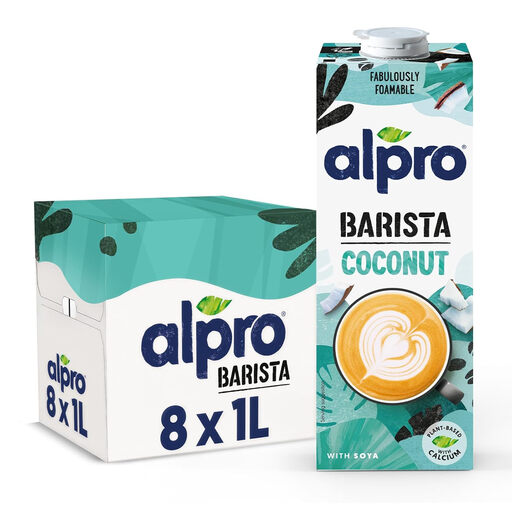
This selection covers an Alpro Barista Coconut multipack for a working-from-home lunch that includes coffee. Check the pack’s allergen and certification information against your own requirements.
 No image available
This coconut drink is presented for frothing in a lunch-time coffee and is described as gluten-free. The Joybuy product information lists calcium and vitamins B2, B12 and D; the drink contains soya. Check the current pack if you require a named gluten-free certification or need to avoid nuts.
The Food Standards Agency says a food labelled ‘gluten-free’ in the UK must contain no more than 20 mg/kg of gluten in the food as sold. Check the declaration and allergen information on the carton you buy.
No. A UK gluten-free labelling claim and Coeliac UK’s Crossed Grain Trademark are separate. Coeliac Commercial describes product analysis and an independent manufacturing-site audit for its trademark scheme; check the current carton for the mark if you require it.
Do not choose the Alpro Coconut Barista product listed by Sainsbury’s if you need to avoid soya: soya is an ingredient. That listing also says ‘may contain nuts’, so check the exact pack’s statement if nut avoidance matters.
Follow the refrigeration and opened-life instructions on the exact coconut-drink carton. If you only use a little at each lunch, consider whether you can finish its contents within that stated period.
Do not assume it is gluten free from its ingredients list: the M&S product information does not make an explicit gluten-free declaration. Check the current pack for that statement before choosing it for a strict gluten-free diet; M&S advises that product information can change.