What should you check?
Choose for the drink’s main use first, then compare the exact cartons on nutrition, fortification and allergens rather than assuming coconut drinks have the same formulation.
| Priority |
What to check |
Your needs |
| Everyday use |
Check whether the carton is intended for drinking, cereal or cooking. Compare chilled and long-life formats against how you plan to store and use it. |
I want one carton for several everyday uses, rather than a drink chosen mainly for coffee. |
| Sugars and nutrition |
Read sugars, saturated fat and protein per 100ml. Alpro UK lists 0g sugars for Coconut No Sugars; Koko lists 0.2g for Unsweetened. A no-added-sugar coconut-and-rice drink listed by Waitrose shows 4.1g sugars per 100ml. |
I want to compare the numbers on the nutrition panel, not choose from front-of-pack sugar wording alone. |
| Fortification |
Look for calcium on the exact carton, plus any other nutrients you want to compare. Alpro UK and Koko each list 120mg calcium per 100ml for their named unsweetened coconut drinks; Marks & Spencer lists calcium, iodine, vitamin B12 and vitamin D for Creamy Coconut Drink. |
If coconut drink will regularly replace dairy in my shop, I want to know which nutrients this particular carton lists. |
| Ingredients and allergens |
Read the current ingredients and allergy statement for the exact product. Marks & Spencer describes Creamy Coconut Drink as vegan but says it is not suitable for those with a milk allergy. |
Someone in my household needs product-specific allergy information, not just a vegan or dairy-free description. |
| Coffee use |
Check for a stated barista or foamable use and read the ingredients. Alpro UK describes Coconut Barista as foamable for lattes; its listed ingredients include soya, sugar and fructose, and it may contain traces of nuts. |
Lattes or cappuccinos are a regular use for me, so coffee preparation matters alongside the ingredient list. |
Brands and retailer options
These examples show why it helps to compare named products rather than assume every drink from a brand or retailer has the same ingredients.
Alpro
Its Coconut No Sugars and Coconut Barista drinks serve different shopping priorities.
- Alpro UK lists 0g sugars and 120mg calcium per 100ml for Coconut No Sugars.
- Alpro UK describes Coconut Barista as foamable, but lists soya, sugar and fructose among its ingredients and says it may contain traces of nuts.
Koko
Koko offers an Unsweetened coconut drink alongside an Original drink that it presents for hot and cold drinks and cooking.
- Koko lists 0.2g sugars, 1.2g protein and 120mg calcium per 100ml for Unsweetened.
- Check the exact variant: Koko’s description of uses for Original does not establish the ingredients or nutrition of every Koko drink.
Tesco
Tesco’s coconut-drink category lists own-label drinks alongside branded alternatives.
- Its category provides a way to compare named own-label and branded coconut drinks.
- Compare each carton’s nutrition and fortification separately; a shared category does not make the products equivalent.
M&S
Creamy Coconut Drink is an own-label example with several listed added nutrients.
- Marks & Spencer lists calcium, iodine, vitamin B12 and vitamin D for this drink.
- Its product page says the vegan drink is not suitable for those with a milk allergy.
Coconut drinks on Joybuy
These are barista coconut drinks for a coffee-focused shop. If you mainly need an everyday carton for cereal or tea, compare their labels with everyday coconut drinks before choosing.
 No image available
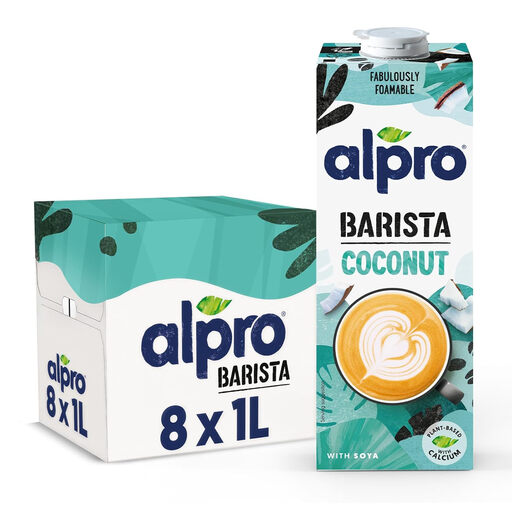
Alpro Barista Coconut Long Life Drink, 8 × 1L
This barista coconut drink is a coffee-focused option if you want a carton for lattes or cappuccinos.
The listing is for eight 1L cartons, so consider whether that quantity suits a first trial. Alpro UK describes Coconut Barista as foamable and lists soya, sugar and fructose among its ingredients; check the current pack if those ingredients matter to your household.
View on Joybuy
 No image available
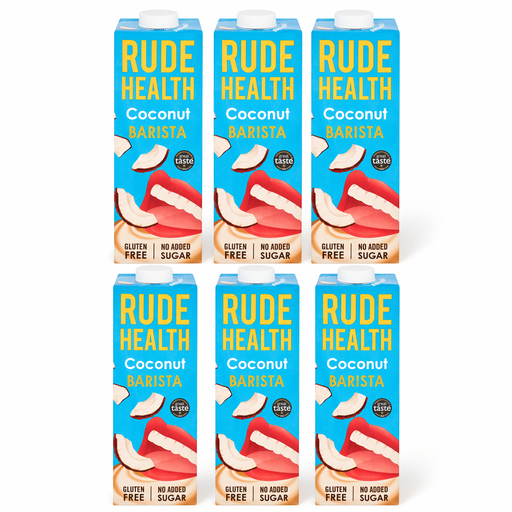
Rude Health Barista Coconut, 6 × 1L
This coconut barista drink is an option to consider when coffee is the main intended use.
The listing names six 1L cartons. Check the current pack for its ingredients and allergen statement if anyone avoids oats, and compare its nutrition panel if sugars or calcium fortification matter to your choice.
View on Joybuy
Frequently asked questions
What coconut drink should I consider for a first dairy-free food shop?
An unsweetened, calcium-fortified carton is a practical starting point for everyday use; then check its sugars, saturated fat, protein, allergens and stated uses. The NHS includes unsweetened, calcium-fortified coconut alternatives in its dairy-and-alternatives food group.
Does vegan mean a coconut drink is suitable for a milk allergy?
No. Check the exact pack’s ingredients and allergy statement. Marks & Spencer describes Creamy Coconut Drink as vegan but also states that it is not suitable for those with a milk allergy.
Is “no added sugar” the same as zero sugars?
No. Read the sugars figure per 100ml: Alpro UK lists 0g for Coconut No Sugars, while a no-added-sugar coconut-and-rice drink listed by Waitrose shows 4.1g.
Do I need a barista coconut drink for tea and cereal?
Not necessarily. A barista drink is most relevant if coffee foam is important to you. Alpro UK describes Coconut Barista as foamable for lattes, but its listed ingredients include soya, sugar and fructose, so compare it with an everyday carton for your usual uses.
Can coconut drink replace breast milk or formula for a baby?
Not as the main milk drink before age 1. North East London NHS Foundation Trust says plant-based milks can be introduced during weaning from 6 months, but should not replace breast milk or formula as the main milk until the child is 1 year old; seek individual clinical advice for allergy or feeding concerns.


