Parents choosing an everyday dairy-free drink
A carton for cereal, smoothies or a drink alongside a snack needs to fit the intended use. Compare sugars, fortification and whether the carton’s storage instructions suit how often it will be used.


For drinking, cereal or smoothies after school, start with a carton coconut drink rather than tinned coconut milk intended for cooking. If it will regularly replace dairy, compare its fortification and nutrition label; if a child has a diagnosed milk allergy, check the current pack’s ingredients and allergy statement rather than relying on ‘vegan’ or ‘dairy-free’ wording alone.
A carton for cereal, smoothies or a drink alongside a snack needs to fit the intended use. Compare sugars, fortification and whether the carton’s storage instructions suit how often it will be used.
Milk-allergy suitability needs a product-specific check. Marks & Spencer labels its Creamy Coconut Drink vegan but also states that it is not suitable for people with a milk allergy.
A coconut drink need not provide the same nutrients as dairy milk. The UK Office for Health Improvement and Disparities notes that plant-based drinks vary considerably in nutrient content, so compare the carton’s nutrition panel and consider the rest of the snack.
Choose the format for the snack first, then check allergy information and the exact carton’s nutrition and storage details.
| Priority | What to check | Your needs |
|---|---|---|
| Milk allergy | Read the current ingredients list and allergy statement. Check any precautionary wording against the child’s allergy plan; do not equate a vegan label with milk-allergy suitability. | If my child has a diagnosed milk allergy, I need to check this exact product before serving it. Marks & Spencer’s vegan Creamy Coconut Drink, for example, is labelled unsuitable for people with a milk allergy. |
| Fortification and protein | Compare calcium and protein on the same per-100ml basis. Check the label for iodine and added vitamins if the drink regularly replaces dairy; the UK Office for Health Improvement and Disparities notes that plant-based drinks vary considerably. | When coconut drink is a regular part of our dairy-free snacks, I want to know what the drink contributes rather than treating every carton as equivalent to dairy milk. |
| Sugars and ingredients | Check whether the specific product is unsweetened or labelled no sugars, then read its sugars value per 100ml and ingredients. Flavoured, original and barista recipes need not be the same. | For a routine drink or cereal topping, I may prefer an unsweetened option, while still choosing the rest of the snack separately. |
| Product format | Look for a carton coconut drink for pouring or blending. Check whether a similarly named tin is sold as a cooking ingredient; the British Heart Foundation distinguishes these coconut milk formats in its July 2026 discussion. | I need something to pour over cereal or use in a smoothie, not a tin bought for a recipe. |
| Storage | Check whether the unopened carton needs chilling and follow the pack’s refrigeration and use instructions after opening. | If we use only a little at a time, I need a carton size and storage routine that fit how we prepare snacks. |
Carton drinks and tinned cooking coconut milk serve different purposes. Marks & Spencer lists 17.3g fat and 15.1g saturates per 100g for its tinned Coconut Milk.
For cereal, smoothies or a drink alongside a snack, start with a carton coconut drink. Use a tin in recipes according to the dish.
A vegan description does not establish suitability for a diagnosed milk allergy: Marks & Spencer’s Creamy Coconut Drink is labelled vegan but states that it is not suitable for people with a milk allergy.
Read the current pack’s ingredients and allergy statement each time, and follow the child’s allergy plan where applicable.
The UK Office for Health Improvement and Disparities notes substantial variation in the nutrients supplied by plant-based drinks. Fortification and protein therefore matter when dairy is routinely excluded.
Compare the exact drink’s nutrition panel and plan the other snack foods separately rather than assuming the drink replaces every contribution of dairy.
The pack is the practical reference for the product being served, particularly when its ingredients or allergy wording matter.
Before serving, check its ingredients, allergen statement and storage instructions.
These examples show why the exact coconut product matters more than a brand name alone.
Koko’s Unsweetened Alternative Drink is a carton coconut drink listed by Tesco as fortified with calcium and vitamins D2 and B12.
Alpro has coconut drinks with different recipes and formats. Sainsbury’s lists a long-life Coconut No Sugar drink with added calcium and vitamins B12 and D.
Marks & Spencer lists a Creamy Coconut Drink separately from its tinned Coconut Milk for cooking.
Tesco lists Koko Unsweetened and Alpro Coconut Original as distinct coconut drink products.
Sainsbury’s lists both Koko Unsweetened and Alpro Coconut No Sugar drinks.
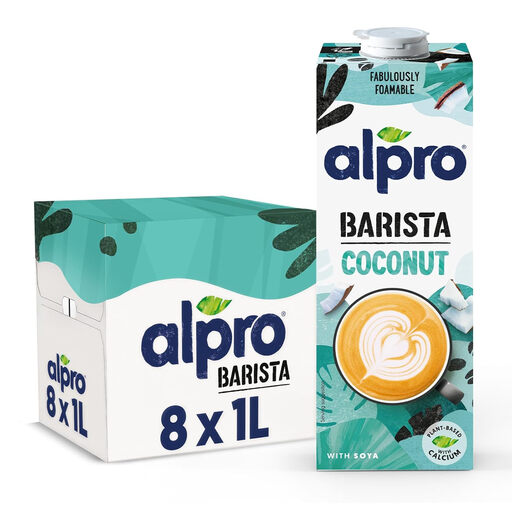
This long-life carton is an option when a dairy-free coconut drink is wanted alongside an after-school snack. Check its recipe and allergy information against the child’s needs.
 No image available
This long-life coconut drink is described as dairy-free and can be served chilled with a snack. It contains soya. Its barista recipe is not described as unsweetened, so check the current pack’s sugars value and allergen statement if either affects your choice.
A carton coconut drink can be dairy-free, but check the exact product’s current ingredients and allergy wording. The name ‘coconut milk’ can also refer to a tinned cooking ingredient, so check the format as well as the label.
No. Marks & Spencer’s Creamy Coconut Drink is labelled vegan but states that it is not suitable for people with a milk allergy. Check the current pack’s ingredients and allergy statement and follow the child’s allergy plan where applicable.
Compare the exact drink’s calcium fortification and protein, and check whether it lists iodine and added vitamins. The UK Office for Health Improvement and Disparities notes that plant-based drinks vary considerably in nutrient content, so consider the drink within the wider dairy-free diet rather than assuming it matches dairy milk.
A carton coconut drink is the more relevant format for cereal or drinking; tinned coconut milk is generally a cooking ingredient. For example, Marks & Spencer lists 17.3g fat and 15.1g saturates per 100g for its tinned Coconut Milk, so check which product a recipe or shopping list means.
Follow the instructions on the exact carton, including whether to refrigerate it and when to use it after opening. Check those instructions when choosing a carton size for snacks made only occasionally.