Dairy-free shoppers tracking calories and sugars
If you regularly add coconut drink to cereal, tea, coffee or smoothies, compare the nutrition figures with the amount you use rather than treating all dairy-free drinks alike.


For an everyday dairy-free drink, start by comparing unsweetened coconut drinks on kcal and sugars per 100ml, then consider how much you actually pour. A sweetened original or a barista drink may suit a different use, but its ingredients and nutrition need checking separately; dairy-free does not mean free from soya or nuts.
If you regularly add coconut drink to cereal, tea, coffee or smoothies, compare the nutrition figures with the amount you use rather than treating all dairy-free drinks alike.
If you also need to avoid soya, nuts, peanuts or gluten, check the ingredients and precautionary allergen statement on the exact carton. A dairy-free claim does not answer those separate questions.
If foam matters for your coffee, a barista coconut drink may meet that use. Compare its sugars, kcal and other ingredients with an everyday unsweetened drink before using it interchangeably.
Use the per-100ml figures to compare cartons, then look at the ingredients and the amount you normally pour.
| Priority | What to check | Your needs |
|---|---|---|
| Calories and portion | Compare kcal per 100ml on the same basis. NHS Better Health notes that a labelled portion may differ from the amount you consume, so check your usual pour. | I use coconut drink several times a day and want to account for the amount going into each drink or bowl. |
| Sugars | Read both the sugars figure per 100ml and the ingredients list. Alpro UK lists 0g sugars for Coconut No Sugars; Tesco Groceries lists 0.2g for Koko Unsweetened and 2.4g, with added sugar, for Tesco Long Life Coconut Original. | When choosing an everyday carton, I want to distinguish an unsweetened drink from a sweetened original, not rely on the word “coconut”. |
| Other allergens | Check ingredients and any may-contain statement on the current carton. Waitrose & Partners lists soya in Alpro Barista Coconut; Tesco Groceries lists a peanuts-and-nuts precaution for Tesco Long Life Coconut Original. | Dairy-free is only one part of my choice if I also need to avoid soya, peanuts or tree nuts. |
| Fortification and protein | Check calcium, vitamin and protein declarations for the exact drink rather than assuming coconut drinks have the same formulation. Tesco Groceries lists calcium and vitamins D2 and B12 for Koko Unsweetened, alongside 1.2g protein per 100ml. | If coconut drink regularly replaces milk for me, I want to compare those labelled nutrients as well as kcal and sugars. |
| Coffee use | Check whether the carton is intended for frothing, then compare its ingredients and nutrition. Waitrose & Partners describes Alpro Barista Coconut as foamable and lists 33 kcal and 3.3g sugars per 100ml for its chilled formulation. | I want coconut flavour and foam in coffee, but I may choose a different carton for cereal or tea. |
Tesco Groceries lists added sugar and 2.4g sugars per 100ml for Tesco Long Life Coconut Original, while its Koko Unsweetened listing declares 0.2g sugars per 100ml.
Compare the ingredients and sugars line per 100ml, even when two cartons have similar kcal figures.
Waitrose & Partners lists soya in Alpro Barista Coconut, and Tesco Groceries gives a may-contain peanuts and nuts statement for Tesco Long Life Coconut Original.
Check the current carton for ingredients and precautionary statements relevant to the ingredients you avoid.
For the formulations listed by Alpro UK and Waitrose & Partners, Alpro Coconut No Sugars has 0g sugars per 100ml, while chilled Alpro Barista Coconut has 3.3g per 100ml.
Choose according to the job the drink needs to do: check a barista formulation for coffee foam and an unsweetened one for routine use.
Ingredients, allergen statements and storage instructions need to match the product you are about to use.
Read the physical pack, particularly when an allergy or an after-opening storage instruction affects your choice.
Its Coconut No Sugars and Barista Coconut formulations address different everyday-drink and coffee needs.
The Unsweetened coconut-based drink is an option for comparing dairy-free formulations and other stated allergen claims.
Tesco Long Life Coconut Original is a sweetened, long-life alternative to compare with unsweetened drinks.
Its coconut-and-rice drink offers a different ingredient profile from the other coconut drinks discussed here.
These barista-style coconut drinks are options to consider when coffee use matters. For an everyday carton, compare their current labels with unsweetened drinks as well.
 No image available
A barista coconut drink to consider for coffee, supplied as eight 1L cartons. Check the current carton’s sugars and soya ingredients if you also plan to use it regularly in other drinks or cereal.
 No image available
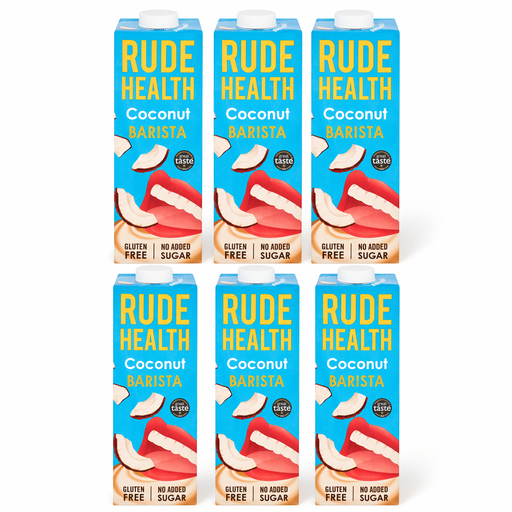
A coconut-and-oat barista drink for coffee, supplied as six 1L cartons. It contains oats; check the current carton and compare kcal and sugars per 100ml against the amount you pour.
No. NHS Better Health advises accounting for energy from drinks as well as food. Compare kcal per 100ml and consider how much you use; the label’s stated portion may not match your pour.
Read the ingredients alongside the sugars figure per 100ml. Tesco Groceries lists sugar as an ingredient and 2.4g sugars per 100ml for Tesco Long Life Coconut Original, but 0.2g sugars per 100ml for Koko Unsweetened; Alpro UK lists 0g for Coconut No Sugars.
No. Waitrose & Partners lists soya in Alpro Barista Coconut, while Tesco Groceries gives a may-contain peanuts and nuts statement for Tesco Long Life Coconut Original. Check the ingredients and precautionary wording on the current carton for each ingredient you need to avoid.
Consider one when frothing is important to how you make coffee. Waitrose & Partners describes its listed chilled Alpro Barista Coconut as foamable, but also lists soya, 33 kcal and 3.3g sugars per 100ml; check the figures on the exact formulation you buy.