People comparing calories in everyday drinks
If you add coconut drink to tea, coffee, cereal or smoothies, the per-100ml label lets you compare cartons on the same basis. Check your usual poured amount as well as calories, sugars and saturated fat.


For an everyday long-life coconut drink, compare calories, sugars and saturated fat per 100ml, then consider how much you usually pour. Tesco lists Koko Unsweetened at 19kcal and 0.2g sugars per 100ml; if the drink regularly replaces dairy, check protein and added nutrients too. A no-added-sugar or organic label does not describe the whole nutritional profile, and canned coconut milk is a different cooking product.
The choice depends on whether the carton is an occasional ingredient or a regular replacement for dairy milk.
If you add coconut drink to tea, coffee, cereal or smoothies, the per-100ml label lets you compare cartons on the same basis. Check your usual poured amount as well as calories, sugars and saturated fat.
When coconut drink takes the place of dairy milk day to day, check its protein and whether it contains added calcium, vitamin D, vitamin B12 and iodine. The UK government’s assessment of plant-based drinks notes that their nutrient composition and fortification vary considerably.
An organic or no-added-sugar carton may appeal if ingredients are your starting point, but it still needs a nutrition-label check. The listed Plenish organic drink, for example, contains sugars despite having no added sugar.
Start with the nutrition information per 100ml, then check the nutrients and storage instructions that matter for the way you will use the carton.
| Priority | What to check | Your needs |
|---|---|---|
| Calories, sugars and saturates | Compare kcal, sugars and saturated fat per 100ml on current labels. Check how much you usually pour; an amount printed as a serving may be different. | I use coconut drink in several cups of tea or coffee, or pour it over cereal, so the amount I use matters as much as the per-100ml figure. |
| Fortification | Look for added calcium, vitamin D, vitamin B12 and iodine individually. Do not assume that an unsweetened or organic carton contains them. | If this regularly replaces dairy milk, I want to know which nutrients the particular carton supplies, rather than choosing by its front-of-pack wording. |
| Protein | Read protein per 100ml separately from calories and sugars. The British Heart Foundation notes that carton coconut drink is not nutritionally comparable with dairy milk on protein. | For a meal with cereal or a smoothie, I would not count on coconut drink alone to provide the protein I want in that meal. |
| Storage and intended use | Check that you are buying a long-life or UHT drink rather than canned cooking coconut milk. Read the carton’s refrigeration and use-by instructions for after opening. | I want a carton I can keep unopened in the cupboard, but I also need to be able to finish it within its stated period once opened. |
They serve different purposes. The British Heart Foundation describes carton coconut drink as mostly water and puts canned coconut milk at around 17g fat per 100g.
For tea, cereal or smoothies, look for a carton labelled coconut drink. Choose canned coconut milk when a recipe calls for that cooking ingredient, and check the amount the recipe uses.
Those descriptions do not tell you the carton’s calories, naturally occurring sugars, protein or added nutrients. The UK government’s assessment notes substantial variation between plant-based drinks.
Compare the current label per 100ml. If it routinely replaces dairy, check fortification as well as calories and sugars.
The listed coconut drinks differ in protein: Tesco reports 1.2g per 100ml for Koko Unsweetened, while Ocado reports 0.2g per 100ml for M&S Plant Kitchen Coconut Drink. Neither figure describes a whole meal.
If protein matters to that meal, consider the other foods you are having with the drink rather than judging it by a low calorie figure.
Long-life describes the unopened product, not how it should be kept after opening. The Tesco listing for Koko Unsweetened and Ocado listing for M&S Plant Kitchen Coconut Drink both specify refrigeration and use within five days once opened.
Follow the instructions on the carton you buy and consider whether you will use its contents within the stated period.
These product-line examples show why it is worth comparing individual cartons rather than assuming every coconut drink from a brand has the same nutrition.
Koko Dairy Free Unsweetened Alternative Drink is a long-life option with added calcium, vitamin D2 and vitamin B12.
Alpro Coconut No Sugar Long Life is a UHT coconut drink described by Sainsbury’s as containing added calcium and vitamins B12 and D.
Sainsbury’s Sweetened Long Life Coconut Drink is a fortified retailer-label option.
M&S Plant Kitchen Coconut Drink is a UHT carton with added calcium, iodine, vitamin B12 and vitamin D.
Plenish Organic Coconut Drink is a UHT coconut-and-rice drink listed by Sainsbury’s with four ingredients and no added sugar.
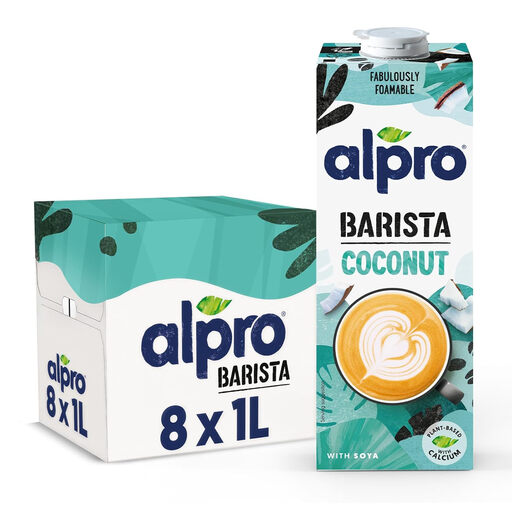
This Joybuy option is a long-life coconut drink in a barista variant, relevant if you want a coconut drink for coffee. Compare its current carton label with other long-life drinks if calories, sugars or dairy replacement are your main concerns.
 No image available
A long-life barista coconut drink to consider for coffee, supplied as 8 x 1L. Compare the current nutrition label per 100ml with the amount you pour. Check the ingredients if avoiding soya, and check the listed added nutrients if you use it regularly instead of dairy milk.
No. Carton coconut drink is intended as a drink or dairy alternative, while canned coconut milk is a cooking ingredient. The British Heart Foundation describes carton drink as mostly water and canned coconut milk as containing around 17g fat per 100g, so check which product your recipe or usual drink calls for.
Compare calories, sugars, saturated fat and protein per 100ml, then check the amount you normally use. NHS food-label guidance explains that per-100ml information makes products easier to compare; a serving shown on the carton may not be the amount you pour.
No. Unsweetened does not describe the drink’s protein or fortification. The UK government’s assessment says plant-based drinks vary considerably in nutrient composition, so check calcium and other added nutrients on the particular carton if it regularly replaces dairy milk.
Follow the opened-pack instructions rather than treating a UHT carton as cupboard-stable indefinitely. Tesco’s Koko Unsweetened listing and Ocado’s M&S Plant Kitchen Coconut Drink listing both say to refrigerate after opening and use within five days; check the instructions on the carton you buy.