Parents making quick half-term snacks
A coconut drink can be poured over cereal or blended into a smoothie, while a tin is intended for recipes that need a thicker cooking ingredient. Choosing the format first makes the label comparison more useful.


For cereal, smoothies or a drink alongside a half-term snack, start with a pourable coconut drink and compare sugars and saturates per 100 ml. Choose reduced-fat tinned coconut milk when a cooked recipe needs its thicker texture, but do not assume “reduced fat” means it has as little saturated fat as a drink. If a child would use a coconut drink as their main milk drink, check the product’s age guidance and nutritional suitability separately.
A coconut drink can be poured over cereal or blended into a smoothie, while a tin is intended for recipes that need a thicker cooking ingredient. Choosing the format first makes the label comparison more useful.
Compare sugars, saturates and calcium on the exact carton. If the drink is for a child, also check its age guidance and whether it is intended as an occasional ingredient or a main milk drink.
A reduced-fat tin may suit a cooked snack that calls for coconut milk. Its saturated-fat figure still needs checking against other tins, rather than assuming the wording on the front describes every nutrition measure.
Decide whether the snack needs a pourable drink or a tinned cooking ingredient, then compare labels within the format you would actually use.
| Priority | What to check | Your needs |
|---|---|---|
| Format and saturates | Check whether it is a pourable drink or tinned cooking milk. Compare saturates and energy per 100 ml: the Alpro and Koko drinks list 1.1 g and 1.2 g saturates, while the Waitrose and Amoy reduced-fat tins list 5.5 g and 7.7 g respectively, according to their manufacturer and retailer labels. | I want something to pour over cereal, or I need coconut milk for a cooked recipe. Those uses call for different formats, even when both packs mention coconut. |
| Sugars | Read sugars per 100 ml and the ingredients, rather than relying on coconut flavour or the words “reduced fat”. Alpro Coconut No Sugars lists 0 g sugars per 100 ml; Tesco lists 0.2 g for Koko Dairy Free Unsweetened. | For a smoothie or pancake batter, I want to know what the coconut drink contributes before adding other ingredients. |
| Use as a child’s milk drink | Check the exact carton’s age guidance, protein and fortification. Frimley Healthier Together NHS guidance distinguishes plant alternatives used in cooking from those used as a child’s main milk drink; Tesco gives Koko Dairy Free Unsweetened a lower age limit of two years. | If a child would regularly drink it instead of their usual milk, I need to assess that separately from using a little in a recipe. |
| Allergens and storage | Read the current ingredients and allergen statement. Check the pack’s refrigeration and use-after-opening instructions; Waitrose & Partners says to use its Essential Reduced Fat Coconut Milk within two days of opening. | Someone in the household may need an allergen check, or I may only use part of a tin for one snack recipe. |
On the cited product labels, the Waitrose and Amoy reduced-fat tins list 5.5 g and 7.7 g saturates per 100 ml, compared with 1.1 g and 1.2 g for the Alpro and Koko drinks. “Reduced fat” describes a product comparison; it does not make a tin equivalent to a drink.
Choose the format your snack requires, then compare the per-100-ml saturated-fat figures on the products you are considering.
Plant drinks vary in their nutrient content and age guidance. Frimley Healthier Together NHS guidance says plant alternatives may be used in cooking from six months but not as a main milk drink until a child is over one year old; individual product guidance may set a higher age limit.
If a child would use one as their main milk drink, check the exact product’s guidance and discuss dietary suitability with an appropriate health professional.
An allergen or cross-contact statement can differ between coconut products. Dairy-free wording alone does not answer whether a particular pack is suitable for someone with another allergy.
Read the current ingredients and allergen information for the exact carton or tin before using it.
Opened-storage instructions differ. Waitrose & Partners says its Essential Reduced Fat Coconut Milk should be refrigerated and used within two days of opening.
Plan another use for any remainder and follow the storage directions on the tin you buy.
A short opened-life period can make a partly used tin less practical for a single snack recipe.
Alpro Coconut No Sugars is a 1 L pourable coconut drink, rather than tinned cooking milk.
Koko Dairy Free Unsweetened is a 1 L coconut drink for pouring rather than a tinned cooking ingredient.
Amoy Reduced Fat Coconut Milk is a 400 ml tin for recipes needing a cooking ingredient.
Essential Reduced Fat Coconut Milk is a 400 ml tinned option for cooking.
M&S Food lists coconut milk for baking and includes a reduced-fat coconut milk in its cooking range.
This tinned coconut milk is an option for a cooked half-term snack recipe, not a pourable coconut drink.
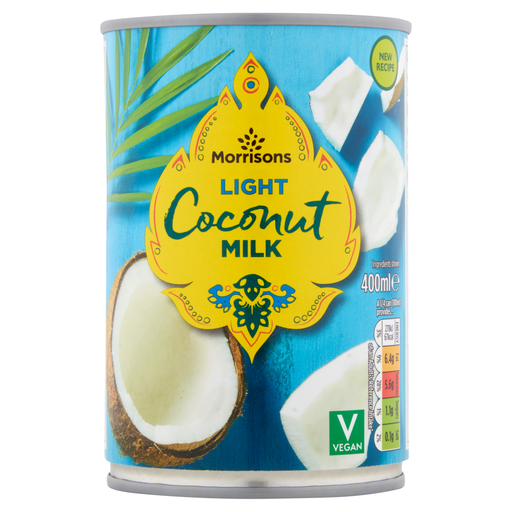 Image unavailable
For a cooked snack recipe that calls for tinned coconut milk rather than a pourable drink. This is a 400 ml reduced-fat tin; compare saturates per 100 ml and check opened-storage and allergen instructions on the current pack.
No. A coconut drink is pourable, while tinned coconut milk is a cooking ingredient. The Alpro and Koko drink labels list 1.1 g and 1.2 g saturates per 100 ml respectively; the Waitrose and Amoy reduced-fat tins list 5.5 g and 7.7 g. Choose the format your snack needs before comparing labels.
Compare energy, saturates and sugars per 100 ml on products you would use in the same way. The NHS explains that nutrition labels provide a per-100-g or per-100-ml basis; also read the ingredients and storage instructions for the exact product.
Do not assume a coconut drink is a nutritionally equivalent main milk replacement. Frimley Healthier Together NHS guidance says plant alternatives can be used in cooking from six months but not as a main milk drink until a child is over one year old. Product restrictions can differ: Tesco lists a lower age limit of two years for Koko Dairy Free Unsweetened, so check the carton and seek appropriate dietary advice if it would replace a child’s usual milk.
No. Check the ingredients and allergen statement on the exact pack, including any cross-contact warning. UK government food-labelling guidance says that any of the 14 regulated allergens present in a prepacked food or drink must be clearly identified in its ingredients list.
Follow the instructions on the specific pack rather than applying one timeframe to all coconut products. Waitrose & Partners says its Essential Reduced Fat Coconut Milk should be refrigerated below 5°C and used within two days after opening; Tesco says Koko Dairy Free Unsweetened should be used within five days after opening.