What to check before choosing
Match the liquid to the recipe before comparing labels: a fat figure alone cannot tell you whether a carton drink will perform like tinned coconut milk in a particular bake.
| Priority |
What to check |
Your needs |
| Product format |
Read whether the recipe specifies coconut milk, ordinary milk or an allowed plant-drink substitute. Check whether the product is a cooking tin or a carton drink. |
My recipe calls for tinned coconut milk, so I want a reduced-fat tin rather than assuming a carton drink is an equal swap. |
| Fat and saturates |
Read both values on the exact pack. Compare products on the same basis: per 100 g with per 100 g, or per 100 ml with per 100 ml. Do not treat “reduced fat” and “no sugars” as claims about the same nutrient. |
Reducing fat matters to me, but I also want to see the saturates figure instead of relying on the word “light”. |
| Recipe texture |
Check whether the recipe relies on the thicker tinned ingredient for its filling, mixture or finish. If it gives substitution advice, follow the specified product and quantity. |
For a bake designed around coconut milk, I would rather keep the specified type of liquid and consider a reduced-fat version than change both its format and fat content at once. |
| Ingredients and storage |
Check the current ingredients and allergen information for the exact product. Read its instructions for refrigeration and use after opening. |
I need to check a dietary requirement against the pack, and I may have coconut milk left over after baking. |
Reduced-fat coconut milk on Joybuy
This tinned option is relevant to baking recipes that specify coconut milk. Check its current label against your fat, saturates and ingredient requirements before choosing it.
 No image available
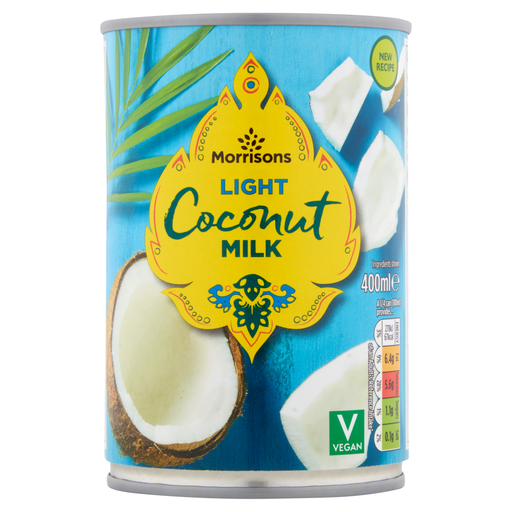
Morrisons Canned Reduced Fat Coconut Milk 400ml
This 400 ml reduced-fat tin is an option when a baking recipe specifies coconut milk. Compare the current pack’s fat and saturates values with other tins, and check its instructions if you will have leftovers.
View on Joybuy
Questions about coconut milk for baking
Can I replace tinned coconut milk with a carton coconut drink in a cake?
Only when the recipe calls for a milk-style liquid or permits that substitution. If it specifies tinned coconut milk for a creamy component, a reduced-fat tin keeps the type of ingredient closer to the recipe; a carton drink may change the result.
Does “light” coconut milk mean it is low in saturates?
No: read the saturates figure for the exact product rather than drawing that conclusion from “light”. Tesco Groceries lists 8.8 g saturates per 100 g for Tesco Ingredients Light Coconut Milk, which does not establish the value for another tin.
What should I compare on coconut product labels?
Check the product format, then compare fat and saturates on a like-for-like per-100 g or per-100 ml basis. Read the current ingredients and allergen information for each exact product. Where a traffic-light label is used, GOV.UK says it indicates whether specified nutrients are high, medium or low.
How should I store light coconut milk after opening?
Follow the instructions on your exact tin. Sainsbury's Coconut Milk Light says to refrigerate and use it within 3 days of opening; Marks & Spencer says to transfer unused M&S Reduced Fat Coconut Milk to a non-metallic container, refrigerate it and eat it within 2 days.
Should I check ingredients when buying a familiar brand again?
Yes, particularly if an ingredient or allergen affects your choice. Marks & Spencer advises reading the product label because its ingredient, dietary, nutrition and allergen information can change; check the exact pack you will use.


