Bakers choosing a lower-fat tin
If your cake recipe calls for light or reduced-fat coconut milk, compare tinned products by fat per 100ml. Check the pack format too: a coconut drink sold in a carton is a different ingredient.


For a cake recipe that calls for reduced-fat coconut milk, choose a tin rather than a ready-to-drink coconut drink. If the recipe calls for regular tinned coconut milk, a reduced-fat version changes the ingredient’s fat content; compare the labels and test an adaptation rather than assuming a direct swap will give the same result.
If your cake recipe calls for light or reduced-fat coconut milk, compare tinned products by fat per 100ml. Check the pack format too: a coconut drink sold in a carton is a different ingredient.
If the recipe specifies regular tinned coconut milk, compare its fat and coconut-extract declarations with those of a reduced-fat tin. A small test bake is more informative than assuming the substitution will work unchanged.
When serving a cake to someone with an allergy, check the ingredient and allergen information on the exact pack you use. Do not carry an allergen statement over from another coconut-milk product.
Start with the type of coconut ingredient named in the recipe. Then compare nutrition on the same per-100ml basis and check the pack before baking.
| Priority | What to check | Your needs |
|---|---|---|
| Fat content | Compare fat per 100ml, not just the words “coconut milk”. Sainsbury's lists 5.6g for its Light tin and 14.8g for its regular tin, according to its product information. | I want a reduced-fat tinned ingredient, rather than picking up a regular tin with a similar name. |
| Recipe adaptation | Check whether the recipe specifies light or regular coconut milk. Sainsbury's declares 40% coconut extract in its Light product and 68% in its regular product; those label figures do not establish how an adapted cake will turn out. | For a recipe written with regular coconut milk, I would rather test a small batch than assume a lighter tin is interchangeable. |
| Product format | Check whether the pack is tinned cooking coconut milk or a coconut-based drink. Tesco Groceries lists Koko Unsweetened as a drink containing 9% coconut milk and 1.4g fat per 100ml. | My recipe asks for tinned coconut milk, so a ready-to-drink carton is not the substitution I am looking for. |
| Pack information | Read the exact pack’s ingredients, allergen statement and instructions for using and storing any leftovers. | If I am baking for someone else, I need to check the pack I actually use and handle any leftovers as its label directs. |
A carton drink and tinned cooking coconut milk can have different formulations. Tesco Groceries lists Koko Unsweetened with 9% coconut milk and 1.4g fat per 100ml.
Match the format to the recipe. Use a coconut drink when the recipe calls for one, rather than assuming it can replace tinned coconut milk.
Labels differ: Sainsbury's Light declares 5.6g fat and 40% coconut extract per 100ml, while Waitrose Essential Reduced Fat declares 6.2g fat and 23% coconut extract per 100ml. Those figures describe the ingredients, not the result of baking with them.
If you are changing a recipe written for regular coconut milk, compare both declarations and consider a small test bake.
Coconut milk can separate or solidify, so a portion taken from the top may not represent the contents of the whole tin.
Follow the pack’s directions for shaking, stirring or gently warming the product before measuring it.
Ingredient and allergen information can change between purchases, and one product’s allergen statement does not apply to another.
Check the physical pack each time, particularly when the cake will be served to someone with an allergy.
These examples show why the exact product matters: a reduced-fat cooking tin, a regular tin and a coconut drink are not the same purchase for a cake recipe.
Tesco Light Coconut Milk is a tinned reduced-fat option.
Its Light and regular tinned coconut milks provide a same-brand label comparison.
Essential Reduced Fat Coconut Milk is a tinned cooking ingredient.
M&S lists both Reduced Fat Coconut Milk and regular Coconut Milk.
Koko Unsweetened is a coconut-based drink, not a tin of cooking coconut milk.
Alpro coconut drinks appear in Tesco Groceries’ coconut-milk search results.
This tinned option is relevant when a cake recipe calls for, or permits, reduced-fat coconut milk. Its pack format alone does not establish how it will perform in a recipe written for regular coconut milk.
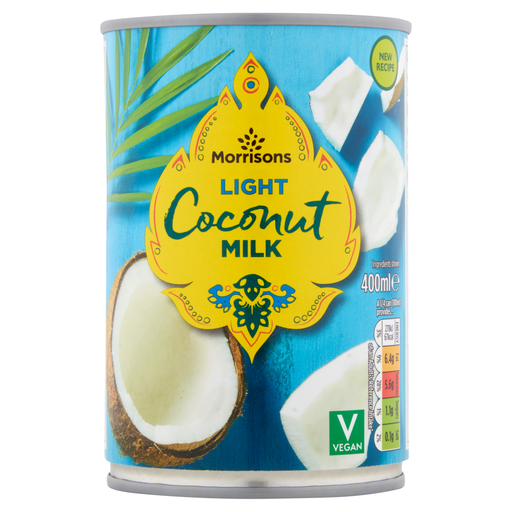 No image available
A 400ml reduced-fat tin to consider when the cake recipe permits light tinned coconut milk. If you are adapting a recipe that specifies regular coconut milk, test the change rather than assuming an identical result; check the current pack for allergen and storage instructions.
Not as an automatically equivalent swap. Sainsbury's lists 14.8g fat and 68% coconut extract per 100ml for its regular tin, compared with 5.6g fat and 40% coconut extract for Light. Follow a recipe that specifies reduced-fat coconut milk, or test a small batch when adapting one written for regular milk.
No. Tesco Groceries lists Koko Unsweetened as a coconut-based drink containing 9% coconut milk and 1.4g fat per 100ml. Use a carton drink when the recipe calls for that type of ingredient, rather than treating it as a direct substitute for a cooking tin.
Follow the instructions on your tin. If its contents have separated or solidified, mix them as the pack directs before measuring the amount needed for the recipe.
Follow the exact tin’s instructions for transferring, refrigerating and using the opened contents. Storage directions can differ between products, so check the pack before saving leftovers for another bake.
Read the ingredient and allergen statement on the current pack of every product you use. Do not assume that another brand’s statement, or information from an earlier purchase, applies to this tin.