Who is this choice for?

Cooks reducing fat in a coconut-based dish

If your recipe calls for canned coconut milk, a reduced-fat can lets you keep that ingredient format while comparing its declared fat with regular cans. Check what the recipe requires before changing its cooking liquid.

Shoppers choosing between cans and cartons

A carton coconut drink may suit milk-style uses, but it is a different choice from a canned cooking ingredient. Read the product description and ingredients if a recipe simply says “coconut milk”.

Cooks using only part of a can

If the dish needs less than a full can, check the pack’s refrigeration and use-after-opening instructions before choosing a size and planning what to make with the remainder.

What should you check?

Reduced-fat cooking can

Choose when: The recipe needs canned coconut milk as a cooking liquid and reducing fat matters to you.

Bear in mind: “Light” and “reduced fat” do not give every can the same fat or saturates figures; the recipe may also require a particular richness.

Regular cooking can

Choose when: The recipe specifies full-fat coconut milk and reducing fat is not your main aim.

Bear in mind: Sainsbury’s lists 19g fat per 100ml for Aroy-D Coconut Milk, compared with 5.6g per 100ml for its Coconut Milk Light; those figures describe the cited products, not every can.

Carton coconut drink

Choose when: You need a plant-based drink or the recipe specifically calls for a milk-style coconut drink.

Bear in mind: Sainsbury’s lists Koko Unsweetened Coconut UHT with 9% coconut milk. Do not assume it will give a dish the same result as a cooking can.

Priority What to check Your needs
Product format Read whether the pack describes a canned cooking ingredient or a carton drink. Check the recipe before substituting one for the other. My dish calls for coconut milk in a sauce or filling, so I need to know which format the recipe means.
Fat and saturates Compare both figures per 100ml on current packs. Sainsbury’s lists 5.6g fat and 4.9g saturates per 100ml for Coconut Milk Light; Waitrose lists 6.2g and 5.5g for Essential Reduced Fat Coconut Milk. I want to reduce fat without assuming that every can labelled “light” has the same nutrition figures.
Ingredients and coconut content Check the ingredients and declared coconut percentage. The cited Sainsbury’s light can contains 40% coconut extract, while Sainsbury’s lists 9% coconut milk in the Koko drink; these are different products, not a recipe test. If coconut flavour or the consistency of the cooking liquid matters to my dish, I want to check the ingredient I am actually buying.
Pack and leftovers Check the amount your recipe uses and follow that pack’s instructions for storage after opening. I may use only part of a can and need a plan for the remainder.

Common buying mistakes

  • Choosing a low-fat drink for a recipe that needs a cooking can

    A carton drink and a canned cooking ingredient have different stated uses and ingredients. Sainsbury’s lists 9% coconut milk in the cited Koko drink, whereas its Coconut Milk Light can lists 40% coconut extract; the drink is not an automatic like-for-like substitution.

    Check the recipe and product description. Choose the cooking format the dish calls for, or use a carton only if the recipe accommodates it.

  • Treating every “light” can as nutritionally identical

    Figures differ between cited products: Sainsbury’s Coconut Milk Light lists 5.6g fat per 100ml, Waitrose Essential Reduced Fat lists 6.2g, and Sainsbury’s lists 8.8g for Amoy Reduced Fat.

    Compare the current packs on the same per-100ml basis, including saturates, rather than relying on the front-of-pack description alone.

  • Overlooking the current ingredient and allergen label

    Ingredients and precautionary allergen statements can differ between products and change over time. This matters particularly when cooking for someone with an allergy or intolerance.

    Read the physical pack’s ingredient list and allergen statements before use; do not rely solely on a previously viewed listing.

  • Opening a can without planning for leftovers

    A recipe that uses only part of a can leaves an opened ingredient to store under that product’s instructions.

    Check the labelled refrigeration and use-after-opening period, then plan another suitable use for the remainder.

    Unused coconut milk may be wasted if it cannot be used within the pack’s stated period.

Brand and retailer references

These examples show why pack format and the current nutrition panel matter; a brand’s inclusion does not mean every product in its range has the same figures.

Sainsbury’s

Its Coconut Milk Light is a canned cooking option for comparing declared fat and saturates.

  • Sainsbury’s lists 5.6g fat, 4.9g saturates per 100ml and 40% coconut extract for this product.
  • Check the physical can for its current ingredients and instructions.

Waitrose essential

Essential Reduced Fat Coconut Milk is another canned cooking option.

  • Waitrose & Partners lists 6.2g fat, 5.5g saturates per 100ml and 23% coconut extract.
  • “Reduced fat” does not replace a check of the saturates figure or opened-storage directions.

Blue Dragon

Blue Dragon Light Coconut Milk is a canned option described for cooking.

  • Sainsbury’s lists 6.2g fat, 5.1g saturates per 100ml and 25% coconut extract.
  • Its cited listing carries a precautionary peanuts-and-nuts statement; check the current pack if allergens matter.

Amoy

Amoy Reduced Fat Coconut Milk is labelled as reduced in fat relative to Amoy Rich.

  • The Sainsbury’s listing states 30% less fat than Amoy Rich Coconut Milk.
  • That listing declares 8.8g fat per 100ml; a relative reduction does not make its figure the same as other light cans.

Koko

Koko Unsweetened Coconut UHT is a carton drink for milk-style uses, not a canned cooking product.

  • Sainsbury’s lists 1.4g fat per 100ml and 9% coconut milk for the cited drink.
  • Those figures do not establish how it will perform in a recipe calling for canned coconut milk.

Alpro

Alpro’s cited coconut product is a plant-based drink rather than a cooking can.

  • The cited product description identifies it as a coconut drink.
  • Check the recipe before using a milk-style drink in place of canned coconut milk.

Tesco

Tesco’s cited coconut-milk category includes Laila Light Coconut Milk 400ml.

  • The listing identifies a light canned option to examine.
  • Compare its current pack’s fat and saturates per 100ml before deciding how it fits alongside other cans.

M&S

Marks & Spencer lists regular and reduced-fat coconut milk in its category.

  • Its regular Coconut Milk product page declares 17.3g fat per 100g.
  • Check the reduced-fat product’s own panel rather than applying the regular product’s figures to it.

Joybuy cooking-can option

This reduced-fat canned coconut milk is an option to consider when your Mexican-night recipe calls for coconut milk as a cooking ingredient.
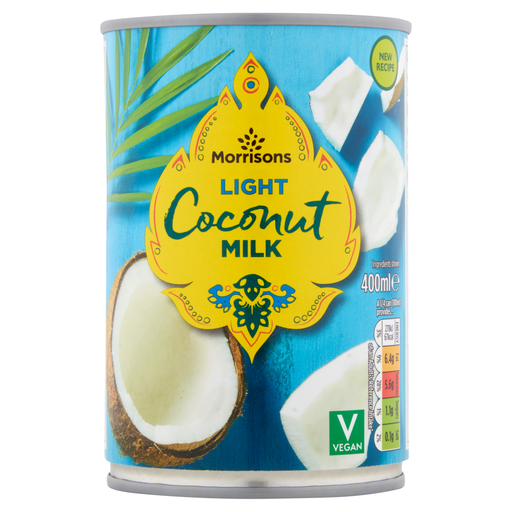
Morrisons Canned Reduced Fat Coconut Milk 400ml

Morrisons Canned Reduced Fat Coconut Milk 400ml

A reduced-fat canned option for a recipe that calls for coconut milk as a cooking ingredient. Check the current pack’s fat, saturates and opened-storage instructions against your recipe and planned use.

View on Joybuy

Frequently asked questions

Can I use a low-fat coconut drink instead of canned coconut milk?

Not as an automatic substitution when a Mexican-night recipe calls for canned coconut milk. The cited Koko carton is a milk-style drink containing 9% coconut milk, according to Sainsbury’s; check whether your recipe is written for a drink or a cooking can.

How do the cited reduced-fat cans compare for fat?

On their cited per-100ml labels, Sainsbury’s Coconut Milk Light lists 5.6g fat, Waitrose Essential Reduced Fat and Blue Dragon Light each list 6.2g, and Amoy Reduced Fat lists 8.8g. These retailer product figures compare those cans only, not every coconut milk available.

Does “reduced fat” tell me the saturated-fat content?

No: check the separate saturates figure. The cited Sainsbury’s light can lists 4.9g saturates per 100ml, while Waitrose Essential Reduced Fat lists 5.5g per 100ml; the description “reduced fat” does not make those figures interchangeable.

What should I do with coconut milk left in an opened can?

Follow that can’s instructions for transferring, refrigerating and using its contents after opening. If your recipe needs only part of the can, check the labelled period before planning a second dish.

What if I am cooking for someone with an allergy?

Read the physical pack’s current ingredients and precautionary allergen statements before use. The cited Blue Dragon Light listing includes a peanuts-and-nuts precautionary statement, but a previous online listing should not replace the label on the product you have.