What matters when choosing the format?
Start with the recipe’s required liquid or cooking ingredient, then compare the nutrition figures on the same per-100ml basis where the labels allow it.
| Priority | What to check | Your needs |
|---|
| Low-fat claim |
Check total fat per 100ml against the 1.5g limit for low-fat liquid claims in Business Companion’s UK guidance. Do not treat “light” or “reduced fat” as the same claim. |
I want a coconut liquid that meets the low-fat figure, rather than a tin that is lighter only than another coconut milk. |
| Recipe format |
Check whether the recipe calls for a drink or tinned culinary coconut milk. Sainsbury’s lists 40% coconut extract in its Light Coconut Milk; a product’s coconut content and fat figure both matter when considering a substitution. |
For scone dough, I need to know whether a thinner drink will work in my recipe. For a coconut dessert component, I may prefer a culinary tin and accept its different nutrition figures. |
| Saturated fat |
Compare the saturates line per 100ml. Tesco Light lists 5.2g and Sainsbury’s Coconut Milk Light lists 4.9g per 100ml, according to their product labels. |
With other rich cream-tea accompaniments on the table, I want to see the tin’s saturated-fat figure rather than rely on “light” wording. |
| Allergen labels |
Read the current ingredients, allergen declaration and precautionary statements. The Food Standards Agency says vegan labelling alone is not a substitute for allergen labelling. |
If I am serving someone with a milk allergy, I need to check the specific pack, even when the product is marked vegan. |
Which brands illustrate the differences?
These product examples show why a coconut drink and a reduced-fat culinary tin should be assessed separately; they do not indicate what Joybuy stocks.
Alpro
Alpro Coconut No Sugars is a drink-format example for recipes that can use a thinner coconut liquid.
- Alpro UK lists 1.2g fat and 1.1g saturates per 100ml.
- A drink should not be assumed to replace thick culinary coconut milk in a recipe.
Koko
Koko Cuisine Coconut Milk is a culinary product to assess separately from low-fat coconut drinks.
- It provides a coconut cooking-milk format.
- Koko Dairy Free lists 17.4g fat and 15.7g saturates per 100ml for this product.
Tesco
Tesco Light Coconut Milk is a tin described in comparison with Tesco standard coconut milk.
- Tesco states that its Light tin has 50% less fat than its standard coconut milk.
- Its label still lists 6.0g fat and 5.2g saturates per 100ml.
Sainsbury’s
Sainsbury’s Coconut Milk Light is a tinned option for recipes calling for a coconut cooking ingredient.
- The product lists 40% coconut extract.
- Sainsbury’s lists 5.6g fat and 4.9g saturates per 100ml, above the low-fat figure for liquids in Business Companion’s UK guidance.
M&S
M&S has reduced-fat tinned coconut milk and a separately labelled coconut drink; check the particular product rather than applying one label to the range.
- Its Reduced Fat Coconut Milk label gives nutrition figures per 100g.
- M&S lists 9.3g fat and 8.2g saturates per 100g for that tin. Its vegan Creamy Coconut Drink carries a warning that it is not suitable for those with a milk allergy.
Waitrose
Waitrose Essential Reduced Fat Coconut Milk is another tinned option to compare by its nutrition label.
- Its label provides per-100ml figures for direct comparison with other tins labelled on that basis.
- Waitrose lists 6.2g fat and 5.5g saturates per 100ml.
A Joybuy coconut drink option
This drink-format option may be relevant when serving coffee at a cream tea. If you need coconut liquid for baking, check its nutrition label and whether your recipe can use a drink in place of its specified ingredient.
 No image available
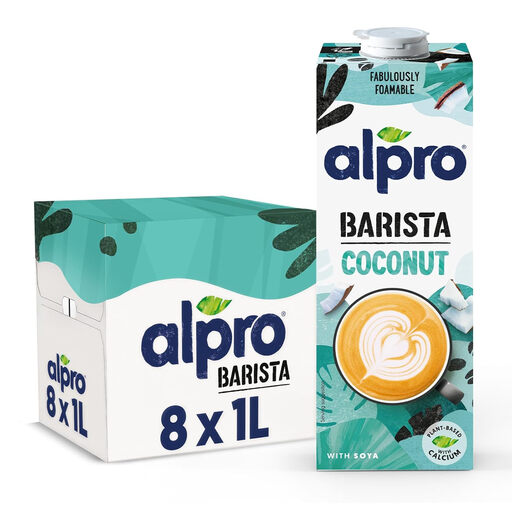
Alpro Barista Coconut Long Life Drink, 8 x 1L
For a cream tea that includes coffee, this is a coconut drink labelled Barista. The pack contains 8 x 1L; before buying it for scone dough, check the fat figure on the current label and whether a drink suits your recipe.
Joybuy
Cream-tea coconut milk questions
Does “light coconut milk” mean low fat?
No. Business Companion’s UK guidance sets a maximum of 1.5g fat per 100ml for a low-fat claim on liquids. Tesco Light Coconut Milk lists 6.0g per 100ml, so check the nutrition figure rather than treating “light” as a low-fat claim.
Should I use a coconut drink or a light tin for scones?
If your recipe accepts a thinner liquid and low fat is the priority, check coconut drinks first: Alpro UK lists 1.2g fat per 100ml for Coconut No Sugars. A light tin is a different cooking ingredient, so try a small batch if changing the format specified by your recipe.
How should I store an opened tin?
Follow the instructions on that tin for refrigeration, transferring leftovers and how soon to use them. Check the current pack rather than assuming every coconut milk has the same directions.
Is vegan coconut milk suitable for a guest with a milk allergy?
A vegan label alone cannot establish that. The Food Standards Agency advises against using vegan labelling as a substitute for allergen labelling; check the current ingredients and allergen statements. M&S, for example, marks its Creamy Coconut Drink vegan but says it is not suitable for those with a milk allergy.
Why compare saturated fat as well as total fat?
A light tin can still list several grams of saturates per 100ml: Sainsbury’s Coconut Milk Light lists 4.9g and Tesco Light lists 5.2g. The NHS identifies coconut milk and coconut cream as foods containing saturated fat and advises comparing labels when shopping.


