What should you check before buying?
Start with the recipe’s product format, then compare organic claims, ingredients and nutrition across the tins that suit it.
| Priority |
What to check |
Your needs |
| Organic claim |
Check the pack for an organic claim and certification information; do not equate “natural” with organic. The UK Department for Environment, Food & Rural Affairs says foods labelled organic must meet production and certification rules, including at least 95% organic agricultural ingredients. |
I want organic production standards to be part of this purchase, not just a simple-looking ingredient list. |
| Curry texture |
Choose a cooking coconut milk and compare coconut content and ingredients on the particular tins. Biona lists 50% coconut in its regular tin and 25% in Biona Light; Waitrose lists 60% coconut extract and organic guar gum in Duchy Organic. |
For a richer sauce, I’ll check the recipe and the tin rather than assume every organic coconut milk will cook the same way. |
| Fat and saturates |
Compare figures on the same per-100g or per-100ml basis. Biona lists 18g fat and 16g saturates per 100g for its regular organic tin, versus 9g fat and 7.9g saturates per 100g for Biona Light. |
A less rich curry would suit this meal, so I want to compare light and regular versions without assuming “organic” describes their nutrition. |
| Product format |
Read the intended use on the pack: Tesco lists 1-litre coconut drinks separately from 400ml cooking coconut milks. Check the drink’s ingredients and the recipe before substituting it for a tin. |
I need coconut milk for a curry sauce, not a carton chosen simply because it says “coconut”. |
Joybuy coconut milk options
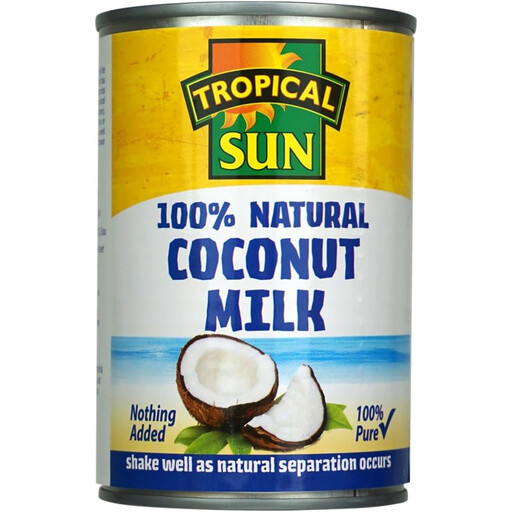
This cooking-tin option is relevant if a short ingredient list matters more to you than choosing a product with an established organic claim.
 No image available
Tropical Sun 100% Natural Coconut Milk 400ml
This cooking coconut milk is described for curries. Sainsbury’s lists coconut extract (48%) and water for this product and notes that separation is normal. If organic production is essential, check the actual pack for an organic claim and certification information rather than relying on “100% Natural”.
View on Joybuy
Coconut milk questions
What does “organic” mean on coconut milk in the UK?
According to the UK Department for Environment, Food & Rural Affairs, food labelled organic must meet organic production rules, contain at least 95% organic agricultural ingredients, and have the required certification for the product and suppliers. “Natural” is not an equivalent organic claim.
Is organic coconut milk necessarily lower in fat?
No: organic status does not specify a lower fat content. Biona lists 18g fat and 16g saturates per 100g for its regular organic coconut milk, while Biona Light lists 9g fat and 7.9g saturates per 100g. Compare the nutrition panels of the products you are considering.
Should I use regular or light coconut milk for curry?
Choose according to the sauce the recipe calls for and the tin’s ingredients. Biona lists 50% coconut in its regular organic milk and 25% in Biona Light; the Light version suits a curry where a less rich sauce is acceptable.
Can a carton of coconut drink replace a tin in curry?
Do not assume they are interchangeable. Tesco lists 1-litre coconut drinks separately from 400ml cooking coconut milks. If you want to use a drink, check its ingredients and intended use, then adapt the recipe for the result you want.
Why has the coconut milk separated in the tin?
Separation can be normal: Biona and Tropical Sun describe it for their coconut milks. Follow the relevant pack’s directions for shaking, stirring or blending, and check its storage instructions before use.


