Home cooks using a curry recipe
If your recipe calls for a can of coconut milk, start with a reduced-fat cooking product. Check the nutrition panel rather than assuming every tin labelled light has the same fat content.


For a curry recipe that calls for canned coconut milk, choose a reduced-fat cooking tin rather than assuming a coconut drink will play the same role. Compare fat and saturated fat on matching per-100ml labels: the legislation.gov.uk annex gives 1.5g fat per 100ml as the low-fat criterion for liquids, while the cited Blue Dragon Light and Essential Waitrose cans each list 6.2g fat per 100ml.
If your recipe calls for a can of coconut milk, start with a reduced-fat cooking product. Check the nutrition panel rather than assuming every tin labelled light has the same fat content.
A reduced-fat cooking tin is not necessarily a product that meets the low-fat criterion for liquids. Compare its fat figure per 100ml with the 1.5g-per-100ml criterion given in the legislation.gov.uk annex.
Vegan suitability does not answer every allergen question. Read the ingredients and precautionary allergen wording on the pack you will use, particularly when cooking for someone with an allergy.
Decide whether the recipe needs canned cooking coconut milk before comparing nutrition figures and the instructions on individual packs.
| Priority | What to check | Your needs |
|---|---|---|
| Fat and saturates | Compare both figures per 100ml where labels use that basis. Blue Dragon Light and Essential Waitrose each list 6.2g fat per 100ml, with 5.1g and 5.5g saturates respectively, according to Sainsbury’s and Waitrose & Partners. | I want to compare cooking tins using the same quantity, including the saturated-fat figure. |
| Cooking format | Check whether the product is sold for curries and sauces or as a drink. Sainsbury’s describes Blue Dragon Light for cooking; Koko’s drink lists 9% coconut milk. | My recipe calls for a can of coconut milk, so I do not want to assume a coconut drink will make the same sauce. |
| Low-fat wording | Read the fat figure, not just “light” or “reduced fat”. The legislation.gov.uk annex gives no more than 1.5g fat per 100ml as the low-fat criterion for liquids. | If I specifically need a product meeting that low-fat criterion, a reduced-fat description alone does not settle the choice. |
| Ingredients and allergens | Read the current pack for ingredients and precautionary allergen statements. Joybuy’s Amoy Reduced Fat listing, for example, states that it may contain several allergens. | I need to check the exact product before serving a curry to someone with an allergy. |
| Leftovers | Check the opened-pack storage instructions and whether the contents must be transferred to another container. Joybuy’s Blue Dragon Light listing says to refrigerate transferred contents and use them within two days. | When a recipe uses less than a whole can, I want to know how to store the remainder. |
Reduced-fat canned coconut milk can still exceed the low-fat criterion for liquids. For example, Sainsbury’s lists Blue Dragon Light at 6.2g fat per 100ml; the legislation.gov.uk criterion is no more than 1.5g per 100ml.
Check the fat figure per 100ml if that criterion matters to your choice.
Alpro describes its coconut product as a drink, and Koko’s drink lists 9% coconut milk. Neither description establishes that it will behave like canned cooking coconut milk in a curry.
If you want to try a drink instead, make a small batch and adjust the other liquids and seasoning to the result.
Fat and saturated fat are separate figures on the nutrition panel. For instance, Waitrose & Partners lists 6.2g fat and 5.5g saturates per 100ml for Essential Reduced Fat Coconut Milk.
Compare both figures using the same stated quantity, and account for how much coconut milk the recipe uses.
Vegan status does not replace an allergen check. Joybuy’s Amoy Reduced Fat listing includes precautionary wording for several allergens.
Read the ingredients and precautionary statements on the pack before cooking for someone with an allergy.
Tesco Groceries lists own-label and branded light coconut milks, including Tesco Light, Laila Light and Blue Dragon Light.
Sainsbury’s lists Amoy Reduced Fat and Blue Dragon Light canned coconut milks with per-100ml nutrition information.
Essential Reduced Fat Coconut Milk is a 400ml cooking tin used in a Waitrose & Partners Thai-style salmon curry recipe.
M&S describes its 400ml Reduced Fat Coconut Milk as a cooking option for Thai curry.
Alpro Coconut No Sugar is sold as a coconut drink, rather than canned cooking coconut milk.
Koko Unsweetened Coconut UHT is a coconut drink listing 9% coconut milk.
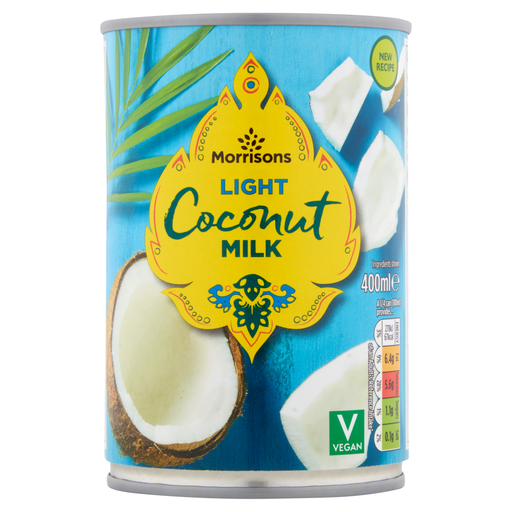
This canned reduced-fat option fits a curry recipe that calls for cooking coconut milk. Check its pack for the nutrition and allergen details that matter to you.
 No image available
A 400ml canned reduced-fat coconut milk for a curry recipe calling for a cooking product. Compare fat and saturates on the pack, and check its current allergen wording if relevant.
No: “reduced fat” and “low fat” do not mean the same thing. For liquids, the legislation.gov.uk annex gives no more than 1.5g fat per 100ml as the low-fat criterion; Sainsbury’s and Waitrose & Partners each list 6.2g per 100ml for their cited light or reduced-fat cooking tins.
Use canned cooking coconut milk when your curry recipe calls for it. Alpro and Koko are sold as drinks, and Koko lists 9% coconut milk; do not assume either will make the same sauce without adapting the recipe.
Start with a recipe written for reduced-fat canned coconut milk and follow its liquid quantities and simmering instructions. Waitrose & Partners’ Thai-style salmon curry uses a 400ml can of Essential Reduced Fat Coconut Milk and includes a 5–6 minute simmer.
Follow the instructions on the particular can. Joybuy’s Blue Dragon Light listing says to transfer opened contents to an appropriate container, refrigerate them and use them within two days.
Vegan wording alone cannot answer that question. Check the ingredients and precautionary allergen statements on the actual pack; Joybuy’s Amoy Reduced Fat listing, for example, states that it may contain several allergens.