What should you check?
Decide whether you need a drink or a cooking ingredient first, then compare the current labels for your gluten-free requirement and the quantity you will use.
| Priority | What to check | Your needs |
|---|
| Total carbohydrate |
Read total carbohydrate per 100ml, not just sugars or a front-of-pack claim. Work out the amount in your actual serving; Diabetes UK identifies total carbohydrate consumed as the key quantity for blood-glucose planning. |
I use different amounts in a coffee and a smoothie, so the figure for what I pour matters more than the label wording alone. |
| Gluten-free claim |
Check the finished product’s current gluten-free wording and allergen information. The Food Standards Agency defines a UK gluten-free claim as no more than 20 mg/kg gluten in the food as sold; that claim does not itself establish third-party certification. |
I need a clear statement on the pack, and I will check certification evidence separately if that is part of my requirement. |
| Drink or cooking milk |
Check the intended use and saturates per 100ml. Koko Dairy Free lists 15.7g saturates per 100ml for Koko Cuisine; the NHS also flags coconut-milk curries as a saturated-fat consideration. |
For a curry, I want a cooking ingredient and need to account for the amount in each portion. For everyday pouring, I am comparing coconut drinks instead. |
| Fortification |
If a coconut drink regularly replaces milk, check its calcium value per 100ml and whether the exact variant lists added vitamins. Diabetes UK advises checking that plant-based milk alternatives are unsweetened and fortified with calcium. |
When I use a dairy-free drink every day, I want to know what the particular carton contains rather than assume all coconut drinks are alike. |
| Protein |
Compare the same per 100ml measure: Alpro UK lists 0.2g protein for Coconut No Sugars, while Tesco lists 1.2g for Koko Dairy Free Unsweetened Alternative Drink. |
If protein content matters to my choice of milk alternative, I want to compare the specific drinks rather than the coconut category as a whole. |
Coconut drink on Joybuy
This Barista coconut drink is an option for coffee rather than the Alpro Coconut No Sugars drink discussed above. Check its sugar and total carbohydrate information before choosing it for regular pours.
 No image available
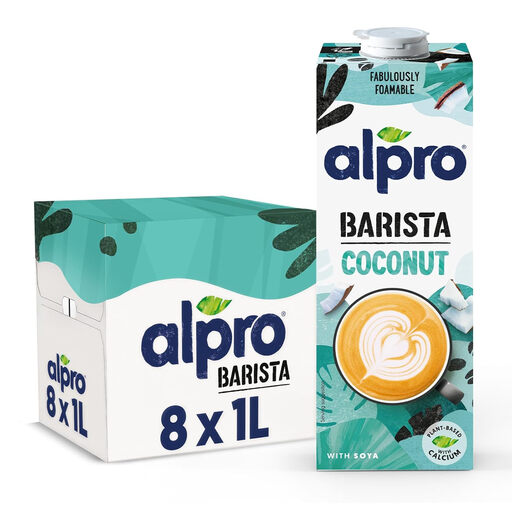
Alpro Barista Coconut Long Life Drink, 8 x 1L
The product information describes this drink for frothing coffee and states that it is gluten-free. It also indicates that the drink contains sugar, so check the current carton’s total carbohydrate for the amount you pour. If you require third-party gluten-free certification, check the pack or manufacturer evidence separately.
View on Joybuy
Questions about coconut drinks and milk
What does “gluten-free” mean on a UK coconut drink?
The Food Standards Agency defines a gluten-free claim as no more than 20 mg/kg gluten in the food as sold to the final consumer. Check that the current pack carries the claim and review its ingredients and allergen information; a gluten-free claim does not, by itself, establish independent certification.
Is a no-sugars coconut drink automatically suitable when managing diabetes?
No-sugars wording alone is not enough for that decision. Diabetes UK advises looking at total carbohydrate consumed, so check the carton’s total carbohydrate per 100ml and calculate it for your serving.
How do Alpro Coconut No Sugars and Koko Unsweetened compare on carbohydrate?
Alpro UK lists 0.0g carbohydrate per 100ml for Alpro Coconut No Sugars, while Tesco lists 0.4g per 100ml for Koko Dairy Free Unsweetened Alternative Drink. Those figures apply to those specific drinks; check the current carton and the amount you use.
Is cooking coconut milk interchangeable with coconut drink?
Not for a like-for-like nutrition comparison. Koko Dairy Free lists 15.7g saturates and 4.4g carbohydrate per 100ml for Koko Cuisine Coconut Milk, while its unsweetened pourable drink has different stated values. Choose for the intended recipe or drink, then check the specific product and serving size.
What should I check if a coconut drink regularly replaces milk?
Check whether the exact drink is unsweetened and fortified with calcium, as Diabetes UK advises for plant-based milk alternatives. Alpro UK and Tesco each list 120mg calcium per 100ml for the Alpro Coconut No Sugars and Koko Unsweetened drinks respectively; fortification can differ between variants.


