Families trying a mild curry or soup
If a child is wary of unfamiliar flavours or textures, try a small amount of cooking coconut milk in a familiar meal. The NHS advises continuing to offer a variety of foods, as acceptance can take many attempts.


For a familiar curry or soup, start with a cooking coconut milk whose product description mentions a mild coconut flavour; a light or reduced-fat label alone does not tell you how a child will find the taste. Compare the exact pack if you want a less rich sauce, and use a coconut drink only when the recipe calls for a plant-based milk alternative.
If a child is wary of unfamiliar flavours or textures, try a small amount of cooking coconut milk in a familiar meal. The NHS advises continuing to offer a variety of foods, as acceptance can take many attempts.
If a regular coconut milk makes a sauce richer than you want, compare reduced-fat and regular cooking products using the fat value and coconut-extract percentage on each pack. Check whether the nutrition figures use the same weight or volume measure before comparing them.
Check whether a recipe calls for a coconut drink or cooking coconut milk. Alpro Coconut Original and Koko Original Like Milk are drinks; Koko Cuisine is Koko’s separate cooking product.
Choose the product type the recipe needs, then compare flavour descriptions, labels and pack directions before making a meal for a child.
| Priority | What to check | Your needs |
|---|---|---|
| Mild coconut flavour | Look for a cooking product whose description explicitly mentions mild coconut flavour. Sainsbury’s describes Island Sun Coconut Milk this way; do not treat “light” as a flavour description. | I want to try coconut milk in a familiar curry or soup without assuming my child will accept a new flavour straight away. |
| Sauce richness | Compare fat and coconut extract on the exact pack. Sainsbury’s lists 5.6g fat per 100ml for its Light milk and 14.8g per 100ml for its regular milk. Marks & Spencer lists 9.3g and 17.3g respectively per 100g. | A reduced-fat cooking milk is worth considering if I want to try a less rich sauce; I will judge the finished recipe rather than assume its label predicts the texture. |
| Product type | Check whether the pack says drink or identifies a cooking milk. Alpro says its Coconut Original drink contains 5.3% coconut milk; Koko lists 11% coconut milk in Original Like Milk and 25% coconut extract in its separate Cuisine cooking product. | For a curry, I need to avoid picking up a coconut drink when the recipe calls for cooking coconut milk. |
| Ingredients and storage | Read the current pack’s ingredient and allergen information, plus its directions for storing any milk left after opening. Check the directions for the product and container you buy. | If I am serving a child with an allergy, the current pack matters more than a previous purchase or an older online description. I also need a plan for any leftovers. |
Reduced-fat cooking milks have different ingredient lists and fat values. A light label does not establish whether a child will accept the coconut flavour.
When mild flavour matters most, look for an explicit flavour description and try a small amount in a familiar meal.
Alpro Coconut Original and Koko Original Like Milk are drinks, while Koko Cuisine is a separate cooking product. Their different compositions make them poor like-for-like choices for a recipe written for cooking coconut milk.
Follow the product type specified by the recipe. If it calls for a plant-based drink, choose one with that use in mind rather than assuming it will produce the same sauce as a cooking milk.
Ingredients and allergen statements are product-specific, so a name or an earlier purchase is not enough to assess a child’s current pack.
Read the ingredient and allergen information on the pack before serving, particularly if a child has an allergy.
These ranges illustrate different product types and label comparisons; a brand name alone does not establish how a coconut milk will taste in a particular recipe.
Its own-brand Light and regular cooking coconut milks allow a comparison within the same range.
Its Reduced Fat and regular cooking coconut milks offer another within-range label comparison.
The range includes a reduced-fat cooking coconut milk.
Koko Original Like Milk is a drink; Koko Cuisine is a separate cooking coconut milk.
Alpro Coconut Original is a coconut drink, not a tinned cooking coconut milk.
Tesco lists both own-brand Light and regular 400ml cooking coconut milks in its coconut-milk range.
This reduced-fat cooking coconut milk is an option to consider for a familiar curry or soup. Its label does not, by itself, settle whether the coconut flavour will suit a fussy eater.
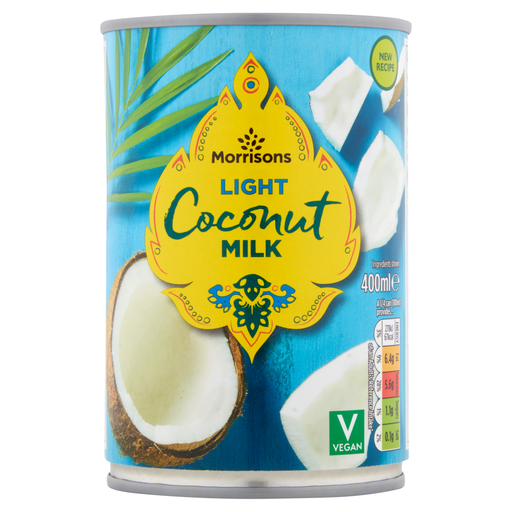 Image unavailable
For a curry or soup, try a small amount in a familiar dish before deciding whether its coconut flavour suits your child. This is a 400ml can labelled reduced fat; check the current pack for ingredients, allergens and storage directions.
No: “light” or “reduced fat” does not establish how mild the coconut flavour will seem to a child. If flavour is the deciding factor, look for a product description that explicitly mentions mild coconut flavour and try it in a small serving of a familiar meal.
Use a coconut drink when the recipe calls for a plant-based drink, rather than assuming it will behave like cooking coconut milk. Alpro Coconut Original and Koko Original Like Milk are drinks; Koko Cuisine is Koko’s separate cooking product.
Follow the storage directions on the exact can or carton. For Morrisons Reduced Fat Coconut Milk, the product information instructs you to transfer leftovers to a non-metallic container, refrigerate them and use them within two days.
No. If a child has an allergy, read the current pack’s ingredients and allergen statement before serving; do not rely on the product name or a pack checked on an earlier occasion.