Who is choosing?

Keto-style home cooks reducing fat

For curries, soups or sauces, a light canned coconut milk keeps the choice in the cooking aisle. Check its carbohydrate and fat for the amount the recipe actually uses; the word “light” cannot settle either calculation.

Low-carb shoppers choosing a coconut drink

For tea, cereal or smoothies, a carton drink may suit the intended use better than a can. Compare individual drinks rather than assuming that every coconut drink has the same carbohydrate content.

People on a medically supervised ketogenic diet

Cambridge University Hospitals NHS Foundation Trust describes ketogenic dietary therapy as medically supervised and very low in carbohydrate. A supermarket product and its planned portion need to fit the individual dietitian-calculated plan, not a general “keto” description.

What should you check?

Carton coconut drink

Choose it for: Tea, cereal, smoothies or coffee when you want a drink rather than a cooking ingredient.

Trade-off: It will not give a curry the richness or fat contribution of canned coconut milk.

Reduced-fat canned coconut milk

Choose it for: Curries, soups or sauces when a coconut cooking ingredient matters more than choosing a drink.

Trade-off: Reduced fat does not establish a particular carbohydrate level; check the recipe portion as well as the label.

PriorityWhat to checkYour needs
Carbohydrate Read carbohydrate per 100 ml or per 100 g and calculate it for the amount used. The published figures are 0.0 g per 100 ml for Alpro Coconut No Sugars Drink and 0.4 g per 100 ml for Koko Unsweetened; their labels do not describe every carton drink. I want to know what my drink or recipe portion contributes to my own carbohydrate plan, rather than deciding from “no sugars” or “light” on the front.
Fat Check fat alongside carbohydrate. Sainsbury's lists 5.6 g fat per 100 ml for its Coconut Milk Light; M&S lists 9.3 g per 100 g for its Reduced Fat Coconut Milk. Keep their different label units in view. For cooking, I want a reduced-fat can, but I still need to know how much fat the portion adds. A medically prescribed ketogenic diet has different, individually calculated requirements.
Format Check whether the pack is a carton drink or canned cooking milk, and whether its stated use fits the dish. The British Heart Foundation distinguishes coconut drinks from tinned coconut milk. A drink works for my tea or cereal; for a curry that needs coconut-milk body, I would start with a cooking product.
Ingredients Read the current ingredients, allergen information and nutrition panel. For plant-based drinks, the UK Office for Health Improvement and Disparities notes that nutrient content varies considerably. If I need to avoid an ingredient or want a particular formulation, the category name alone will not tell me what is in this pack.

Buying pitfalls

  • Assuming “reduced fat” also means less carbohydrate

    The two measures do not move together across products: M&S lists 1.8 g carbohydrate and 9.3 g fat per 100 g for its Reduced Fat Coconut Milk, while Sainsbury's lists 3.5 g carbohydrate and 5.6 g fat per 100 ml for its Coconut Milk Light. The units differ, so these figures are not a like-for-like serving comparison.

    Read both values on the pack you intend to buy and calculate them for your planned portion.

  • Using a carton drink where a recipe needs a can

    A carton coconut drink and canned coconut milk serve different purposes. Substituting a drink can change the body and fat contribution of a curry or sauce.

    Choose by the recipe's intended format first, then compare the nutrition panels within that format.

  • Treating “keto” wording as a clinical diet plan

    Cambridge University Hospitals NHS Foundation Trust describes ketogenic dietary therapy as medically supervised, with individual dietary calculations. Product wording cannot determine whether a portion fits that plan.

    If you follow a prescribed ketogenic diet, check the product and serving with your dietitian or healthcare team.

  • Relying on an older product page

    Ingredients and label information can change, and storage instructions vary by product. A figure copied from an earlier listing may not describe the pack in your hand.

    Check the current pack for nutrition, allergens and instructions for storage after opening.

Brand and retailer references

These examples show why the exact product and format matter; a brand name alone does not identify its fat or carbohydrate figures.

Alpro

Alpro Coconut No Sugars is a carton drink, not canned cooking coconut milk.

  • Alpro lists 0.0 g carbohydrate and 1.2 g fat per 100 ml for Coconut No Sugars.
  • Its drink format is not a direct substitute when a recipe depends on the body of canned coconut milk.

Koko

Koko has separate coconut drink and cooking-milk products.

  • Koko lists 0.4 g carbohydrate and 1.4 g fat per 100 ml for Unsweetened.
  • Its distinct Cuisine Coconut Milk lists 4.4 g carbohydrate and 17.4 g fat per 100 ml; do not use the drink's figures for the cooking product.

Tesco

Tesco's coconut-milk and coconut-drink categories include light canned milk and carton drinks.

  • The separate categories make the intended cooking or drinking format a useful starting point.
  • Compare the nutrition panel on the particular product, not the category heading.

Sainsbury's

Sainsbury's Coconut Milk Light is a canned cooking option.

  • Sainsbury's lists 5.6 g fat and 3.5 g carbohydrate per 100 ml for this product.
  • The light description does not establish whether the amount used fits an individual carbohydrate plan.

M&S

M&S lists reduced-fat and regular canned coconut milks, as well as a separate coconut drink.

  • M&S lists 9.3 g fat and 1.8 g carbohydrate per 100 g for Reduced Fat Coconut Milk, against 17.3 g fat and 2.9 g carbohydrate per 100 g for its regular Coconut Milk.
  • Its Creamy Coconut Drink has a different formulation and carries a warning that it is not suitable for those with a milk allergy.

Waitrose

Waitrose lists Essential Coconut Milk and Essential Reduced Fat Coconut Milk as distinct canned products.

  • The range offers a regular-versus-reduced-fat cooking choice.
  • Use the chosen pack's carbohydrate and fat panel to assess your recipe portion.

Joybuy product options

These options cover two different uses: a reduced-fat canned ingredient for cooking and a coconut-containing barista drink for coffee. Compare each product against the portion and format you need.
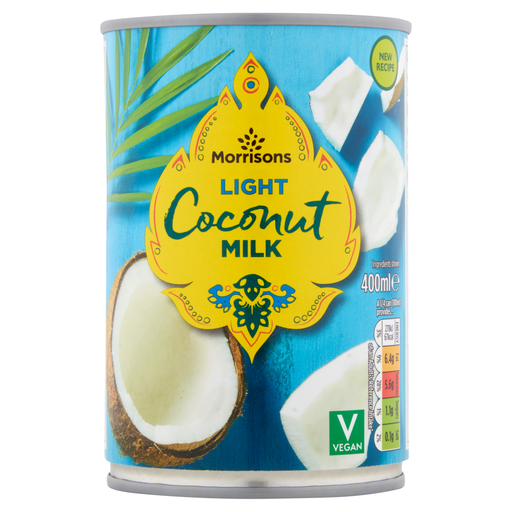
Morrisons Reduced Fat Coconut Milk 400ml can

Morrisons Reduced Fat Coconut Milk 400ml

A canned reduced-fat coconut milk to consider for curries, soups or sauces. Check the current pack's carbohydrate and fat figures, then calculate them for the amount your recipe uses.

View on Joybuy

Alpro Barista Coconut Long Life Drink 8 x 1L

Alpro Barista Coconut Long Life Drink 8 x 1L

A carton barista drink for a coffee or iced latte, rather than canned coconut milk for cooking. Check its carbohydrate, sugar and allergen information on the current pack; do not assume it has the same formulation as Alpro Coconut No Sugars.

View on Joybuy

Questions about choosing

Is reduced-fat coconut milk automatically suitable for a keto-style plan?

No. Reduced fat does not specify how much carbohydrate your portion contains or whether it fits your own plan. Sainsbury's lists 3.5 g carbohydrate and 5.6 g fat per 100 ml for Coconut Milk Light; M&S lists 1.8 g carbohydrate and 9.3 g fat per 100 g for Reduced Fat Coconut Milk. Check the units and calculate the amount you will use.

Should I use a carton coconut drink or canned coconut milk?

Use a carton drink for occasions such as tea or cereal, and start with canned coconut milk when a curry, soup or sauce calls for a coconut cooking ingredient. The British Heart Foundation distinguishes these formats; their intended uses and fat contributions differ.

How do Alpro Coconut No Sugars and Koko Unsweetened compare as drinks?

Alpro lists 1.2 g fat and 0.0 g carbohydrate per 100 ml for Coconut No Sugars; Koko lists 1.4 g fat and 0.4 g carbohydrate per 100 ml for Unsweetened. Those are figures for these specific drinks, not for every Alpro or Koko product. Check the current pack before choosing.

Can supermarket coconut milk be used in a prescribed ketogenic diet?

The product and portion must fit the individual dietitian-calculated plan. Cambridge University Hospitals NHS Foundation Trust describes ketogenic dietary therapy as medically supervised; a “keto” description on a product is not a substitute for that plan.

What if I have diabetes and plan to restrict carbohydrate?

Speak to your diabetes healthcare team before making significant changes to your diet, as Diabetes UK advises. A coconut product's label can help you count a portion, but it cannot determine an individual treatment or medication plan.