Choose reduced-fat canned coconut milk for coconut flavour in a cooked meal, or a coconut drink when you need a lower-fat beverage alternative. Neither should be the meal’s main carbohydrate source: build a training meal around foods such as rice or oats. Before a run, Sports Dietitians Australia advises choosing familiar, well-tolerated foods that are high in carbohydrate and low in fat, and testing meal timing during training.
Who is this choice for?
The useful distinction is whether you need a cooking ingredient, a drink alternative or a familiar pre-run meal.
Runners making coconut-based meals
If you want coconut flavour in a curry, soup or rice dish while keeping its fat contribution lower, compare canned products per 100ml. Use the coconut milk as an ingredient and get the meal’s main carbohydrate from the other foods you serve with it.
Runners planning food before a run
Sports Dietitians Australia advises familiar, well-tolerated, high-carbohydrate, low-fat food before exercise. Coconut milk or a coconut drink can be part of a meal you have tested in training, but is not a substantial carbohydrate source on its own.
Runners choosing a dairy-free drink alternative
A coconut drink may suit cereal or a smoothie when you want a beverage rather than canned milk for cooking. Check its carbohydrate and protein values as well as its fat content, then choose the other ingredients to suit the meal you are making.
What should you check?
Start with how you will use the product, then compare the nutrition values per 100ml and consider the rest of the meal.
| Priority |
What to check |
Your needs |
| Carbohydrate in the meal |
Check carbohydrate per 100ml and what else the meal contains. Waitrose & Partners lists 2.1g per 100ml for its Essential Reduced Fat Coconut Milk; Koko Dairy Free lists 0.4g for Koko Unsweetened No Sugar Milk. |
I want coconut flavour without relying on coconut milk to supply the meal’s carbohydrate. The UK Sports Institute advises adjusting carbohydrate intake to the demands of training and competition. |
| Fat and saturates |
Compare both values per 100ml, preferably between products you would use in the same way. Waitrose & Partners lists 6.2g fat and 5.5g saturates for its reduced-fat can; Koko Dairy Free lists 1.4g fat and 1.2g saturates for its unsweetened drink. |
For regular cooking, I want to see how much fat the amount used in my recipe adds. A reduced-fat label alone does not tell me the saturated-fat value. |
| Product format |
Check whether it is a canned cooking product or a coconut drink. Choose for the recipe or drink you intend to make, rather than treating every product labelled coconut milk as interchangeable. |
I need coconut milk for a sauce, or a drink to pour over cereal. Those uses call for different formats. |
| Pre-run familiarity |
Consider the full meal, portion and time before running. Sports Dietitians Australia recommends trying meal timings and snacks during training rather than experimenting on competition day. |
Before an important run, I would rather use a meal and timing I already know I tolerate than try a new coconut-based recipe. |
Common buying mistakes
-
Treating the coconut product as the main fuel
These products contribute little carbohydrate per 100ml: Koko Dairy Free lists 0.4g for its unsweetened drink, while Waitrose & Partners lists 2.1g for its reduced-fat canned milk.
Choose the coconut product for its role in the drink or recipe, and plan the meal’s carbohydrate foods separately.
-
Reading “reduced fat” as “low in saturates”
A reduction is relative to a comparison product. Sainsbury’s lists 7.7g saturates per 100ml for Amoy Reduced Fat Coconut Milk, despite its stated 30% fat reduction against Amoy rich coconut milk.
Read the total-fat and saturates figures per 100ml on the pack before choosing between products.
-
Using a drink and a cooking milk interchangeably
A coconut drink for cereal or smoothies serves a different recipe role from canned coconut milk for a curry or sauce. Their nutrition values can differ considerably too.
Decide what you are making before comparing products, then check the pack for the intended use.
-
Trying a new coconut-based meal just before a race
Even a reduced-fat product does not establish whether you will tolerate the complete meal or its timing before running.
Follow Sports Dietitians Australia’s advice to trial the meal and timing during training rather than experimenting on competition day.
Relevant brand references
Compare the named products and their intended uses; these figures do not describe every product made by each brand.
Koko
Koko Dairy Free lists both coconut drinks and a separate Cuisine Coconut Milk for cooking.
- Koko Unsweetened No Sugar Milk lists 1.4g fat, 1.2g saturates and 0.4g carbohydrate per 100ml.
- Koko Cuisine Coconut Milk is a different product: its listed values are 17.4g fat and 15.7g saturates per 100ml. Neither product’s coconut content makes it a standalone carbohydrate fuel.
essential Waitrose
Waitrose & Partners describes its Essential Reduced Fat Coconut Milk as a canned product for cooking.
- Its listed values per 100ml are 66kcal, 6.2g fat and 2.1g carbohydrate, giving you figures to use when planning a recipe.
- It also lists 5.5g saturates per 100ml; the rest of the meal needs to supply the main carbohydrate component.
Amoy
Amoy Reduced Fat Coconut Milk is a cooking product listed by Sainsbury’s.
- Sainsbury’s states that it has 30% less fat than Amoy rich coconut milk.
- Its listed values are 8.8g fat, 7.7g saturates and 2.6g carbohydrate per 100ml. The relative fat reduction does not establish that it is low in saturates.
Coconut milk options on Joybuy
This reduced-fat canned coconut milk is an option for cooked meals where you want coconut flavour alongside carbohydrate foods such as rice or noodles.
 No image available
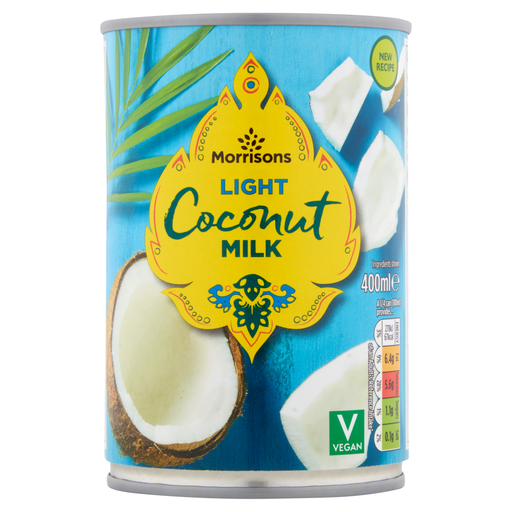
Morrisons Canned Reduced Fat Coconut Milk 400ml
A canned coconut milk for a cooked training meal; serve it with a carbohydrate food rather than using the coconut milk as the meal’s main fuel. Check the pack’s fat and saturates values when deciding how much to use.
View on Joybuy
Frequently asked questions
Can low-fat coconut milk fuel marathon training on its own?
Do not rely on it as the main carbohydrate source. Koko Dairy Free lists 0.4g carbohydrate per 100ml for its unsweetened drink, while Waitrose & Partners lists 2.1g for its reduced-fat canned milk. Choose the rest of the meal to meet the demands of your training; the UK Sports Institute advises adjusting carbohydrate intake by session.
Should I have reduced-fat canned coconut milk before a long run?
Use it in a pre-run meal only if that meal, portion and timing work for you in training. Sports Dietitians Australia advises familiar, well-tolerated food that is high in carbohydrate and low in fat before exercise; a reduced-fat coconut milk label does not establish how the complete meal fits that advice.
What is the difference between a coconut drink and canned coconut milk?
A coconut drink is a beverage alternative, while canned coconut milk is used as a cooking ingredient. For the named products, Koko Dairy Free lists 1.4g fat per 100ml for Koko Unsweetened No Sugar Milk, and Waitrose & Partners lists 6.2g per 100ml for Essential Reduced Fat Coconut Milk. Choose the format for what you intend to make, then compare its label.
How should I store an opened can?
Follow the instructions on the can you buy. Waitrose & Partners says to keep its Essential Reduced Fat Coconut Milk refrigerated below 5°C after opening and consume it within 2 days; do not assume another product has the same instructions.


