Home cooks comparing recipe ingredients
If you use coconut milk in curries, soups or sauces, compare cooking products per 100ml before working out what the quantity in your recipe contributes. Check saturates as well as kcal and total fat.


For curries, soups and sauces, compare reduced-fat cooking coconut milks by kcal, fat and saturates per 100ml, then consider how much the recipe uses; ‘light’ alone does not tell you the saturated-fat content. For cereal or coffee, compare carton coconut drinks separately: the British Heart Foundation distinguishes them from tinned cooking coconut milk because they serve different purposes.
If you use coconut milk in curries, soups or sauces, compare cooking products per 100ml before working out what the quantity in your recipe contributes. Check saturates as well as kcal and total fat.
If the coconut product is for cereal, coffee or drinking, look at carton drinks rather than assuming a tin of cooking coconut milk serves the same purpose. The British Heart Foundation distinguishes the two formats and their nutritional profiles.
Reduced-fat cooking coconut milks can still list several grams of saturates per 100ml. Compare the figures on individual packs rather than treating ‘light’ as a description of saturated-fat content.
Choose the format for the intended use first, then compare like-for-like nutrition figures and the quantity you expect to use.
| Priority | What to check | Your needs |
|---|---|---|
| Product format | Check whether the pack is cooking coconut milk or a carton drink, and whether it is intended for a sauce or a beverage. The British Heart Foundation describes these as different products. | For a curry or soup, I want a cooking ingredient. For cereal or coffee, I would compare coconut drinks instead. |
| Energy and total fat | Compare kcal and fat per 100ml, then calculate from the quantity added to the recipe. Tesco lists 61kcal and 6.0g fat per 100ml for its Light Coconut Milk; Sainsbury's lists 66kcal and 5.6g fat per 100ml for its Light product. | I want to know what the amount I pour into a sauce contributes, rather than choosing by the word ‘light’ or a suggested serving size. |
| Saturates | Compare saturates using the same units: Tesco Light lists 5.2g per 100ml and Sainsbury's Light lists 4.9g per 100ml. The NHS high-saturates guide is expressed per 100g, so do not apply that cut-off directly to figures per 100ml. | Calories are not my only comparison; I also want to see the saturated-fat figure for the quantity my recipe uses. |
| Ingredients and allergens | Read the current label on the exact pack, including precautionary allergen statements. The Blue Dragon Light listing at Sainsbury's says it may contain peanuts and nuts. | If an ingredient or allergen matters to me, another coconut milk's label is not enough to assess this one. |
| Storage after opening | Follow the individual pack. Tesco Light and Waitrose Essential Reduced Fat say to refrigerate after opening and use within two days; Sainsbury's Light says to use within three days. | When I need only part of a pack, I want to know whether I can use the remainder within its stated storage period. |
Tesco Light, Blue Dragon Light and Waitrose Essential Reduced Fat list 5.2g, 5.1g and 5.5g saturates per 100ml respectively. A reduced-fat description does not replace the nutrition figure.
Compare saturates and kcal per 100ml across the products you are considering, then account for the amount used in the dish.
The British Heart Foundation distinguishes coconut drinks from tinned coconut milk: drinks contain more water and a smaller amount of coconut. They may not give a sauce the same texture.
Choose by intended use before comparing nutrition: cooking coconut milk for a recipe that calls for it, or a carton drink for cereal or beverages.
Opened-pack instructions differ between products, so a timeframe from one brand should not be applied to another.
Check the pack when you open it, refrigerate as directed and use the remainder within its stated period.
If you cannot use the remainder in time, some of the pack may go unused.
The Blue Dragon Light listing at Sainsbury's carries a may-contain peanuts-and-nuts statement. A different product's ingredients or precautionary wording cannot establish what is on this pack.
Where an allergy or intolerance matters, check the current physical label of the exact product before use.
These examples describe particular cooking milks and a carton drink; a brand name alone does not identify the right format or nutrition figures.
Tesco Light Coconut Milk is a 400ml cooking product.
Sainsbury's Coconut Milk Light is a cooking coconut milk listed in a 400g pack.
Essential Reduced Fat Coconut Milk is a 400ml cooking product.
Blue Dragon Light Coconut Milk is a 400ml cooking product listed for curries, soups and sauces.
Koko Unsweetened No Sugar Milk is a carton coconut drink, not a like-for-like cooking coconut milk.
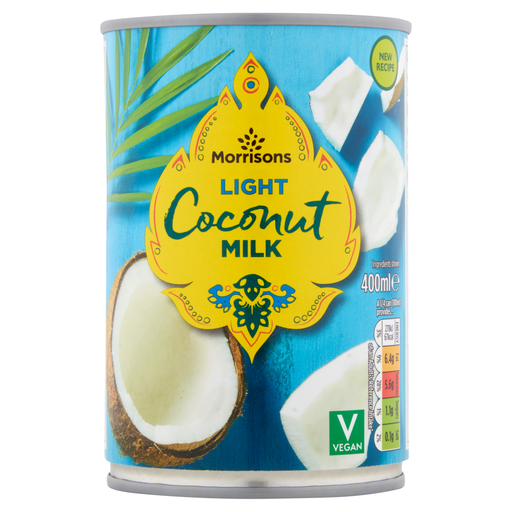
This canned option is for curries, soups and sauces where reduced-fat cooking coconut milk is the intended ingredient. Its nutrition figures are per 100ml; the amount used in a recipe still matters.
 No image available
A cooking coconut milk for curries, soups and sauces when you want to compare reduced-fat options. Joybuy lists 67kcal, 6.4g fat and 5.6g saturates per 100ml. Morrisons describes it as having 50% less fat than its standard coconut milk; that brand-relative claim does not describe its saturated-fat content. After opening, transfer unused contents to a non-metallic container, refrigerate and use within two days.
No: a ‘light’ or reduced-fat description does not establish a low saturated-fat content. The cooking products listed by Tesco, Sainsbury's, Waitrose and Blue Dragon range from 4.9g to 5.5g saturates per 100ml, so check the figure on the particular pack and the quantity your recipe uses.
Buy cooking coconut milk for a recipe that calls for it, and compare carton coconut drinks for cereal, coffee or drinking. The British Heart Foundation explains that tinned coconut milk and coconut drinks are different products; a drink should not be assumed to give a curry the same texture.
Start with kcal, fat and saturates per 100ml, then work out the figures for the amount you actually add. For example, using 50ml means taking half of the stated per-100ml figures. The NHS notes that labels may also show figures per portion, but that portion need not match yours.
Follow the directions on the individual pack. Tesco Light and Waitrose Essential Reduced Fat instruct refrigeration and use within two days after opening; Sainsbury's Light states three days.
No. Check the current label of the exact pack if allergens matter to you: the Sainsbury's listing for Blue Dragon Light Coconut Milk says it may contain peanuts and nuts. Do not apply one brand's statement to another product.