Late-night curry and soup cooks
If your supper needs a coconut-based sauce, start with a light or reduced-fat cooking tin. Check its saturates figure and consider whether the recipe needs the richer texture of a standard tin.


For a late-night curry or soup, choose light or reduced-fat tinned coconut milk if the sauce needs body; for cereal or a hot drink, choose a pourable unsweetened coconut drink instead. Sainsbury’s lists 4.9g saturates per 100ml for its Light cooking milk, while Alpro lists 1.1g per 100ml for its Coconut No Sugars drink. Those figures describe the products’ nutrition, not how mild either one tastes.
If your supper needs a coconut-based sauce, start with a light or reduced-fat cooking tin. Check its saturates figure and consider whether the recipe needs the richer texture of a standard tin.
For cereal, a hot drink or a small snack, an unsweetened carton fits the use better than a cooking tin. Check the exact carton’s ingredients and any declared calcium or vitamin fortification if those details matter to you.
Products called coconut milk can have very different labels. Compare saturates on the same per-100ml or per-100g basis, then consider how much the supper will use; do not treat “light” as a substitute for reading the label.
Decide whether the coconut product needs to form a sauce or be poured, then compare the exact pack’s label and opening instructions.
| Priority | What to check | Your needs |
|---|---|---|
| Cooking or pouring | Check whether the product is tinned cooking milk or a drink carton. For a curry or soup, consider how much sauce body the recipe needs; a pourable drink is not an established like-for-like texture substitute. | I’m making a sauce rather than pouring coconut drink over cereal, so I need a cooking ingredient. |
| Saturated fat | Compare the saturates line using the same label basis. M&S lists 8.2g per 100g for its Reduced Fat tin and 15.1g per 100g for its standard tin. The NHS advises comparing labels and describes more than 5g saturates per 100g as high. | For a small supper, I want to know what the recipe’s portion will contain, not rely on “reduced fat” alone. |
| Ingredients and fortification | Read the exact carton’s ingredient and allergen information. Tesco’s listing for Koko Unsweetened declares calcium and vitamins D2 and B12; check the current pack for the formulation you are buying. | A dairy-free drink for cereal appeals to me, and I want to know whether this carton declares the nutrients I’m looking for. |
| Flavour | Read the product description for any specific flavour wording. “Light”, “reduced fat” and “unsweetened” do not, by themselves, establish how strong the coconut flavour will taste. | I want a gentle coconut flavour, so I won’t assume a nutrition or sugar label answers that question. |
| After opening | Check the pack’s refrigeration and use-within instructions before choosing a size. Waitrose and M&S specify two days for the reviewed tins; Tesco’s Koko Unsweetened listing specifies five days for the carton. | If I need only a splash tonight, I should choose a pack I can use within its stated opening period. |
A pourable coconut drink may not give a curry or soup the body expected from tinned cooking milk.
Choose the format around the dish: start with a cooking tin for sauce texture, or an unsweetened drink for cereal and hot drinks.
A light or reduced-fat tin can list less saturated fat than a comparable standard tin without being low in saturated fat. M&S lists 8.2g per 100g for its Reduced Fat tin; the NHS describes more than 5g per 100g as high.
Read the saturates figure and consider the amount going into your portion.
Unused coconut milk may need transferring, refrigeration and prompt use. The reviewed Waitrose and M&S tins specify use within two days after opening.
Check the exact pack before storing leftovers, and plan another use if one supper needs only part of a tin.
Ingredients, allergen statements and fortification differ between products and can change.
Check the physical pack’s ingredient and allergen information, along with any dietary or nutrient claims that matter to you.
These examples show why the specific product and format matter more than the brand name alone.
Alpro Coconut No Sugars is a pourable drink rather than a tinned cooking milk.
Koko Unsweetened is a pourable coconut drink described by Koko for hot and cold drinks and cooking.
Tesco’s grocery listings include both tinned cooking coconut milk and coconut drinks.
Sainsbury’s Coconut Milk Light is a tinned cooking option for a curry, soup or sauce.
M&S lists reduced-fat and standard coconut milk in a tinned cooking format.
Waitrose Essential Coconut Milk is a standard tinned cooking ingredient for a recipe where a richer base is intended.
This reduced-fat tinned option is relevant to a late-night curry or soup that needs cooking coconut milk, rather than a pourable drink.
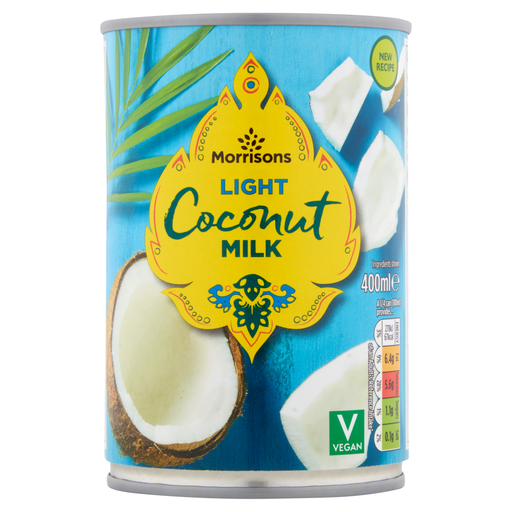 Image unavailable
A tinned cooking-milk option for a curry or soup. Compare the current pack’s saturates figure with other cooking tins; after opening, transfer unused contents to a non-metallic container, refrigerate and use within two days. “Reduced fat” does not establish a mild coconut flavour.
No. A cooking tin and a pourable drink are different formats, so choose according to whether you need sauce body or something for cereal or a drink. Their labels can also differ substantially: Waitrose lists 15.8g saturates per 100ml for Essential Coconut Milk, while Alpro lists 1.1g per 100ml for Coconut No Sugars drink.
“Light” or “reduced fat” does not establish a milder coconut flavour. For a supper, use those terms to identify products whose nutrition labels you want to compare, then check the exact product description if flavour strength is important to you.
Compare the saturates figures on the same per-100g or per-100ml basis, and consider the quantity your recipe uses. The NHS advises comparing labels and describes more than 5g saturates per 100g as high; do not apply that per-100g threshold directly to a per-100ml figure.
Follow the exact pack’s storage instructions. The reviewed Waitrose and M&S tins specify refrigeration and use within two days; Tesco’s Koko Unsweetened carton listing specifies five days after opening. Waitrose also instructs shoppers to move unused contents out of the can and into a non-metallic container.
Check the physical pack’s current ingredients, allergen information and any relevant dietary statement before use. Do not assume that every product from a brand has the same formulation or that a coconut drink and a cooking tin have interchangeable ingredients.