Vegan curry and soup cooks
If a curry, soup, sauce or dessert needs a creamy coconut base, start with a vegan-labelled cooking tin. Marks & Spencer and Sainsbury's list examples intended for these dishes; compare individual labels before choosing.


Choose a vegan-labelled cooking tin for a curry, soup or dessert where a rich coconut base matters. Compare standard and reduced-fat tins by their coconut-extract and fat figures if you want a different composition; choose a carton coconut drink for porridge or hot drinks instead. Check allergen information separately, as a vegan claim does not establish allergen safety.
If a curry, soup, sauce or dessert needs a creamy coconut base, start with a vegan-labelled cooking tin. Marks & Spencer and Sainsbury's list examples intended for these dishes; compare individual labels before choosing.
A reduced-fat tin keeps coconut milk in the recipe but has a different composition from a standard tin. Marks & Spencer lists 9.3g fat and 33% coconut extract per 100g for its reduced-fat version, against 17.3g fat and 60% coconut extract for its standard version.
For porridge, smoothies or a hot drink, look at coconut drinks rather than assuming a cooking tin is the format you need. The Alpro and Koko drinks listed by Sainsbury's are positioned for drinking and everyday use, not as equivalent replacements for rich cooking milk.
Decide how the coconut product will be used, then compare the relevant label details within that format.
| Priority | What to check | Your needs |
|---|---|---|
| Cooking or drinking | Check whether the product is a cooking tin or a carton drink. Compare the stated coconut content and intended uses; the Koko drink listed by Sainsbury's contains 9% coconut milk, while its Blue Dragon cooking tin lists 56% coconut extract. | I want a coconut base for a curry or soup, rather than a drink for porridge or coffee. |
| Fat and coconut content | Compare figures on the same basis. Marks & Spencer lists 17.3g fat and 60% coconut extract per 100g for its standard tin, versus 9.3g fat and 33% coconut extract per 100g for its reduced-fat tin. | For this soup or sauce, I would accept a reduced-fat tin instead of choosing the standard tin for its richer composition. |
| Vegan and allergen labels | Check the individual product's vegan statement, ingredient list, allergen declaration and any precautionary wording. A vegan claim is not an allergen-free claim, as GOV.UK's food-labelling guidance explains. | I need to check suitability for a vegan meal, and I cannot rely on the word “vegan” alone if an allergen matters. |
| After-opening storage | Read the product-specific refrigeration and use-by-opening instructions. Sainsbury's says to use its own-label tin within three days of opening; its Koko chilled-drink listing says five days. | If I will use only part of a tin or carton, I want a plan for the remainder that follows that pack's instructions. |
A vegan label does not establish that a product is suitable for someone who needs to avoid an allergen. The Food Standards Agency also identifies cross-contamination as a reason a vegan product may be unsuitable for people with food hypersensitivities.
Read the current pack's ingredients, allergen declaration and precautionary statements; check for relevant free-from information when allergen avoidance is necessary.
Carton drinks and cooking tins have different stated compositions and uses. Sainsbury's lists 9% coconut milk in its Koko unsweetened drink, while its vegan-labelled Blue Dragon cooking tin lists 56% coconut extract.
For a curry, soup, sauce or creamy dessert, check the recipe and choose a vegan-labelled cooking milk if it calls for that format. Keep carton drinks for recipes that specify a drink or for beverages.
Marks & Spencer's reduced-fat coconut milk has less fat and coconut extract per 100g than its standard coconut milk. The two are not compositionally equivalent.
Compare both labels before substituting, particularly when the coconut milk provides much of a dish's texture.
After-opening instructions differ between products: Sainsbury's lists three days for its own-label cooking tin and five days for the Koko chilled drink.
Follow the particular pack's directions for transferring leftovers, refrigeration and when to use them.
These examples show why it helps to check the individual product, rather than choosing by brand or retailer name alone.
Its Coconut No Sugar Long Life Drink is a 1L coconut drink listed by Sainsbury's for uses including porridge and chai, rather than a rich cooking tin.
The Dairy Free Unsweetened Drink listed by Sainsbury's is a 1L coconut-based drink marked suitable for vegans.
Marks & Spencer lists vegan-labelled 400ml cooking tins in standard and reduced-fat versions.
Its listings include an own-label cooking tin and vegan-labelled branded coconut products.
Tesco separates coconut drinks from tinned coconut milk in its grocery categories, making the intended format a useful starting point.
The Waitrose coconut-milk category lists standard and reduced-fat tins alongside coconut cream and other options.
These options cover a reduced-fat cooking tin for soups and curries and a coconut drink intended for coffee; choose by the use your recipe calls for.
 No image available
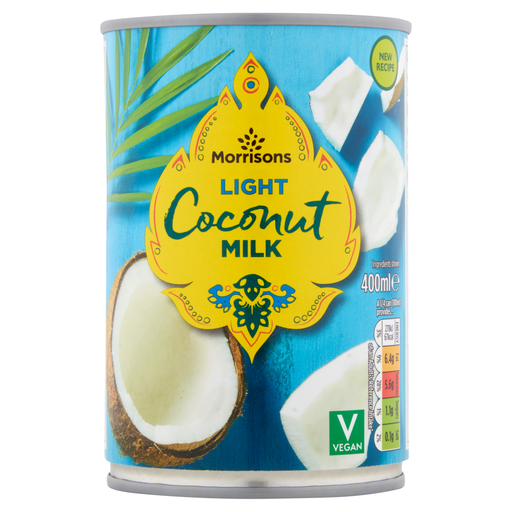
A reduced-fat cooking tin to consider for a vegan curry or soup; the product listing describes it as suitable for vegans.
If the recipe depends on a rich coconut texture, compare this tin with a standard version before substituting. Check the current pack's allergen and after-opening storage instructions.
 No image available
A coconut drink for coffee and frothing rather than a cooking tin; the product listing describes it as suitable for vegans.
The listing identifies soya as an allergen. Check the current pack for complete allergen and precautionary information before buying.
No. GOV.UK's vegan-labelling guidance does not treat a vegan claim as an assurance about allergens. Check the current product's ingredients, allergen declaration and precautionary wording, and look for relevant free-from information where needed.
Choose a vegan-labelled cooking tin if the curry calls for coconut milk as a creamy base. The Blue Dragon tin listed by Sainsbury's contains 56% coconut extract, whereas its Koko unsweetened carton drink contains 9% coconut milk; check the recipe before swapping formats.
Consider a reduced-fat cooking tin when you want a different fat composition and the recipe does not depend on the standard tin's richness. Marks & Spencer lists 9.3g fat and 33% coconut extract per 100g for its reduced-fat milk, compared with 17.3g fat and 60% coconut extract per 100g for its standard milk.
Follow the individual pack's storage and transfer instructions. Sainsbury's says to refrigerate its opened own-label coconut-milk tin and use it within three days; its Koko chilled-drink listing says to consume the drink within five days of opening.
No. Sainsbury's says its own-label coconut milk can solidify in cold conditions and should become liquid again when heated. Still check the packaging, date and product-specific storage instructions rather than judging it by texture alone.