What should you check?
Start with the portion you need for lunch, then compare storage instructions and the nutrition and allergen details on the carton.
| Priority |
What to check |
Your needs |
| Pack format |
Check the size of each carton, not just the number in the multipack. The Tesco Groceries coconut-drink range and the Alpro and Koko listings cited here show 1-litre cartons. |
I need to know whether lunch requires a sealed individual drink or whether we will pour from a carton at home. |
| Opened-carton storage |
Read the exact pack’s refrigeration and use-by-opening instructions. Ocado lists five days after opening for Koko Unsweetened, while Waitrose lists four days for Plenish Organic Coconut Unsweetened. |
If we only use a small amount at a time, can we finish each opened carton within its stated period? |
| Fortification and protein |
For a child who cannot consume dairy, check listed calcium, iodine and protein per 100 ml. Kingston and Richmond NHS Foundation Trust advises looking for a dairy alternative with 120 mg calcium per 100 ml where possible; Royal Devon University Healthcare NHS Foundation Trust notes that many coconut drinks are low in energy and protein. |
My child has this drink regularly instead of dairy, so the nutrients listed on the particular carton matter more than a dairy-free claim alone. |
| Sugars |
Compare sugars on the same per-100-ml basis and check whether the drink is sweetened. Ocado lists 0.2 g per 100 ml for Koko Unsweetened; Tesco Groceries lists 2.4 g per 100 ml for Tesco Long Life Coconut Original. |
I would like to compare what is actually in a serving, without assuming every unsweetened drink has the same fortification. |
| Allergens |
Read the ingredients and suitability statement on the physical pack. Tesco Groceries says its Long Life Coconut Original may contain peanuts and nuts; M&S says its Creamy Coconut Drink is not suitable for people with a milk allergy. |
For a child with an allergy, I need the warning for this exact product, even if its front label says vegan or dairy-free. |
Brand and product-line references
These examples illustrate differences between coconut drink cartons; a brand name alone does not establish the format or contents of every product it sells.
Alpro
Alpro lists a standard long-life Coconut drink and a separate Barista Coconut drink in 1-litre cartons.
- Ocado lists calcium and vitamins B2, B12 and D for the standard Coconut drink.
- The standard drink lists 0.1 g protein per 100 ml. The Barista product is positioned for coffee and lists 3.3 g sugars per 100 ml, according to Ocado.
Koko
Koko Original and Unsweetened are listed as long-life coconut-based drinks in 1-litre cartons.
- Ocado lists 0.2 g sugars, 1.2 g protein and 120 mg calcium per 100 ml for Koko Unsweetened.
- If iodine fortification matters for regular use, confirm it on the particular carton rather than assuming it from the calcium listing.
Tesco
Tesco Long Life Coconut Original is a sweetened 1-litre coconut drink.
- Tesco Groceries lists calcium, iodine and vitamins B12 and D2, including 120 mg calcium and 22.4 µg iodine per 100 ml.
- Tesco lists 2.4 g sugars per 100 ml and states that the drink may contain peanuts and nuts.
M&S
M&S Creamy Coconut Drink is a 1-litre carton with calcium, iodine and vitamins B12 and D listed by Marks & Spencer.
- Its listed iodine and calcium make the carton worth checking when comparing fortification for regular use.
- It is not an individual lunch portion, and Marks & Spencer states that it is not suitable for people with a milk allergy.
Coconut drink multipacks on Joybuy
This 1-litre carton multipack is an option for households that will also use coconut drink at home during the school holidays, rather than a pack of sealed individual lunch drinks.
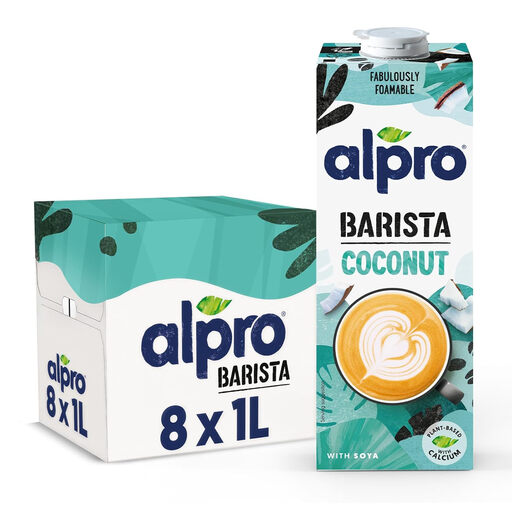 Image unavailable
Alpro Barista Coconut Long Life Drink, 8 × 1L
Eight 1-litre cartons suit shared household use rather than sealed individual lunch portions. The listing gives 3.3 g sugars and 1.5 g protein per 100 ml and lists calcium and vitamins B2, B12 and D. This barista drink contains soya; check the carton’s allergen statement and its calcium and iodine details if it will be used regularly instead of dairy.
View on Joybuy
Questions about coconut drink lunches
Can I put coconut milk from a tin in a lunch drink?
Choose a product sold as a ready-to-drink coconut drink if the intention is drinking. Coconut milk sold for cooking is a different product type, so do not treat the tin and a drinking carton as interchangeable.
Does a coconut drink multipack mean individual lunchbox cartons?
No. The Tesco Groceries coconut-drink range and the Alpro and Koko products discussed here list 1-litre cartons. Check the size of each carton in any multipack before relying on it for a sealed, single-serving lunch drink.
How long will an opened carton keep?
Follow the instructions on the exact carton and refrigerate it as directed. Ocado lists consumption within five days of opening for Koko Unsweetened, Marks & Spencer lists five days for M&S Creamy Coconut Drink, and Waitrose lists four days for Plenish Organic Coconut Unsweetened. Shelf-stable storage before opening does not apply once the carton is open.
What matters if my child regularly has coconut drink instead of dairy?
Compare calcium, iodine, protein, energy and allergen information on the exact product. Kingston and Richmond NHS Foundation Trust advises looking for calcium-fortified dairy alternatives when a child cannot consume dairy, ideally with 120 mg calcium per 100 ml; Royal Devon University Healthcare NHS Foundation Trust also highlights iodine and notes that many coconut drinks are low in energy and protein.
Do school food standards determine what goes in a packed lunch?
England’s Department for Education says the school food standards apply to food and drink provided to pupils by state-funded schools. For a parent-packed lunch or a holiday activity, check the school’s or organiser’s packed-lunch and allergy rules rather than assuming those standards answer that separate question.


