What should you check before buying?
Light canned coconut milk
Choose when: The recipe calls for coconut milk and you want a less rich canned formulation than a regular version.
Bear in mind: A lower coconut-extract figure cannot establish how mild the baked loaf will taste.
Regular canned coconut milk
Choose when: The recipe specifies regular coconut milk or is designed around a richer coconut ingredient.
Bear in mind: Do not change the stated liquid quantity solely because the coconut milk looks rich.
Coconut-based drink
Choose when: The bread recipe calls for ordinary milk and permits a plant-based alternative.
Bear in mind: A drink is not an established one-for-one replacement for canned cooking coconut milk.
Start with the ingredient named in the recipe, then compare labels and follow its instructions for measuring the liquid.
| Priority | What to check | Your needs |
|---|
| Coconut formulation |
Check whether the pack is light or regular cooking coconut milk. Compare declared coconut extract and fat using the same measurement basis; neither figure measures flavour in bread. |
I want a subtle coconut note without choosing a drink in place of the coconut milk my recipe specifies. |
| Ingredient type |
Read whether the product is cooking coconut milk or a coconut-based drink, then check what the recipe permits. Tesco lists Koko Unsweetened as a drink containing 9% coconut milk; Koko describes Cuisine as a cooking product containing 25% coconut extract. |
If I am adapting a recipe that calls for dairy milk, a plant-based drink may fit its instructions. For a coconut-milk recipe, I need to check before substituting one. |
| Dough consistency |
Measure the recipe’s stated liquid quantity first. Mix separated coconut milk until uniform before measuring, following the pack instructions; assess the dough using your recipe’s method. |
A consistent measure matters to me more than guessing an adjustment from the appearance of the tin. |
| Pack information |
Check the current ingredients and any precautionary allergen statement on the purchased pack. Blue Dragon Coconut Milk carries a nuts and peanuts precautionary statement on the Joybuy listing. |
When I bake for someone with an allergy, I need the information for the exact product I will put in the dough. |
Which product ranges are relevant?
These examples show why the product type and individual label matter more than the brand name alone.
Sainsbury's
Its own-label range includes light and regular canned coconut milk.
- Sainsbury's lists 40% coconut extract and 5.6 g fat per 100 ml for its light product, compared with 68% coconut extract and 14.8 g fat per 100 ml for its regular product.
- The label comparison does not establish how either product will taste in bread.
Blue Dragon
The range includes both Light Coconut Milk and regular Coconut Milk for cooking.
- Blue Dragon Light lists 25% coconut extract and 6.2 g fat per 100 ml; its regular product lists 56% coconut extract and 15 g fat per 100 g.
- The brand describes the regular product as mild in coconut flavour, but that description is not a bread-baking flavour comparison.
Koko Dairy Free
Koko has a coconut-based drink and a separate Cuisine cooking product.
- Tesco lists Koko Unsweetened drink at 9% coconut milk and 1.4 g fat per 100 ml; Koko lists Cuisine at 25% coconut extract and 17.4 g fat per 100 ml.
- Check which type the bread recipe permits rather than substituting one for the other cup for cup.
Waitrose Essential
The range includes Essential Reduced Fat Coconut Milk.
- Waitrose lists 23% coconut extract and 6.2 g fat per 100 ml for this canned product.
- Its label notes possible separation or solidification at low temperatures; follow the mixing instructions before measuring.
M&S
Its canned Coconut Milk is a regular cooking ingredient.
- M&S lists 60% coconut extract and 17.3 g fat per 100 g.
- Check the current pack when choosing a formulation for your recipe, as M&S notes that product information can change.
Joybuy coconut milk for this recipe
This canned reduced-fat coconut milk is an option to consider when a bread recipe calls for cooking coconut milk and you want to start with a lighter formulation. Its label cannot promise a particular flavour in the finished loaf.
 No image available
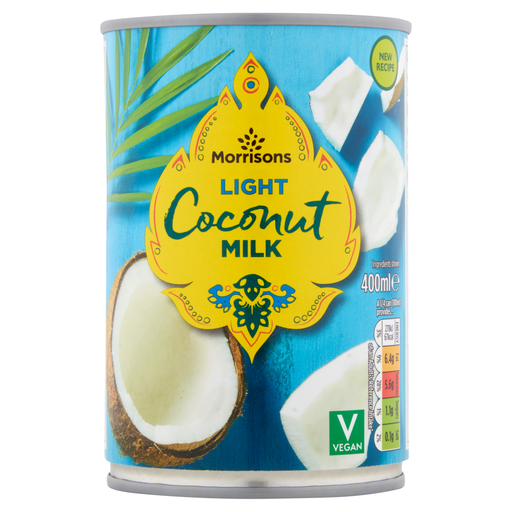
Morrisons Reduced Fat Coconut Milk 400ml
A canned cooking coconut milk to consider for a recipe that calls for coconut milk rather than a coconut-based drink. Mix it until uniform before measuring if it has separated; its reduced-fat designation does not establish the flavour of the baked loaf.
View on Joybuy
Bread-baking questions
Is canned coconut milk the same as a coconut-based drink?
No. Tesco lists Koko Unsweetened as a drink containing 9% coconut milk and 1.4 g fat per 100 ml, while Koko lists its separate Cuisine cooking product at 25% coconut extract and 17.4 g fat per 100 ml. Use a drink in place of canned cooking coconut milk only when the recipe permits that substitution or you are testing an adaptation.
Does a lower coconut-extract figure guarantee milder bread?
No. Coconut-extract and fat figures help you compare formulations, not predict the flavour of a finished loaf. Blue Dragon Light lists 25% coconut extract and 6.2 g fat per 100 ml, while Sainsbury's Light lists 40% and 5.6 g per 100 ml; neither label establishes which loaf will taste milder.
Should I add flour if coconut-milk bread dough feels sticky?
Follow your chosen recipe before adjusting it. Red Star Yeast’s Coconut Milk Bread recipe describes a moist, sticky dough and advises against adding extra flour unless the dough will not combine; its guidance applies to that recipe, not every bread formula.
What should I check for allergens before baking?
Read the ingredients and any precautionary statement on the exact pack. GOV.UK guidance for UK prepacked food says regulated allergens used as ingredients must be emphasised in the ingredients list; the Joybuy listing for Blue Dragon Coconut Milk also carries a ‘may contain’ statement for nuts and peanuts. Do not assume similarly named products have identical statements.


