What matters when choosing?
Start with the constraint that most affects your code-review work, then check the exact keyboard variant against your desk, devices and frequently used keys.
| Concern | What to check | Who this matters to |
|---|
| Desk position |
Check whether the keyboard can sit centrally and just below elbow height, with room for your mouse. |
If I spend long stretches reviewing diffs, I need a desk arrangement that lets me type and use the mouse without awkward positioning. Around 36% of consumers put workable posture first. |
| Shortcuts and switching |
Check device-switching limits and whether remapping or macros work with your operating systems and required software. |
When I review on several machines or repeat the same actions, switching and configurable keys matter more to me than extra features I would never set up. Roughly 29% of consumers make workflow flexibility their primary concern. |
| UK layout and navigation |
Confirm the exact regional variant, symbol legends and the dedicated navigation keys you use. |
If familiar punctuation and direct access to navigation keys keep my reviews moving, I do not want to discover a different arrangement after purchase. Around 21% of consumers prioritise layout and key access. |
| Desk space |
Check keyboard width against your available space and whether a compact layout moves essential keys to an Fn layer. |
At a small desk or beside a laptop, I need space for the mouse but still want the keys I use to review changes. About 14% of consumers put a smaller footprint first. |
Joybuy keyboard options
These options include full-size wireless keyboards and mechanical layouts from 75% to full-size. For code review, compare each model’s stated layout with the keys you use and the space available beside your mouse.
 No image available
Targus EcoSmart Full Size Wireless Keyboard (UK)
Consider this full-size wireless keyboard if your desk-based reviews call for a larger key arrangement. The name identifies a UK variant; confirm its physical layout and allow enough desk width for your mouse.
View on Joybuy
 No image available
Hyper HyperSpace Next Bluetooth Wireless Keyboard (UK), White
Consider this model if a Bluetooth wireless connection fits the devices you use for reviews. The named variant is white and UK-labelled; inspect its physical legends and navigation-key arrangement for your workflow.
View on Joybuy
 No image available
AULA F75 75% Tri-Mode Mechanical Keyboard, US QWERTY
If desk width is tight, the 75% layout is worth considering for code review. The name specifies wired, Bluetooth and 2.4G modes, PBT keycaps and a US QWERTY layout; check its dedicated navigation keys, operating-system compatibility and symbol positions before buying.
View on Joybuy
 No image available
Ticktype DP104 Tri-Mode 108-Key Mechanical Keyboard, Gecha Gray, Silent Tactile Switches (US)
For reviews at a desk where you want a full-size mechanical arrangement, consider this 108-key variant. Its name specifies hot-swappable silent tactile switches and a US layout; the switch description is not a noise measurement. Check operating-system support and available desk space.
View on Joybuy
 No image available
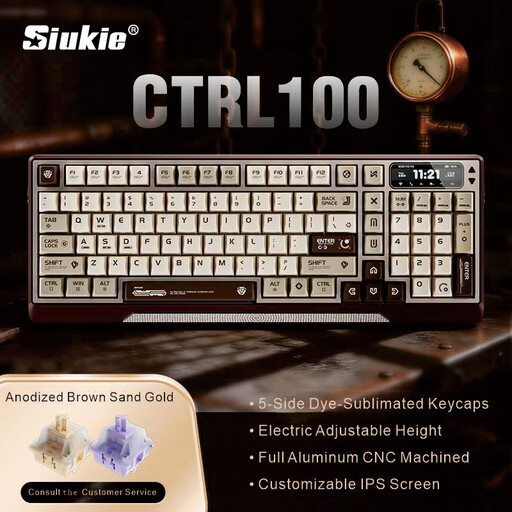
Siukie CTRL100 CNC Aluminium 96% Mechanical Keyboard, HMX Cream Taro, Brown (US QWERTY)
Consider this 96% layout if you want to compare a near-full-size arrangement with a full-size board for review work. The name specifies tri-mode wireless connectivity, HMX Cream Taro switches and US QWERTY; inspect the navigation keys, symbol positions and operating-system compatibility.
View on Joybuy
Common questions
Do I need a special ergonomic keyboard for code review?
Not necessarily: the Health and Safety Executive’s workstation guidance considers the whole setup, including a keyboard kept central and just below elbow height. Choose a keyboard size and position that work with your desk, chair, screen and mouse rather than expecting its shape alone to address discomfort.
Should I choose UK-ISO rather than a US layout?
Choose the physical keys and symbol positions you use most reliably. Keychron identifies UK-ISO variants separately, so check the exact variant if you are accustomed to a British layout; a product-family name may cover more than one regional arrangement.
Will a Mac Touch ID keyboard provide every function on any computer?
Do not assume it will: Apple lists a Mac with Apple silicon running macOS 15.1 or later as the system requirement for its Touch ID Magic Keyboard. Check your exact computer, operating system and required functions before purchase.
Are programmable keys useful for reviewing code?
They can be useful when you repeat review actions and are willing to configure them. Logitech describes Smart Actions through Logi Options+, Keychron specifies QMK/VIA for the Q6 Max, and Razer lists remapping and macros for Pro Type Ultra. Check software compatibility and avoid shortcuts that conflict with your editor, browser or review tool.


