What should you check?
Check gluten-free status first, then compare sugar information and the ingredients that matter to you.
| Priority |
What to check |
Your needs |
| Gluten-free status |
Look for an explicit gluten-free label on the exact biscuit. Coeliac UK says foods labelled gluten free must contain no more than 20 parts per million of gluten; also read the current ingredients and allergen statement. |
I need a biscuit identified as gluten free, not one chosen solely because its sugar claim sounds suitable. |
| Sugar wording |
Distinguish sugar-free, no-added-sugar and relative less-sugar wording. Compare the nutrition panel’s sugars per 100g, and per biscuit if given; a percentage reduction is not a sugar-free claim. |
If avoiding sugar is essential to my choice, I want the pack’s claim and sugar figure to answer that requirement. If I am comparing reductions, the per-100g figure helps me compare biscuits on the same basis. |
| Oat ingredients |
Check whether an oat-based biscuit and its oats are labelled gluten free. Coeliac UK says most people with coeliac disease can eat gluten-free oats. |
Oat biscuits are an option if gluten-free oats suit me; otherwise, I need a different gluten-free recipe. |
| Other ingredients |
Read the sweetener list and any milk, egg, soya or nut declarations and precautionary statements on the current pack. |
Gluten is not my only ingredient concern, so I want to check the whole recipe rather than relying on a front-of-pack claim. |
Relevant brand references
These examples describe particular product lines and label checks, not every biscuit made by each brand.
Gullón
Gullón describes its Gluten-Free and No Added Sugar Chip Choc as gluten free and made without added sugars.
- Offers a chocolate-chip biscuit to examine when both gluten-free and sugar wording matter.
- Check the exact pack’s sugar claim, sugars per 100g, sweeteners and allergen statement before deciding whether it meets your requirements.
Nairn's
Tesco lists Nairn's Gluten Free Oaties Chocolate Chip as a gluten-free oat biscuit with a relative less-sugar claim.
- Provides an oat-based option for shoppers comparing gluten-free chocolate biscuits.
- A relative reduction is not a sugar-free claim; check the nutrition panel and whether gluten-free oats suit you.
McVitie's
Tesco lists McVitie's Gluten Free Milk Chocolate Hobnobs as gluten free.
- A milk-chocolate Hobnob-style option where that format is the priority.
- Tesco gives 33g sugars per 100g for this product, so it does not answer a sugar-free requirement.
Sainsbury's Free From
Sainsbury's describes its Free From Chocolate Chip Cookies as milk and gluten free.
- Worth examining when both milk-free and gluten-free labelling matter.
- Check the current sugars figure and any nut precautionary statement if those affect your choice.
Arnott's
Sainsbury's lists Arnott's Gluten Free Original Tim Tam as a gluten-free chocolate biscuit.
- A chocolate-biscuit-bar format for shoppers prioritising that style.
- Sainsbury's gives 46.9g sugars per 100g, so it does not meet a sugar-free requirement.
Joybuy product options
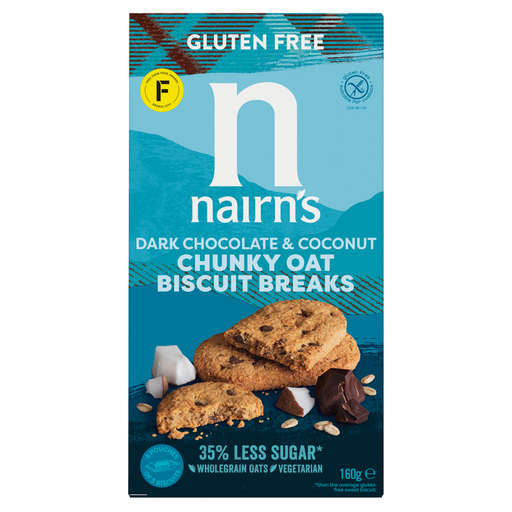
This option is a gluten-free oat biscuit break in a Dark & Coconut variant. Check its current pack if a particular chocolate ingredient or sugar claim is essential to your choice.
 No image available
Nairns Gluten Free Biscuit Breaks Chunky Oats, Dark & Coconut 160g
This gluten-free oat biscuit break is an option if gluten-free oats suit you. For a sugar requirement, compare sugars per 100g and the exact claim on the current pack; check its other allergen statements as well.
View on Joybuy
Questions about labels and ingredients
Is a sugar-free chocolate biscuit automatically suitable for someone with coeliac disease?
No. Sugar-free wording concerns sugars, not gluten. Look for an explicit gluten-free label on the biscuit, then check its sugar information separately.
What does “gluten free” mean on a UK biscuit label?
Coeliac UK explains that foods labelled gluten free must contain no more than 20 parts per million of gluten. Check that the label applies to the exact biscuit you are buying.
Does “no added sugar” mean sugar free?
No. The phrases make different claims, so do not use one as a substitute for the other. Read the current nutrition panel for sugars per 100g and check the exact wording on the pack.
Can I choose chocolate oat biscuits if I have coeliac disease?
An oat biscuit may be an option when it is labelled gluten free and gluten-free oats suit you. Coeliac UK says most people with coeliac disease can eat gluten-free oats; do not assume that every oat biscuit is gluten free.
Do I still need to read the ingredients on a gluten-free biscuit?
Yes. Gluten-free labelling does not answer separate questions about milk, egg, soya, nuts or sweeteners. Read the current ingredients and any relevant precautionary statement before buying.


